MAM
More than 300,000 viewers witnessed the launch of stayIN Alive – India’s dedicated foundation for performing artists

MUMBAI: stayIN aLIVE launched on 16 May 2020 with a tremendous start! Over 100 artists, 12 collectives and 300k viewers from across the globe came together to share experiences, engage with each other, and entertain with never seen performances and collaborations!
The launch kickstarted with a session about Creators x Fitness and the role physical wellbeing plays in every artists’ life. It flowed into an insightful discussion about artists maintaining and working towards mental health and dealing with the highs and lows of a public-facing life. Through the day, artists touched upon subjects that have not been covered so far on such a level. Topics such as Self Motivation vs Validation, Passion vs Pay Cheque, Finding you own Path, Importance of Networking, Role of Mentors and Lockdown Learnings were discussed at length by leading names including the likes of Shruti Haasan, Vishal Dadlani, Uday Benegal, Tanmay Bhat, Bosco Martis, Priya Malik, Dualist Inquiry, Nikhil D’souza, Tejas, Nikhita Gandhi, Neeti Palta, Ankur Tewari, Rahul Vaidya, Shankar Chugani and Roshan Abbas.
The evening then took a turn to collaborations, performances and some enthusiastic online jam sessions. Dramatic Readings saw industry stalwarts such as Imtiaz Ali, Faye Dsouza, Sandhya Mridul, Cyrus Sahukar, Danish Hussain, Kausar Munir, Amol Parashar and Sainee Raj. This was followed with representation from the Indian folk music field in a session called ‘Back to the Roots’ by Kavita Seth, Divya Kumar, Kanishk Seth and Dhruv Sangari. The final session of the day ‘Collaboration Central’ was a befitting end with some enthusiastic and power packed interactions between Ashish Shakya & Palash Sen, Su Real and Karan Kanchan, Bhuvan Bam & Roshan Abbas and Amit Tandon & Gursimran Khamba!

Nakash Aziz, Indian composer and singer, spoke about his association with stayIN Alive, “It's really hard for younger artists in the music industry and I'm so happy that initiatives like stayIN aLIVE are helping artists to be more aware, find like-minded people and build a community – something that's missing in our ecosystem.”
Amit Tandon, stand-up comedian quoted, “In the toughest of times, it is art that keeps people in high spirits. It is good to see someone decided to do something for the artist community as well because they were the first ones to lose livelihood and will be among the last to get back on feet once things go back to normal.”
Nikhita Gandhi, singer and performer shared, “As artists in these times, we really need to talk about mental health since it can really take a toll on you! I'm really glad to be a part of stayINaLIVE and hope to do more to be able to support artists who are finding their feet in the industry!
Gaurav Wadhwa, Founder, Big Bang Music shared, “The idea behind the festival was to announce the foundation and the artist relief fund and through a fresh approach to programming we hope to inspire, educate and celebrate artists, who are grappling with the realities of this new world. I'm glad that so many partners from the industry came together for a common vision – to make the world a better place for the artist! We can't wait to dial-up our efforts to do more for the community”.
The stayIN Alive Artist Emergency Fund (SAAEF) has been formed in collaboration with GiveIndia, India’s leading not for profit organization. The fund is intended to help artists in the short run via a ‘personal emergency fund’ aimed at addressing specific financial challenges and as a stop-gap measure. The type of grants will range from small cash grants, reimbursement for a certain class of urgent expenses (such as rent, important bills) and utility payments to third parties. Interested patrons can continue to donate here – https://stayinalive.giveindia.org/
StayIN aLIVE continues to prepare for its next round of artist interactions which will happen on a regular basis, encouraging the community to come together stronger than ever before.


MAM
India’s financial sector spent less on TV ads in 2025 but flooded the internet
Banks, insurers and lenders cut tv ads as digital jumps, LIC and Muthoot lead tv and Axis Bank tops online
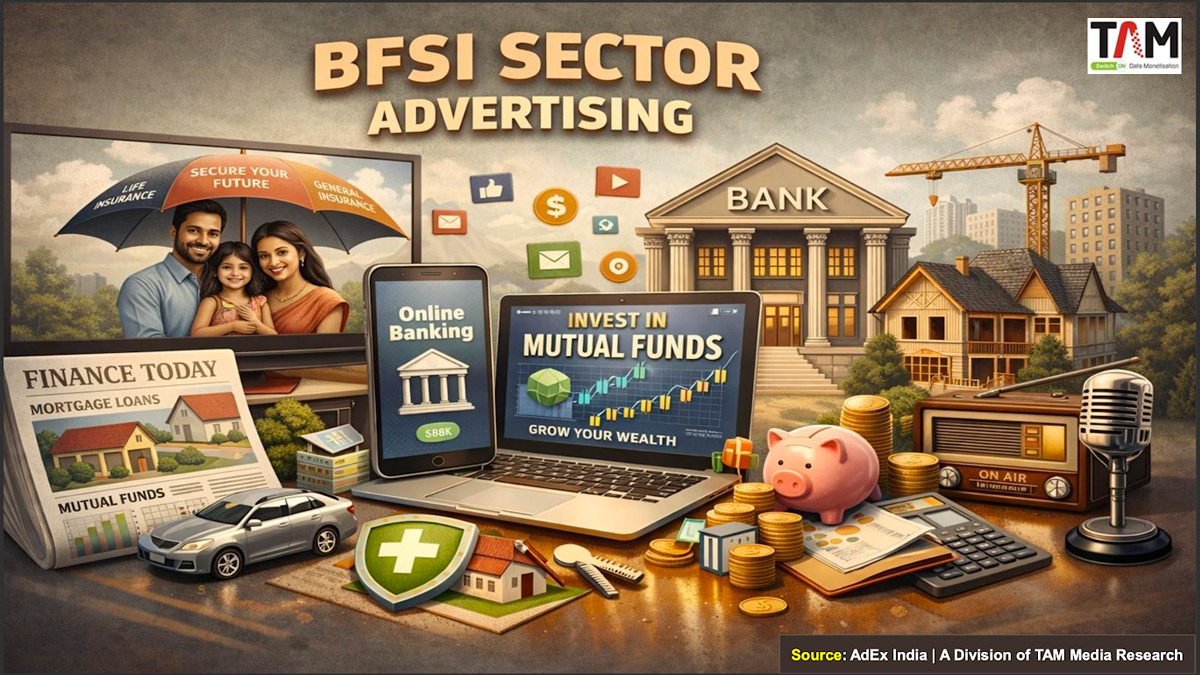
MUMBAI: India’s banking, financial services and insurance sector, one of the most prolific advertisers in the country, delivered a split verdict on media in 2025. It spent less on television, held its nerve in print, turned up the volume on radio and deluged the internet with a ferocity that left every other medium looking pedestrian. The picture that emerges from TAM AdEx’s cross-media report for the BFSI sector is of an industry in transition, still wedded to the news bulletin but increasingly seduced by the algorithm.
Television: a retreat with caveats
TV ad volumes for the BFSI sector fell 16 per cent in 2025 compared with 2024, a sharp reversal after two years of consistent growth that had pushed volumes 16 per cent above 2021 levels by 2023 and a further 7 per cent higher by 2024. Within 2025 itself, the drop was concentrated in the middle of the year: the second and third quarters saw ad volumes slide 35 per cent each against the first quarter, with a partial recovery of 13 per cent in the fourth.
The retreat did not reshuffle the deck. Life insurance retained first place among TV categories with 19 per cent of ad volumes, mortgage loans held second with 16 per cent, and the top ten categories together accounted for 82 per cent of all BFSI television advertising. The dominance of news channels was equally pronounced: news claimed 68 per cent of ad volumes, general entertainment channels a distant 14 per cent and movies 12 per cent. Together, news and GEC captured 82 per cent of the sector’s television spend. News bulletins alone took 48 per cent of programme-genre volumes, with feature films second at 12 per cent. Prime time, between 6pm and 11pm, drew 34 per cent of ad volumes, followed by afternoon at 22 per cent and morning at 20 per cent. A full 82 per cent of all ads ran between 20 and 40 seconds.
Life Insurance Corporation of India was the sector’s biggest TV spender with 11 per cent of ad volumes. Muthoot Financial Enterprises came second with 9 per cent, followed by National Payments Corporation of India at 6 per cent, Tata AIG General Insurance at 5 per cent and State Bank of India at 5 per cent. The top ten advertisers together accounted for 51 per cent of total TV volumes. Three names were new to the top ten in 2025: Tata AIG General Insurance, IIFL Finance and Tata Capital. At brand level, Muthoot Finance Loan Against Gold led with 9 per cent share, Tata AIG Health Insurance entered the top ten for the first time, and the top ten brands together contributed 35 per cent of ad volumes.
Print: the long climb continues
Print told a different story. Ad space for the BFSI sector has grown every year since 2021, rising 16 per cent in 2022, 30 per cent in 2023, 51 per cent in 2024 and 64 per cent in 2025, all measured against a 2021 baseline. Within 2025, ad space was flat in the second quarter but surged 46 per cent in the third and 33 per cent in the fourth compared with the first. Life insurance led print categories with 21 per cent of ad space, followed by mutual funds and banking services and products at 13 per cent each, and corporate financial institutes at 11 per cent. The top ten categories together took 82 per cent of print ad space. LIC led print advertisers with 6 per cent share, and the top ten together covered just 19 per cent of ad space, a reflection of how fragmented print spending remains. Three new entrants joined the top ten in 2025, with Billion Brains Garage Ventures the only exclusive presence not seen in 2024’s list. In the top ten brands, LIC dominated with a 2 per cent share, while Nippon India Mutual Fund rose to third position from fourth in 2024. English accounted for 62 per cent of print ad space, Hindi for 20 per cent. Business and finance publications took 59 per cent of the genre split. The south zone led regional spending with 33 per cent of print ad space, Bangalore topping that zone, while New Delhi and Mumbai were the leading cities nationally.
Radio: louder than ever
Radio ad volumes for the BFSI sector have climbed steadily, rising 12 per cent above 2021 levels in 2023, 36 per cent in 2024 and 45 per cent in 2025. The quarterly pattern within 2025 was volatile: a sharp drop of 43 per cent in the second quarter and 42 per cent in the third, followed by a near-full recovery in the fourth. Life insurance led radio categories with 22 per cent of volumes, banking services and products second at 14 per cent and corporate NBFCs third at 11 per cent. LIC of India held its position as the leading radio advertiser with 20 per cent of ad volumes; the top ten radio advertisers together covered 69 per cent. Muthoot Financial Enterprises led radio brands with 10 per cent share, five of the top ten brands belonged to LIC alone, and SBI Mutual Fund made a remarkable leap to fifth position from 272nd in 2024. Evening and morning time-bands together captured 84 per cent of radio ad volumes, with evenings at 44 per cent and mornings at 40 per cent. Maharashtra was the leading state for radio BFSI advertising with 18 per cent share; Maharashtra, Gujarat and Uttar Pradesh together accounted for 43 per cent.
Digital: the five-times surge
If one number defines the 2025 BFSI advertising story, it is five. Digital ad impressions for the sector multiplied fivefold between 2021 and 2025, having already doubled in 2023 and doubled again in 2024 before the 2025 leap. Within the year, impressions dipped 19 per cent in the second quarter and 12 per cent in the third before recovering 8 per cent above the first quarter by the fourth. Banking services and products led digital categories with 27 per cent of impressions, life insurance and credit cards tied at 19 per cent each, and securities and sharebroking organisations fell from first place in 2024 to fourth in 2025. Axis Bank was the runaway leader among digital advertisers with 12 per cent of impressions, followed by ICICI Bank at 9 per cent, IDFC First Bank at 7 per cent and Kotak Mahindra Bank at 6 per cent. The top ten digital advertisers covered 59 per cent of impressions, and seven of them were new entrants compared with 2024, signalling rapid churn in the digital spending hierarchy. At brand level, Axis Bank led with 9 per cent, ICICI HPCL Super Saver Credit Card vaulted to third place from 921st in 2024, and six of the top ten digital brands were new to the list. Programmatic buying accounted for 91 per cent of all digital BFSI transactions; combined with ad networks, it captured 96 per cent.
The data from TAM AdEx paints the portrait of a sector that still believes in the power of the television news bulletin to sell insurance to the masses, but increasingly knows that the next generation of borrowers, investors and cardholders is scrolling, not watching. The race is now on to reach them before the algorithm serves up someone else’s loan offer first.






