MAM
Media speculation rife on Karmazin’s next stop

MUMBAI: After Viacom what does Mel Karmazin have next up his sleeve? That is the big question doing the rounds of US media circles.
There has been strong talk that Karmazin might join Disney in the near future by succeeding Michael Eisner as the CEO. That is something Roy Disney and the dissident group would be cock a hoop about. The differences between Eisner and Roy Disney have been well documented.
However, not surprisingly, Disney chairman George Mitchell reacted to the talk by issuing a statement saying, “The board has complete confidence in the current management. On the strength of our recent results we believe that confidence has been justified, and will be further validated as our performance continues to improve.”

The Disney talk has been gaining momentum because Eisner’s top deputy, Bob Iger is not seen as a potential heir to the Disney throne. Karmazin is said to be on a list of at least 20 candidates the Disney board has compiled for succession.
There has also been talk of Karmazin heading to Time Warner. A report in CBS Marketwatch stated that while Time Warner chairman and CEO Richard Parsons has thus far been able to keep shareholders happy, should Time Warner stumble again Karmazin could well be called upon to revive the giant. In fact rumours of Time Warner looking at Karmazin go back over a year when the outfit was called AOL Time Warner. At that time he had been courted to serve as president of the media conglomerate.
There is also the possibility of Karmazin being tapped to function as Parsons’ number 2, but that remains another long shot.
Media reports are also of the opinion that Karmazin going to NBC Universal is a more distant shot. That is because NBC is going though a difficult phase. On his part Karmazin has maintained that so far he has not intimated anybody about his future plans.







Brands
Axis Bank named Official Banking Partner of DP World PGTI
Partnership supports all tournaments this season to grow professional golf in India.
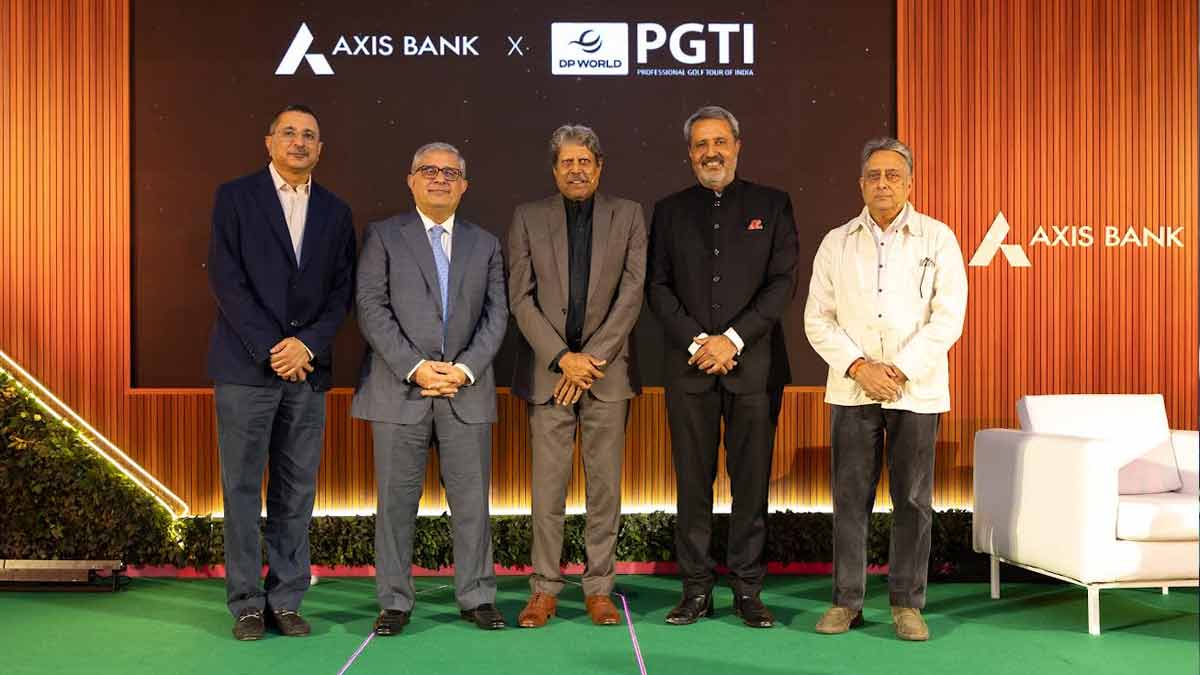
MUMBAI: Axis Bank just teed up a hole-in-one partnership because when a bank sponsors golf’s biggest swing in India, even the fairways feel more financially secure. Axis Bank has been appointed Official Banking Partner of the DP World Professional Golf Tour of India (DP World PGTI), strengthening its commitment to sporting excellence and community engagement while backing the growth of professional golf across the country.
Under the partnership, Axis Bank will support all DP World PGTI tournaments this season, contributing to talent development, enhanced tournament experiences and wider fan engagement. The collaboration aligns the bank’s values of precision, discipline and trust with the Tour’s focus on performance and opportunity.
Axis Bank executive director Munish Sharda said, “We are pleased to partner with DP World PGTI as its Official Banking Partner. Golf embodies precision, discipline, and a pursuit of excellence qualities that strongly reflect who we are at Axis Bank. This association also strengthens our engagement with India’s growing premium customer segments, where the sport has a deep and enduring connect.”
Professional Golf Tour of India president Kapil Dev said, “We are extremely pleased to welcome Axis Bank as a Tour Partner of the DP World Professional Golf Tour of India. Partnerships of this stature play a vital role in strengthening the foundation of the Tour, enhancing opportunities for our players, and expanding the sport’s reach across the country.”
Professional Golf Tour of India CEO Amandeep Johl added, “Axis Bank’s strong legacy of excellence, innovation, and nationwide reach aligns perfectly with DP World PGTI’s goal to elevate professional golf in India and provide greater opportunities for our players.”
In a sport where every stroke counts and every partnership drives distance, Axis Bank isn’t just backing golfers, it’s investing in the fairway to future, turning India’s greens into a stage where precision meets passion and every drive has the power to inspire.