MAM
Media agency Lodestar’s Mumbai office, the mood is jubilant

The date: 2 July 2004. At media agency Lodestar’s Mumbai office, the mood is jubilant. President Shashi Sinha, vice-president Nandini Dias, and general manager Arpita Menon have just heard that their agency has been awarded the Shaw Wallace account.
 |
|
It all began here!
|
However, there’s no time to celebrate as the team has to head for India’s leading media awards, the Emvies 2004. There’s more good news in store for the trio: at the function in the evening, Lodestar is crowned the media agency of the year. The Lodestar team is ecstatic. And they head for the city’s Grand Hyatt Hotel to pop some champagne and down some bubbly.
The next month, August, is even better for Lodestar, which is actually a part of the FCB Worldwide network. Following the breaking up of the Tata AOR from TME, Lodestar bags Tata Consultancy Services (TCS), Tata Motors, Tata Indicom and Trent – a significant chunk of the brands from the reputed Tata stable.
 |
|
Lodestar president – Shashi Sinha
|
Since then, there has been no looking back. Says the calm, soft spoken, but inwardly extremely aggressive, Shashi (as he is known to all and sundry): “It was in 2001 that we charted out a plan to become one of the top media agencies in the country. The seeds were sown then. The results are showing now. Our dream run began with the Shaw Wallace acquisition which led to the past 12 months turning out to be the most dramatic ones in the agency’s history. It truly has been a golden year. The Gods are looking down upon us favourably.”
To know about what peers think of Lodestar – Click Here

|
New Biz : 04′- 05′
|
|
TCS
|
|
Tata Motors
|
|
Trent
|
|
Shaw Wallace
|
|
Orra
|
|
Nickledeon
|
|
Kyocera
|
|
Naukri.com |
|
Shoprite
|
|
LIC
|
|
Oberoi Hotels
|
|
L’Oreal
|
|
JKHC
|
|
Shoprite
|
|
SC Johnson
|
|
Unitech Builders
|
|
Sapat
|
|
ICICI Lombard
|
|
Hong Kong Tourism
|
|
Emirates
|
He’s got enough reason to sound happy. The agency snared 20 new accounts last year (its client roster ended up having a healthy 50:50 split between media only and creative-led media business). And it lost just three clients during the year – IDBI, Samsung and Henkel. The latter two departed on account of a global realignment.
It grew at a blistering 60 per cent, notching up year end billings (according to industry estimates) of Rs 7400 million. In the process, it pushed its way into the ranks of the fastest growing media agencies in the country. Topping that is the fact that it is not really reliant on its overseas parent FCB for clients. Just five per cent of its business comes its way courtesy its umbilical connection with FCB – the two big names on its roster being SC Johnson and Hong Kong Tourism.
With that kind of hyperactivity, practically no one in the industry views it as a media arm of FCB Ulka anymore. Sinha says a lot of effort has gone into creating a separate identity for Lodestar Media over the past 18 months.
|
Key Accounts
|
|
Amul
|
|
Mahindra |
|
Whirlpool
|
|
Baush & Laumb
|
|
Nerolac
|
|
Blue Star
|
|
HCL
|
|
Wipro
|
|
Agrotech
|
Says he: “Agreed, there was a perception problem. But it was something that was prevalent two years ago. Today that does not stand. We have ensured that we function as a separate entity. We have shifted into new premises, we make separate contracts and ensure that we behave like an independent.”
Interestingly, it is only in India that FCB has a media agency which does not go under the sobriquet of FCB Media. The fact is that Lodestar is a significant contributor to the network’s Asian revenues accounting for a sizable 30 per cent of the agency’s Asia Pacific billings, making it the leader office among the 18 Asia Pacific countries (Hong Kong, New Zealand, Malaysia, China) FCB Media has offices in.
Recognising that something good is happening out of its India operation, the FCB Media management centralised its Asia PAcific operations under Lodestar Media, with Sinha being given the additional responsibility as regional media director in December 2004. On his shoulders lies the responsibility of acquiring new businesses and handling the media requisites of other FCB agencies in Asia Pacific region.
So what is it that has got Lodestar’s fortunes on the ascendant and got it the MFN status in the FCB Media network? For starters, it is the way it looks at how media should be handled. It has 110 media professionals on its rolls. 70 of them are planners, while the remainder work in operations. However, in the Lodestar scheme of things, every media professional within the agency is both a planner and a buyer. A process, that Sinha instituted around five years ago. He explains: “This structure ensures strategic-focus even while buying and has a higher likelihood of brand-focused innovations.”
|
Media helped solve a problem with an innovative idea.
The Problem:
1) Nerolac seen as the ‘white paints’ company Lodestar created the WORLD’S LONGEST Shade Card – On a train with a total of 1800 shades & every shade had the right name and number. (Nerolac Train Gold for best Media Innovation at Emvies 2002) |
 Nerolac Train Case Study 2002:
 |
|
Lodestar vice president – Nandini Dias
|
Lodestar Media vice-president Nandini Dias adds: “Till 2000, we followed the structure of having two separate blocks of planning and buying. But we realised that the moment you separate the two functions, you do not have a brand custodian. With our current structure, there is more ownership towards a brand which drives professionals to get a media positioning that is distinctive.”
 |
|
Lodestar’s localised tools
|
Then there’s its focus on research and on the development of planning tools which emerges from the LabCentre which it set up in 2000. “It started as a necessity for me, as I was competing with the Group Ms and the other big agencies of the world. They were bringing in their global tools, so this was our answer. The work kick-started in 2001,” points out Sinha.
 |
|
Lodestar GM – Arpita Menon
|
Adds Lodestar Media general manager Arpita Menon who oversees the Lab Centre operations, “This is our way of raising our capability.”
The Lab Centre, run by Mahua Chaturvedi, today is a revenue generator to fund the agency to invest in and develop localised tools. It contributes 10 per cent to Lodestar Media’s overall revenues and takes on consulting assignments from other firms. This apart it develops tools for FCB Media counterparts in the Asia Pacific making it “a centre of excellence” in Sinha’s words. He points out that his agency is the only one in India to export its tools to others in the region. It has also organised training workshops in Hong Kong, Malaysia, Singapore, Thailand, Indonesia, Sri Lanka to familiarise managers in these regions with the tools.
 What is exciting Sinha is the fact that FCB Media’s US office has picked up an indegenously developed proprietary tool called ‘Media Graphics.’ Developed locally with AC Neilson it is essentially a media segmentation tool which allows users to understand how different people consume media, although they might be in the same age bracket. Additional recognition has come in the form of the Lab Centre being assigned various jobs in global modelling from FCB Worldwide.
Sinha believes that success despite, he has challenges on hand. The first being maintaining the agency’s momentum and the second sustaining the culture that organization has built for itself. The third is growing scalable backend systems so that managers can cope with growth.
“With the agency becoming larger and a lot more people coming on board with different sets of experiences, my task at hand is to imbibe in them the agency’s belief and spirit,” he says.
What will help is the fact that Lodestar moved out of the office space it used to share with Interface Communications into its own premises in Mumbai’s Lower Parel area. Investments have been made in software, hardware and communications to ensure an uninterrupted service to clients.
He points out that growth for Lodestar is very clearly going to come from organically. Just last month, the agency pocketed the Rs 600 million Loreal account. This should go a long way in helping it keep up the scorching pace it has set itself.
“Loreal is most definitely a strategic win with a lot of potential. But the focus will most definitely be the Delhi market with Lodestar Delhi getting active this year,” says Sinha, adding that the Lab Centre will be leveraged to further strengthen the agency’s position – both internally (within the FCB international network and externally – to win new businesses).
What will also add to the growth is the specialised cells that he set up within the agency in November 2004 in order to build expertise in and unconventional media solutions. Amongst these: FCB i (the interactive division), Lodestar OOH (Out of Home), Lodestar Brand Experiences (non mass media). A rechristening of FCB i to Lodestar i is on the anvil with the FCB i team at Nariman Point reporting to Sinha, thus completing the integration of all of the divisions under the Lodestar umbrella.
He will be adding a public relations and an “interesting” sports unit to the list of specialised services with cells being set up in the agency in the not too distant future.
 |
|
We rock!
|
Says Sinha: “Its not been easy. Media is a game of scale. So in 2001, I used to wonder – Will we ever play the big game questioning every move of ours in terms of if we were on the right track? 2004 has been a big confidence booster for us. For FCB as a whole, the Lodestar story is a big success story.”





MAM
India’s financial sector spent less on TV ads in 2025 but flooded the internet
Banks, insurers and lenders cut tv ads as digital jumps, LIC and Muthoot lead tv and Axis Bank tops online
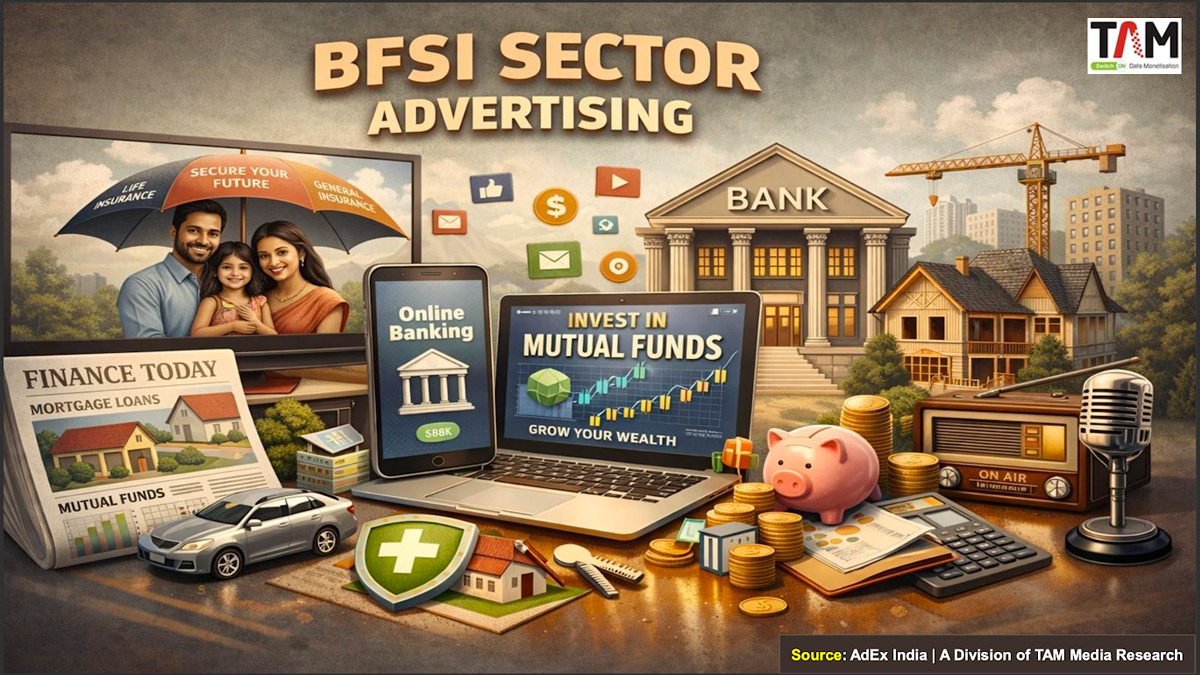
MUMBAI: India’s banking, financial services and insurance sector, one of the most prolific advertisers in the country, delivered a split verdict on media in 2025. It spent less on television, held its nerve in print, turned up the volume on radio and deluged the internet with a ferocity that left every other medium looking pedestrian. The picture that emerges from TAM AdEx’s cross-media report for the BFSI sector is of an industry in transition, still wedded to the news bulletin but increasingly seduced by the algorithm.
Television: a retreat with caveats
TV ad volumes for the BFSI sector fell 16 per cent in 2025 compared with 2024, a sharp reversal after two years of consistent growth that had pushed volumes 16 per cent above 2021 levels by 2023 and a further 7 per cent higher by 2024. Within 2025 itself, the drop was concentrated in the middle of the year: the second and third quarters saw ad volumes slide 35 per cent each against the first quarter, with a partial recovery of 13 per cent in the fourth.
The retreat did not reshuffle the deck. Life insurance retained first place among TV categories with 19 per cent of ad volumes, mortgage loans held second with 16 per cent, and the top ten categories together accounted for 82 per cent of all BFSI television advertising. The dominance of news channels was equally pronounced: news claimed 68 per cent of ad volumes, general entertainment channels a distant 14 per cent and movies 12 per cent. Together, news and GEC captured 82 per cent of the sector’s television spend. News bulletins alone took 48 per cent of programme-genre volumes, with feature films second at 12 per cent. Prime time, between 6pm and 11pm, drew 34 per cent of ad volumes, followed by afternoon at 22 per cent and morning at 20 per cent. A full 82 per cent of all ads ran between 20 and 40 seconds.
Life Insurance Corporation of India was the sector’s biggest TV spender with 11 per cent of ad volumes. Muthoot Financial Enterprises came second with 9 per cent, followed by National Payments Corporation of India at 6 per cent, Tata AIG General Insurance at 5 per cent and State Bank of India at 5 per cent. The top ten advertisers together accounted for 51 per cent of total TV volumes. Three names were new to the top ten in 2025: Tata AIG General Insurance, IIFL Finance and Tata Capital. At brand level, Muthoot Finance Loan Against Gold led with 9 per cent share, Tata AIG Health Insurance entered the top ten for the first time, and the top ten brands together contributed 35 per cent of ad volumes.
Print: the long climb continues
Print told a different story. Ad space for the BFSI sector has grown every year since 2021, rising 16 per cent in 2022, 30 per cent in 2023, 51 per cent in 2024 and 64 per cent in 2025, all measured against a 2021 baseline. Within 2025, ad space was flat in the second quarter but surged 46 per cent in the third and 33 per cent in the fourth compared with the first. Life insurance led print categories with 21 per cent of ad space, followed by mutual funds and banking services and products at 13 per cent each, and corporate financial institutes at 11 per cent. The top ten categories together took 82 per cent of print ad space. LIC led print advertisers with 6 per cent share, and the top ten together covered just 19 per cent of ad space, a reflection of how fragmented print spending remains. Three new entrants joined the top ten in 2025, with Billion Brains Garage Ventures the only exclusive presence not seen in 2024’s list. In the top ten brands, LIC dominated with a 2 per cent share, while Nippon India Mutual Fund rose to third position from fourth in 2024. English accounted for 62 per cent of print ad space, Hindi for 20 per cent. Business and finance publications took 59 per cent of the genre split. The south zone led regional spending with 33 per cent of print ad space, Bangalore topping that zone, while New Delhi and Mumbai were the leading cities nationally.
Radio: louder than ever
Radio ad volumes for the BFSI sector have climbed steadily, rising 12 per cent above 2021 levels in 2023, 36 per cent in 2024 and 45 per cent in 2025. The quarterly pattern within 2025 was volatile: a sharp drop of 43 per cent in the second quarter and 42 per cent in the third, followed by a near-full recovery in the fourth. Life insurance led radio categories with 22 per cent of volumes, banking services and products second at 14 per cent and corporate NBFCs third at 11 per cent. LIC of India held its position as the leading radio advertiser with 20 per cent of ad volumes; the top ten radio advertisers together covered 69 per cent. Muthoot Financial Enterprises led radio brands with 10 per cent share, five of the top ten brands belonged to LIC alone, and SBI Mutual Fund made a remarkable leap to fifth position from 272nd in 2024. Evening and morning time-bands together captured 84 per cent of radio ad volumes, with evenings at 44 per cent and mornings at 40 per cent. Maharashtra was the leading state for radio BFSI advertising with 18 per cent share; Maharashtra, Gujarat and Uttar Pradesh together accounted for 43 per cent.
Digital: the five-times surge
If one number defines the 2025 BFSI advertising story, it is five. Digital ad impressions for the sector multiplied fivefold between 2021 and 2025, having already doubled in 2023 and doubled again in 2024 before the 2025 leap. Within the year, impressions dipped 19 per cent in the second quarter and 12 per cent in the third before recovering 8 per cent above the first quarter by the fourth. Banking services and products led digital categories with 27 per cent of impressions, life insurance and credit cards tied at 19 per cent each, and securities and sharebroking organisations fell from first place in 2024 to fourth in 2025. Axis Bank was the runaway leader among digital advertisers with 12 per cent of impressions, followed by ICICI Bank at 9 per cent, IDFC First Bank at 7 per cent and Kotak Mahindra Bank at 6 per cent. The top ten digital advertisers covered 59 per cent of impressions, and seven of them were new entrants compared with 2024, signalling rapid churn in the digital spending hierarchy. At brand level, Axis Bank led with 9 per cent, ICICI HPCL Super Saver Credit Card vaulted to third place from 921st in 2024, and six of the top ten digital brands were new to the list. Programmatic buying accounted for 91 per cent of all digital BFSI transactions; combined with ad networks, it captured 96 per cent.
The data from TAM AdEx paints the portrait of a sector that still believes in the power of the television news bulletin to sell insurance to the masses, but increasingly knows that the next generation of borrowers, investors and cardholders is scrolling, not watching. The race is now on to reach them before the algorithm serves up someone else’s loan offer first.






