MAM
McKinsey examines COVID-19 disruptions in business


Mumbai: McKinsey has published an updated research ‘COVID-19: Implications for business’ examining when the pandemic might end and attempted to estimate when some pandemic-related disruptions could return to normalcy. The study details McKinsey’s latest perspectives on the coronavirus outbreak, the twin threats to lives and livelihoods, and how organisations can prepare for the next normal.
Some parts of the world felt a surge of optimism in the spring, as vaccination rates were climbing and COVID-19 cases dropping. Those regions now face the disappointment of a reversal, thanks to the spread of the Delta variant. Such whiplash is starting to feel like a way of life for people everywhere, as well as for industries including shipping, retail, and healthcare.
Among high-income countries, cases caused by the Delta variant reversed the transition toward normalcy first in the United Kingdom, during June and July of 2021, and subsequently in the United States and elsewhere. McKinsey’s analysis supports the view of others that the Delta variant has effectively moved overall herd immunity out of reach in most countries for the time being. The United Kingdom’s experience nevertheless suggests that once a country has weathered a wave of Delta-driven cases, it may be able to resume the transition toward normalcy. Beyond that, a more realistic epidemiological endpoint might arrive not when herd immunity is achieved but when COVID-19 can be managed as an endemic disease. The biggest overall risk would likely then be the emergence of a significant new variant.

The research finds that while many of consumers’ pandemic-inspired digital habits are sticking, the acceleration into digital channels now seems to be levelling off in both Europe and the United States. Companies can build on their digital surge by creating strategies based on long-term value, investing aggressively in tech talent, and being smarter about how they work with data.
US consumer spending recovered in the second quarter of 2021, driven by increasing vaccination rates, stimulus payments in March 2021, and the general reopening of the economy. Consumers’ pent-up demand and willingness to spend in some discretionary categories caused spending to grow at 20 to 30 per cent year over year, reaching four to seven per cent above pre-COVID-19 levels.
One of the most economically pervasive pandemic effects is a boom in shipping costs. In a video explaining why container shipping prices have surged, McKinsey partners say that sending a container from Asia to Europe or North America cost roughly $2,000 before the pandemic and $12,000 or more today. Though demand should remain high in the coming months as retailers prepare for the holiday season, prices should begin to come down by the end of the year.
McKinsey’s July survey of 100 large private-sector US hospitals revealed that amid returning patient volumes and continuing COVID-19 hospitalisations, challenges in clinical-support staffing remain high. 84 per cent of survey respondents report trouble with turnover and vacancies in their nursing staffs. This may only be the start of greater challenges, as 22 per cent of the nursing workforce reported in our Spring 2021 Future of Work in Nursing Survey that they may leave their roles providing direct patient care in the next year.
Some of this week’s other key findings from the sector research:
· The COVID-19 pandemic has triggered an acceleration of digital-payment adoption in the Middle East, as it has in other regions. Payments players with the right strategies can capitalise on this revolution in a region that is traditionally heavily dependent on cash.
· Amid increased consolidation, digitisation, and specialisation in the insurance industry, private equity is investing in specialty-insurance carriers and brokers and benefiting from the long-term capital insurance companies provide.
· Between September and November of 2020 alone, 178,000 women in the United Kingdom lost their jobs. In an interview with McKinsey, Smart Works CEO Kate Stephens said that the UK charity, which provides support to women who are job hunting, saw a corresponding 21 percent rise in the number of women seeking its services, many of which are now offered remotely.





MAM
One Hand Clap acquires Agenseed to enter distribution space
Creative agency expands into full-stack services with strategic buyout.
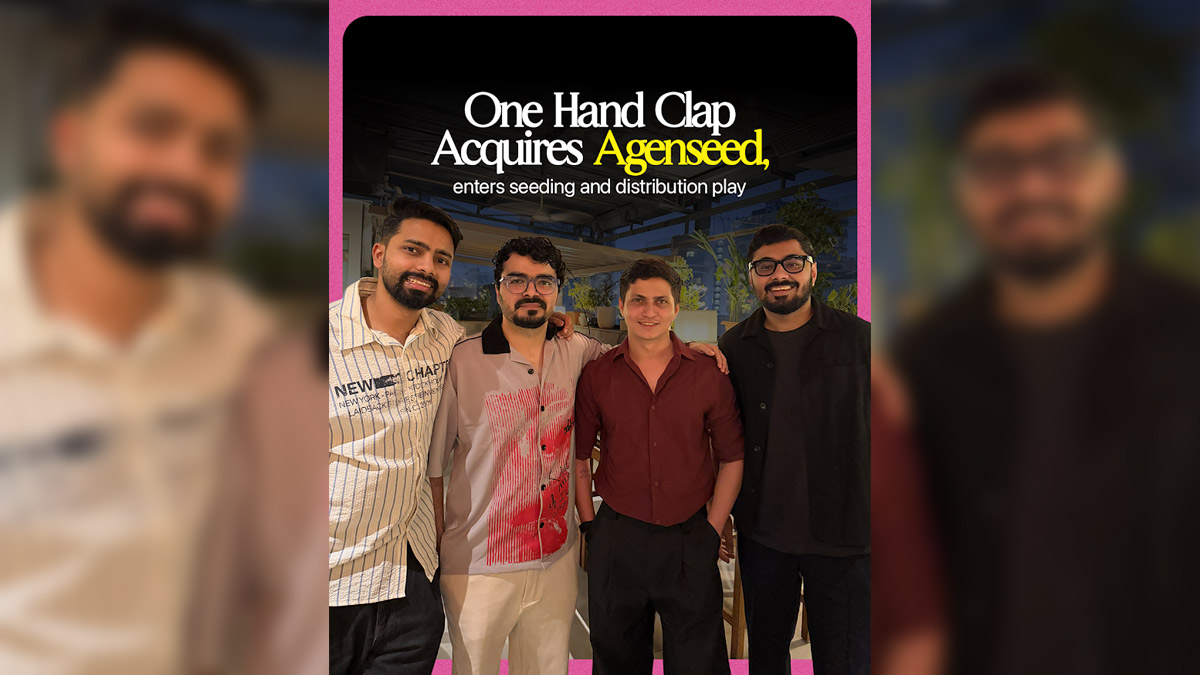
MUMBAI: One Hand Clap has decided to stop just clapping for great ideas now it wants to make sure they actually travel. The leading new-age creative agency and production house has acquired Agenseed, a seeding and distribution firm, marking its formal entry into the distribution segment. The move is aimed at expanding its role across the entire marketing value chain and unlocking new growth opportunities.
One Hand Clap expects the new distribution vertical to contribute up to 15 per cent of its overall revenues over the next 12–18 months, signalling a clear strategic shift beyond pure creative services.
Agenseed, founded by Monish Hardasani and Akram Malik, will function as the agency’s dedicated distribution arm. This acquisition strengthens One Hand Clap’s position as it aims to become a full-stack creative and distribution company in India’s rapidly growing digital advertising market.
With over 90 million posts shared daily on Instagram and brands allocating 25–35 per cent of their digital budgets to distribution and creator-led reach, amplification has become critical to campaign success. By integrating distribution early into the creative process, the agency hopes to help campaigns gain stronger cultural traction and momentum.
One Hand Clap founder Aakash Shah said, “The future of advertising is not just about executing great ideas, but about placing them intelligently. By owning both storytelling and distribution, we can drive greater impact for brands while opening up new revenue streams.”
Agenseed co-founder Monish Hardasani added, “The future belongs to ideas designed to travel. This partnership allows us to integrate distribution thinking at the source.”
Founded in 2019 by former AIB leaders Aakash Shah and Naveed Manakkodan, One Hand Clap has worked with major brands including Swiggy, Google, Netflix India, Crocs, Duolingo, CRED, Bumble, BGMI and Chetak. The agency also secured investment from Zerodha co-founder Nikhil Kamath last year.
In an increasingly fragmented attention economy, this acquisition reflects a broader industry shift where agencies are building end-to-end capabilities to stay competitive. One Hand Clap is clearly clapping louder and ensuring its ideas now reach much further.






