MAM
Marketing lessons a la AAP

MUMBAI: The recent-concluded Delhi elections, took everyone by surprise when Aam Admi Party won 28 seats. We take a look at what one can learn from the new entrant.
When it was formed less than a year ago on 26 November, 2012, little did the Aam Aadmi Party imagine it would make such a big splash at the polls.
Winning 28 out of 70 seats in the Delhi Assembly elections on 8 December, the AAP came a close second to the BJP which won 31 seats, pushing the ruling Congress to an irrelevant third position. What’s more, three-time Congress CM Sheila Dixit suffered defeat at the hands of AAP chief Arvind Kejriwal. Before the elections, the now ex-CM of the national capital, didn’t think before making statements like, “Arvind isn’t even on our radar.” Dixit probably forgot the legend of David Vs Goliath.

For a fledgling party which emerged as an offshoot of the larger ‘India against Corruption’ movement launched by activist Anna Hazare -where people took to the streets to protest the many ills plaguing the current administration – this is no mean feat.
And neither is the fact that AAP – registered as a political party with the Election Commission (EC) only in March this year – has successfully met the EC’s criteria to become a state party.
So what did the AAP do right to banish all the scepticism its broom-wielding members met with from seasoned politicians who dismissed the party, at least initially, as ‘chillar’ or worse, a group that made a lot of noise but had no real impact.
Looking at the AAP’s historic win from a marketing perspective, we at indiantelevision.com believe brands may do well to take a few lessons from the party’s promotional strategy:
* Strong USP
Each brand need to have a very strong USP which helps position it in the minds of the target audience. AAP’s USP is that it gives the common man a belief, a hope, that there is going to be a better tomorrow, and that it has been created by the common man who is fed up of the politics of politics, and will hence deliver on its promise.
*Be consistent
At the heart of the AAP’s party manifesto is its stand against corruption – which cuts through classes. And it has not deviated from that. It has refused to ally with either the Congress (I) or the BJP, despite there being a possibility of it occupying the seats of power in Delhi.
Brands need to stick to their core premise and promise and not try to ride fads.
* Marry your brand USP with the brand mnemonics
The AAP has always had one agenda – the aam aadmi, and it has stayed true to it ever since inception. Party members are common people who have volunteered and are unpaid. They come across as common people; they dress up like common people; they move around like common people. Even though many of them are well educated.
And during this election campaign there was none of the largesse distribution or ostentation that the general political parties generally resort.
 The choice of name and the symbol in the case of the AAP was also crucial. The name says it all -Aam Aadmi Party. Then the symbol was the killer: what is the one thing that is still common across all homes in India, even in middle-class and upper class homes and hutments – it is the broom. Using the broom as the mnemonic meant many things: it will be used to sweep clean all the dirt in the political system, while it helped identify the common man with a tool that is used in his/her home every day.
* Know your customer; make him your network and your ambassador
The AAP needed to connect with its customer: the electorate of New Delhi. Almost 130,000 volunteers all over the world, some of whom descended on Delhi before the election campaign became both the best focus group and research agency anyone could ask for.
Some executives even took leave from their high paying jobs in India and overseas, housewives found time from their day to day chores, young college students, technicians, labourers, cable TV operators – everyone pitched to connect with the consumer and pass on what troubled the common Delhi-ite – crucial information to the central headquarters of the AAP. And they then propagated that further themselves to the electorate.
With millions of products overflowing on shop shelves and online, brands need to know what their customers really want, when they want it and how they want it, and in the process make them your ambassadors and messengers.
* Choose the correct medium at the correct time
AAP had little financial resources at its disposal; some say less than Rs 20 crore. That’s probably what’s spent by politicians on a couple of constituencies. Once again volunteers stepped in to build the buzz.
Twitter, facebook, online, print, and television. AAP went the whole hog on all the mediums. But not to splurge; just to have its message heard. The media were relatively complying: did not the common man also work in media? It hooked the middle class and the upper middle class through social media.
And what about the man on the street? Well it used direct selling: volunteers went door to door to the electorate in Delhi, connected with the common man. In trains, in buses, on auto rickshaws, in jhuggis, in bastis – there was the huge poster campaign, and it was the educated folks who went where they normally would not.
Brands have to be careful about the medium they choose and utilise it to maximise impact. Brands too have to keep themselves in people’s mind through various activations/campaigns especially in today’s market where the sharks are ready to rip apart any competition.







MAM
India’s financial sector spent less on TV ads in 2025 but flooded the internet
Banks, insurers and lenders cut tv ads as digital jumps, LIC and Muthoot lead tv and Axis Bank tops online
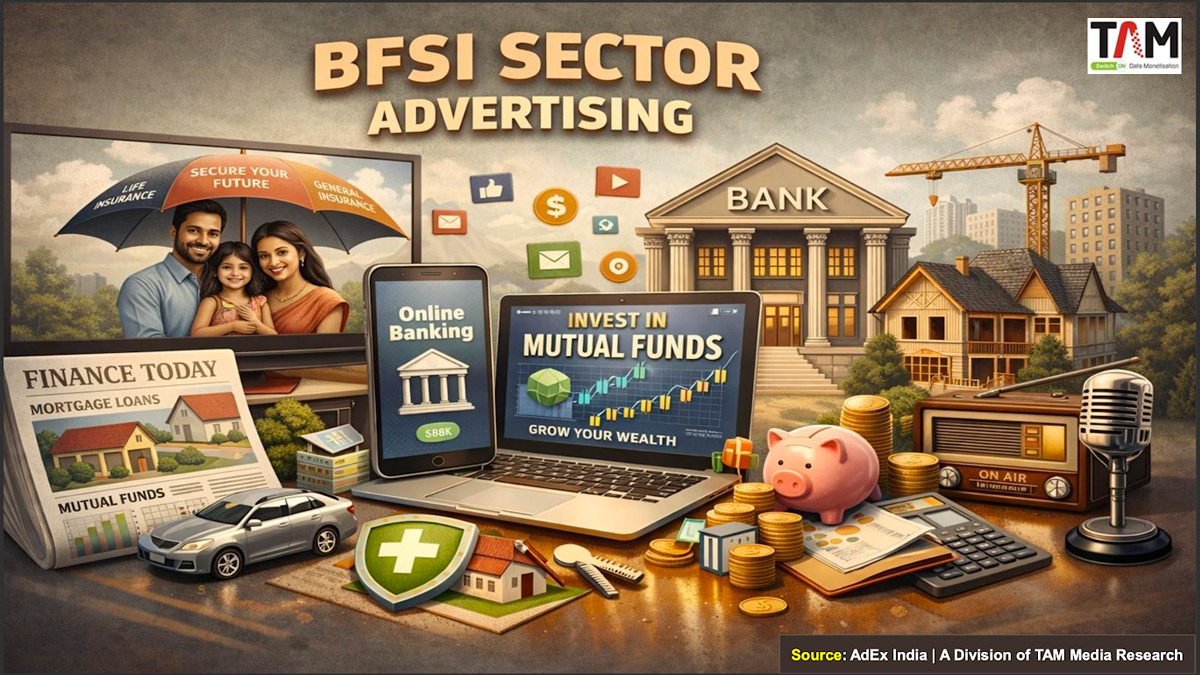
MUMBAI: India’s banking, financial services and insurance sector, one of the most prolific advertisers in the country, delivered a split verdict on media in 2025. It spent less on television, held its nerve in print, turned up the volume on radio and deluged the internet with a ferocity that left every other medium looking pedestrian. The picture that emerges from TAM AdEx’s cross-media report for the BFSI sector is of an industry in transition, still wedded to the news bulletin but increasingly seduced by the algorithm.
Television: a retreat with caveats
TV ad volumes for the BFSI sector fell 16 per cent in 2025 compared with 2024, a sharp reversal after two years of consistent growth that had pushed volumes 16 per cent above 2021 levels by 2023 and a further 7 per cent higher by 2024. Within 2025 itself, the drop was concentrated in the middle of the year: the second and third quarters saw ad volumes slide 35 per cent each against the first quarter, with a partial recovery of 13 per cent in the fourth.
The retreat did not reshuffle the deck. Life insurance retained first place among TV categories with 19 per cent of ad volumes, mortgage loans held second with 16 per cent, and the top ten categories together accounted for 82 per cent of all BFSI television advertising. The dominance of news channels was equally pronounced: news claimed 68 per cent of ad volumes, general entertainment channels a distant 14 per cent and movies 12 per cent. Together, news and GEC captured 82 per cent of the sector’s television spend. News bulletins alone took 48 per cent of programme-genre volumes, with feature films second at 12 per cent. Prime time, between 6pm and 11pm, drew 34 per cent of ad volumes, followed by afternoon at 22 per cent and morning at 20 per cent. A full 82 per cent of all ads ran between 20 and 40 seconds.
Life Insurance Corporation of India was the sector’s biggest TV spender with 11 per cent of ad volumes. Muthoot Financial Enterprises came second with 9 per cent, followed by National Payments Corporation of India at 6 per cent, Tata AIG General Insurance at 5 per cent and State Bank of India at 5 per cent. The top ten advertisers together accounted for 51 per cent of total TV volumes. Three names were new to the top ten in 2025: Tata AIG General Insurance, IIFL Finance and Tata Capital. At brand level, Muthoot Finance Loan Against Gold led with 9 per cent share, Tata AIG Health Insurance entered the top ten for the first time, and the top ten brands together contributed 35 per cent of ad volumes.
Print: the long climb continues
Print told a different story. Ad space for the BFSI sector has grown every year since 2021, rising 16 per cent in 2022, 30 per cent in 2023, 51 per cent in 2024 and 64 per cent in 2025, all measured against a 2021 baseline. Within 2025, ad space was flat in the second quarter but surged 46 per cent in the third and 33 per cent in the fourth compared with the first. Life insurance led print categories with 21 per cent of ad space, followed by mutual funds and banking services and products at 13 per cent each, and corporate financial institutes at 11 per cent. The top ten categories together took 82 per cent of print ad space. LIC led print advertisers with 6 per cent share, and the top ten together covered just 19 per cent of ad space, a reflection of how fragmented print spending remains. Three new entrants joined the top ten in 2025, with Billion Brains Garage Ventures the only exclusive presence not seen in 2024’s list. In the top ten brands, LIC dominated with a 2 per cent share, while Nippon India Mutual Fund rose to third position from fourth in 2024. English accounted for 62 per cent of print ad space, Hindi for 20 per cent. Business and finance publications took 59 per cent of the genre split. The south zone led regional spending with 33 per cent of print ad space, Bangalore topping that zone, while New Delhi and Mumbai were the leading cities nationally.
Radio: louder than ever
Radio ad volumes for the BFSI sector have climbed steadily, rising 12 per cent above 2021 levels in 2023, 36 per cent in 2024 and 45 per cent in 2025. The quarterly pattern within 2025 was volatile: a sharp drop of 43 per cent in the second quarter and 42 per cent in the third, followed by a near-full recovery in the fourth. Life insurance led radio categories with 22 per cent of volumes, banking services and products second at 14 per cent and corporate NBFCs third at 11 per cent. LIC of India held its position as the leading radio advertiser with 20 per cent of ad volumes; the top ten radio advertisers together covered 69 per cent. Muthoot Financial Enterprises led radio brands with 10 per cent share, five of the top ten brands belonged to LIC alone, and SBI Mutual Fund made a remarkable leap to fifth position from 272nd in 2024. Evening and morning time-bands together captured 84 per cent of radio ad volumes, with evenings at 44 per cent and mornings at 40 per cent. Maharashtra was the leading state for radio BFSI advertising with 18 per cent share; Maharashtra, Gujarat and Uttar Pradesh together accounted for 43 per cent.
Digital: the five-times surge
If one number defines the 2025 BFSI advertising story, it is five. Digital ad impressions for the sector multiplied fivefold between 2021 and 2025, having already doubled in 2023 and doubled again in 2024 before the 2025 leap. Within the year, impressions dipped 19 per cent in the second quarter and 12 per cent in the third before recovering 8 per cent above the first quarter by the fourth. Banking services and products led digital categories with 27 per cent of impressions, life insurance and credit cards tied at 19 per cent each, and securities and sharebroking organisations fell from first place in 2024 to fourth in 2025. Axis Bank was the runaway leader among digital advertisers with 12 per cent of impressions, followed by ICICI Bank at 9 per cent, IDFC First Bank at 7 per cent and Kotak Mahindra Bank at 6 per cent. The top ten digital advertisers covered 59 per cent of impressions, and seven of them were new entrants compared with 2024, signalling rapid churn in the digital spending hierarchy. At brand level, Axis Bank led with 9 per cent, ICICI HPCL Super Saver Credit Card vaulted to third place from 921st in 2024, and six of the top ten digital brands were new to the list. Programmatic buying accounted for 91 per cent of all digital BFSI transactions; combined with ad networks, it captured 96 per cent.
The data from TAM AdEx paints the portrait of a sector that still believes in the power of the television news bulletin to sell insurance to the masses, but increasingly knows that the next generation of borrowers, investors and cardholders is scrolling, not watching. The race is now on to reach them before the algorithm serves up someone else’s loan offer first.






