AD Agencies
Madison Media releases Advertising Report 2024


Mumbai: Madison Media is back with its predictions for the advertising industry for 2024. Mr. Shantanu Khosla, Executive Vice Chairman – Crompton Greaves Consumer Electricals Ltd. who was the Chief Guest at the event and launched the Report said, “India is an underpenetrated, underserved country and that the pie is going to increase, but it is imperative for brands to be authentic, build trust and have a sense of purpose”. He further added on, “Creative/Content will always be more important than media”.
The Highlights of the Report were released to a large Audience this afternoon by Sam Balsara, Chairman, Madison World.
Key findings of the Report: Figures at a glance:

Indian Advertising Market over last 3 years ( Jan – Dec )

A. Overall:
1) In 2023 total Adex grew by a mere 10%, vs our projection of 16%. Traditional Adex grew by 7% and Digital Adex by 15%. Increase in raw material prices in H1, continuing wars in Russia/Ukraine and Israel/Hamas, inflation, funding winter within the start-up industry are some of the factors that have contributed to the slow growth rate. Whilst the GDP growth is estimated at 7.3%, if you look deeper, the contribution of private final consumption expenditure component of GDP has come down, which may explain the reason for lower buying of products and services by the middle class and rural India.
2) Compared to Indian Adex growth rate of 10%, Global Adex, according to WARC grew by just 5% in 2023. Brazil and India are now the two fastest growing Adex markets.
3) Traditional Adex dominates Indian Adex with a 60% Share, whereas in Global Adex, the figure is just 27%.
4) The Audio Visual medium contributes to 46.3% of total Adex. Linear TV at Rs. 32,886 crores and Digital Video at Rs. 12,996 crores, totalling to Rs.45,882 crores.
5) H1 2023 grew by just 6%, but H2 2023 grew by 14%. Q4 was the best performing quarter with a contribution of 31% to the full year and accounted for 50% of the annual growth. 6) FMCG continues to be the largest category contributor in Adex and has gained Share of 1% point to 33% in 2023.
7) Ecommerce as a category has established itself as the 2nd biggest contributor to Adex, with a Share of 11% in 2023.
8) There is no change in the Top 3 Advertisers of Adex – HUL, Reckitt and RIL. Godrej Consumer Products is the new entrant in the Top 5 list, having moved up in rank from 12 to 5. The Top 50 Advertisers list has 20 FMCG companies and only 1 Start-up in the list, compared to 9 last year, reconfirming the funding winter in the start-up eco system. Whilst total Adex has grown by 10%, if we look at the Top 10 advertisers, their advertising budgets have grown 20%.
B. Digital
1) Digital grew by a mere 15% in 2023, vs our projections of 25% to reach Rs. 39,714 crores. This is the slowest growth in more than a decade, barring the Covid year.
2) But Digital continues to be the largest contributor to Adex with a 40% Share and has gained 2% points in terms of Share.
3) With a Share of 40% of Adex, Digital in India still trails behind Global Adex, where its Share is 73%. 4) Video, Social, Display, Ecommerce and Search drive Digital Adex. Digital Video continues to dominate Digital Adex, although its growth has slowed down from 40% last year to 26% in 2023,
it is the largest contributor to Digital Adex and has gained Share from 30% to 33%. 5) Advertising on Connected TV has increased from Rs 450 crores to around Rs. 1,000 crores in 2023. 6) Digital will continue to be the key driver of Adex in 2024 growing by a modest 17% with a rise in Share from 40% to 42%.
C. Television
1) TV registered a modest growth of 7%, against our forecast of 9% to reach Rs. 32,886 crores in 2023.
2) TV’s Share of Adex further declined from 34% in 2022 to 33% in 2023.
3) There was a 2% drop in advertising FCT in 2023 over 2022.
4) Not only does FMCG continue to be the largest contributor to TV Adex, with a growth in spends of 12%, its contribution to TV Adex increased from 45% to 47%.
5) Ecommerce continues to be the 2nd largest contributor to TV Adex. Auto has increased spends by 21% and contributes to 6% of TV Adex. Education as a category has reduced its spends by 41% and now contributes just 2% to TV Adex.
6) Hindi satellite mainline along with 2nd line and Sports are the 2 major genres and contribute to almost 50% in value, but Hindi satellite, marginally de-grew in FCT, whilst Sports increased its FCT by 8%. Hindi movies de- grew 6% and English Niche, English Movies and Infotainment de-grew around 30% by volume.
7) We expect TV Adex to grow by 8% in 2024 to reach a total of Rs. 35,575 crores with a Share of 32%.
D. Print
1) Print Adex grew by 4% to reach Rs. 19,250 crores, but is still below its pre-Covid level. 2) Whilst Print’s Share to total Adex has dropped by 2% points from 21% to 19%, it is still far higher than the Global average of 4%.
3) Auto, FMCG, Education, Retail and Real Estate contribute 50% to Print Adex. This year Auto is the leader of the pack with 14% Share and contributed most to the growth of Print Adex. 4) Hindi and English Publications contribute over 64% to the total Print Advertising space consumed in India. Marathi comes next. But the volume of space used collectively in Kannada, Tamil, Telugu, Malayalam, Gujarati, Oriya. Bengali, Punjabi, Assamese and Urdu is relatively low. 5) We expect Print to grow by 7% in 2024 to reach Rs. 20,613 crores and finally surpass the pre-Covid 2019 figures.
E. Other Media
1) OOH Adex has registered a growth of 13%, on the back of a 68% growth the previous year, taking the industry to Rs. 4,140 crores.
2) Radio Adex has grown by 12% to reach Rs. 2,272 crore, to finally surpass its pre Covid level. 3) Real Estate has emerged as the largest category in both OOH and Radio, pipping FMCG. 4) Although Cinema registered the highest growth of 36%, to reach Rs. 776 crores, it has yet not reached its pre-Covid levels; its Share has marginally gone up from 0.60% to 0.80%.
Sharing the highlights of the report, Madison World chairman Sam Balsara said, “Whilst the Outlook for Adex in India is extremely strong in the mid-term and long-term, in the short term we are witnessing a slow down in momentum because of India Inc’s focus on quarterly profits. This does not augur well for sustained growth in profits for Advertisers who should be focussing on volume growth.”





AD Agencies
Kevin Vaz opens FICCI-EY report with a declaration: India’s M&E industry set to breach Rs 3 trillion mark by 2027
In a keynote address at the FICCI-EY report launch, Kevin Vaz says sport, AI and the connected TV boom are driving a multi-screen revolution with no signs of slowing
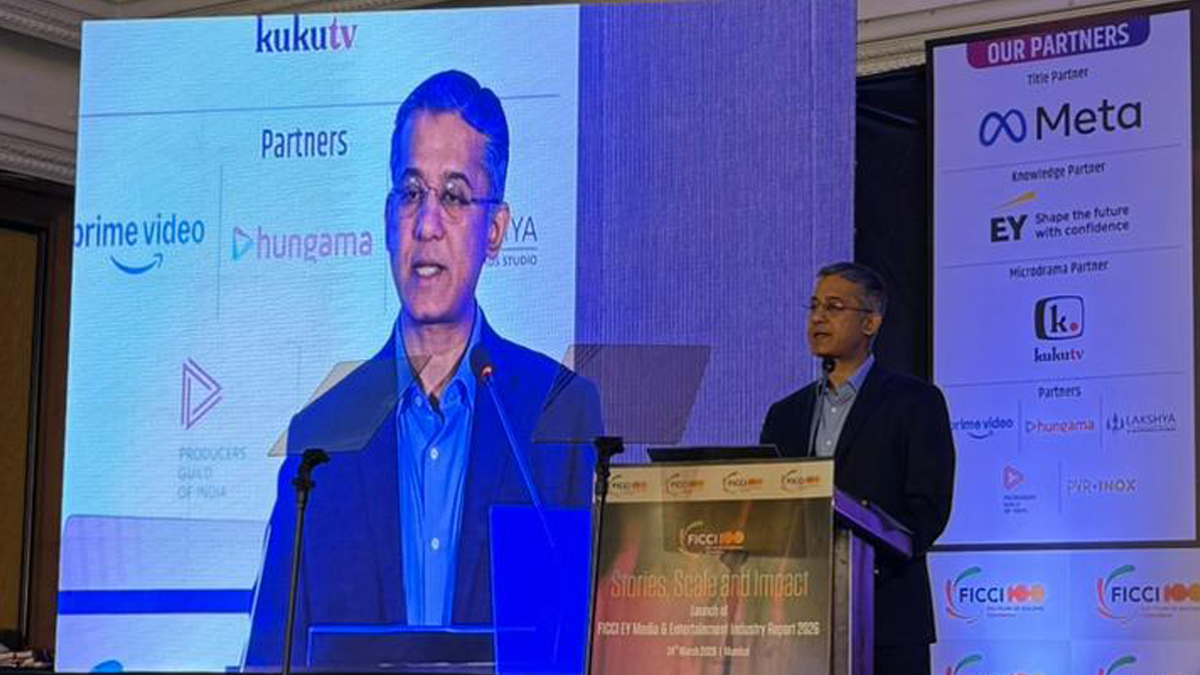
MUMBAI: India’s media and entertainment industry is growing faster than the economy, reshaping global benchmarks and is on course to blow past Rs 3 trillion by 2027. That was the headline message from Kevin Vaz, chairman of the FICCI Media and Entertainment Committee and chief executive of entertainment at JioStar, who delivered the opening keynote at the launch of the FICCI-EY Media and Entertainment Report 2026 in Mumbai on Monday. He did not waste much time on caveats.
The industry hit Rs 2.78 trillion in 2025, outpacing GDP per capita growth and surpassing even last year’s bullish forecasts. Vaz described the year in three words: scale, convergence, transformation. The numbers, he suggested, were only half the story. The other half was how that growth was happening.
Digital has become the industry’s largest segment, driven by advertising, subscriptions and commerce. But Vaz was quick to puncture the familiar narrative of digital killing everything else. India, he argued, is not an either-or market. It is an AND market. Connected TV is surging. Linear television, mobile, films and print are all still expanding. AVGC, the animation, visual effects, gaming and comics sector, is emerging as a serious growth engine, opening new storytelling formats and new global revenue streams. Nothing, he said, is replacing anything. Everything is reinforcing everything else.
Nowhere is that more vivid than in sport. In an on-demand world where audiences can watch anything, anytime, Indians still show up live. “Sports don’t fragment audiences,” Vaz said. “They unite them, just on different screens.” The ICC Men’s T20 World Cup 2026 made the point emphatically. During the final, JioHotstar delivered 72.5 million concurrent streams, a global record. Group chats exploded. Families renegotiated control of the television. Advertisers, Vaz noted with undisguised relish, stopped asking where audiences were and started asking how fast they could get in.
Cinema had its own landmark year. More than 1,900 films were released, with several crossing the Rs 1 billion mark. Dhurandhar was singled out as proof that Indian audiences will still turn up in large numbers for content that grips them. Live experiences, too, are getting bigger and more immersive, though Vaz suggested the surface has barely been scratched.
Then there is artificial intelligence, which he described as quietly, and sometimes not so quietly, reshaping everything. AI is enabling personalisation, efficiency and scale, but Vaz argued its deeper significance lies in what it is doing to creativity itself. He pointed to Mahabharat: Ek Dharmayudh, billed as the world’s first AI-produced show, as evidence that the technology can amplify creative ambition rather than hollow it out. He also used the platform to call on Indian policymakers to engage seriously with the creative industry on AI and copyright, ensuring that creators are fairly compensated as the technology spreads.
The picture that emerges from the report, and from Vaz’s keynote, is of an industry that has stopped thinking of itself as a fast-growing emerging market and started thinking of itself as a global template. Scale, diversity and innovation, he said, are no longer in tension in India. They are coexisting, and the rest of the world is taking notes.
The Rs 3 trillion milestone is two years away. As the man who chairs the committee that shapes the industry’s policy agenda and runs the country’s most powerful entertainment platform, Vaz set the tone for the day with characteristic directness: India’s media business is not just chasing growth. It is deciding what the country talks about at dinner. That is a different kind of power altogether.








