MAM
Lyxel&Flamingo promotes six leaders as partners amid business growth plans

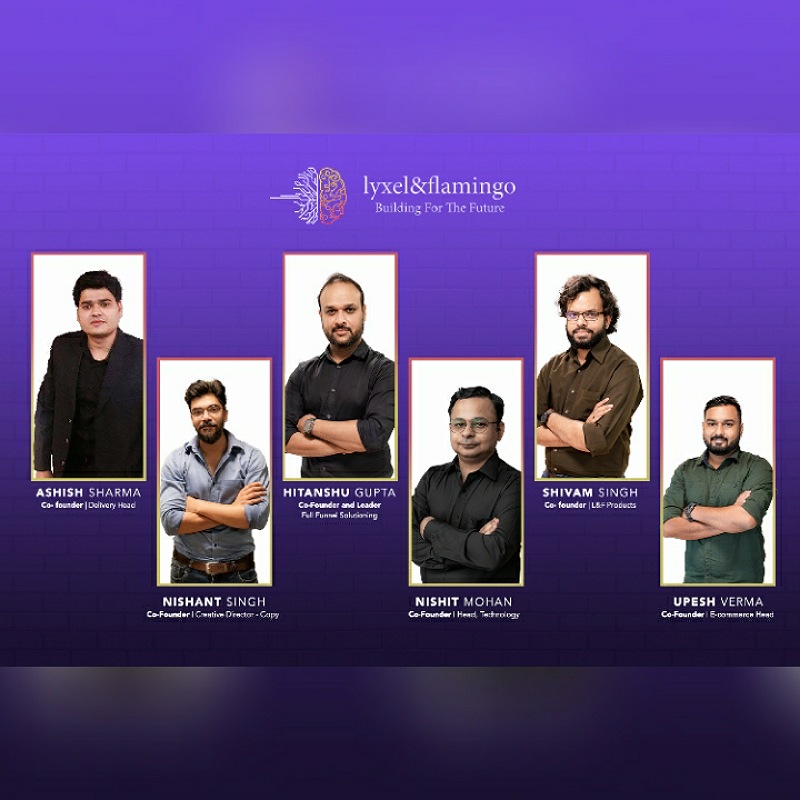
Mumbai: Lyxel&Flamingo (L&F), a Gurugram-headquartered digital-first marketing agency on Tuesday announced major restructuring of its leadership team. The company has elevated six homegrown leaders as new partners to further strengthen the focus on scaling its business pan-India.
The company’s partner comprises of Nishant Singh (creative director – copy), Nishit Mohan (head of technology), Shivam Singh (team lead R&D), Hitanshu Gupta (solutions architect), Upesh Verma (head of e-commerce) and Ashish Sharma (delivery head). “The six newly-minted partners have already spent more than half a decade with the company and have risen through the ranks to now lead very important and profitable businesses within the L&F fold,” said the statement.
“We are incredibly proud to elevate six of ‘our own’ to partners as they represent what homegrown talent can do for the growth of any company. Having come up through the ranks, they embody & exemplify the strong cultural values our organisation is exceedingly proud of,” stated L&F co-founder and CEO Dev Batra. “A few of them began their professional careers with us and have soldiered on through thick & thin to have reached this pivotal point in their careers. They have demonstrated the same perseverance and other core values integral to L&F like any other partner has and hence, this elevation only makes natural sense.”

The four original co-founders, Dev Batra (CEO), Yesh Miranda (CCO), Shreyansh Bhandari (COO) and Priya Batra (director – people strategy and growth), shall dilute as much as 20 per cent of their equity in order to help more than 30 leaders within their company become partners over the next three years in an industry-first restructuring and organisation building process, said the company in a statement.
“As a team we have always had the unwavering belief that L&F has what it takes to grow into a globally relevant, multinational, marketing agency from India. To strengthen our mission of ‘Building For The Future’ and further build on our vision, the natural step was to groom the next generation of leadership within a structure where they hold more equity in the company & build on the momentum of growth & new competencies,” Batra further said.
“The company’s growth culture is an integral part of our outlook. We focus on doing things passionately and always pushing the envelope – yet giving complete independence to our people to decide their own growth and enabling this in a decentralised manner,” commented Priya Batra. “This is where the six new partners are going to bring their expertise to the table – Building For The Future in the process- for brands & for the organisations alike.”
In the last few years, L&F has established competencies across digital, social, analytics, tech, CRM and automation. The company has business spread across Gurugram, Mumbai, Bengaluru, Vancouver, Canada and Wyoming, US.





MAM
WPP appoints Estée Lauder’s Anne-Isabelle Choueiri as chief transformation officer
Former Estée Lauder executive to lead operations, technology and culture overhaul under WPP’s three-year growth plan

LONDON: WPP has appointed Anne-Isabelle Choueiri as chief transformation officer in a newly created role tasked with delivering the group’s Elevate28 strategy.
Choueiri joins from The Estée Lauder Companies, where she led enterprise-wide strategic initiatives, including the “One ELC” operating model and major upgrades to enterprise marketing, data and analytics capabilities. She also led the redesign of enterprise technology teams and served on the company’s AI taskforce, driving AI strategy, adoption and value realisation across the business.
At WPP, she will be responsible for designing, implementing and embedding the operating model behind Elevate28, the company’s three-year growth plan unveiled in February 2026. She will lead efforts to improve innovation, efficiency and integration across WPP’s client offerings, with a focus on delivering agile, outcome-driven solutions and measurable growth.
Choueiri will oversee organisational transformation across the group, working closely with product and enterprise technology teams to deploy AI, data and technology to build new capabilities and improve operational performance. She will also work with the people function to embed cultural change, strengthen an agile performance mindset and support talent development across the organisation.
Before joining Estée Lauder, she held senior roles across consulting and digital agencies, including at Accenture, Masaï (a Bain & Company spin-off), and Kearney, with experience spanning strategy, data and digital marketing transformation.
Cindy Rose, chief executive officer of WPP, said Choueiri brings a strong track record of leading large-scale transformation across operations, technology and culture, adding that her appointment will help accelerate the group’s next phase of growth under Elevate28.
Choueiri said WPP’s strategy represents an ambitious opportunity to reshape how the company operates and delivers for clients, adding that she looks forward to building integrated solutions and fostering a culture of innovation and change.
She will be based in New York and will join WPP’s executive committee.







