Ad Campaigns
Lizol’s #NoMoreHalfTruths campaign busts myths around phenyls

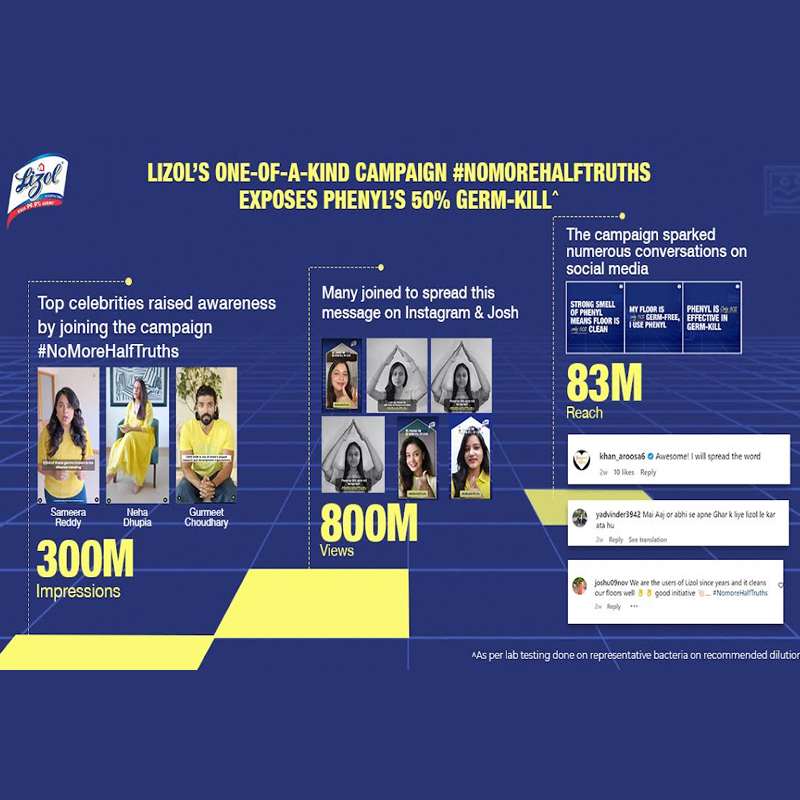
Mumbai: For decades, Indian consumers have believed that phenyls are highly effective floor cleaners, however studies indicate that ordinary phenyls kill only 50 per cent of germs on mopping. A joint study conducted by Lizol, India’s leading disinfectant brand, and an independent research agency revealed the presence of numerous bacteria and viruses on household surfaces, which can lead to various diseases and infections. These can be responsible for diseases, such as diarrhoea, and conditions like skin infections, urinary tract infections, acne, eye and bloodstream infections. In response, Lizol launched the #NoMoreHalfTruths social media campaign on May 29, 2023, aimed at debunking the myths surrounding phenyl efficacy and increasing consumer awareness about proper cleaning practices.
The campaign aimed to raise awareness about the limited effectiveness of the commonly used household cleaner, phenyl, in killing germs. It highlighted that ordinary phenyls only eliminate 50 per cent of germ when used for mopping. Additionally, Lizol received recognition for its product’s superior formulation, offering 99.9 per cent germ kill with just one cap, along with 10 times better cleaning compared to three caps of phenyl. #NoMoreHalfTruths gained significant traction on social media, accumulating over 800 million views and generating more than 50 million likes, comments, and shares across various platforms.
Reckitt- South Asia regional marketing director – hygiene Saurabh Jain said, “A recent study revealed that illness-causing germs found in hospitals are also widespread on the floors of Indian households, posing a health risk to families. The #NoMoreHalfTruths campaign aims to educate consumers about these germs in their homes and the inadequacy of ordinary phenyls in eliminating them. The success of this campaign underlines the potential power of digital Indian audiences and our ability to initiate a movement by engaging them. We also want to ensure school kids are protected from the risk of falling ill due to unclean surfaces, thus we have partnered with The Akshaya Patra Foundation, which marks the beginning of a commitment to ensuring overall surface protection with Lizol.”

As part of the campaign, Lizol collaborated with prominent celebrities like Sameera Reddy, Neha Dhupia, and Gurmeet Choudhary to actively engage and inform consumers about the limited effectiveness of phenyls in cleaning surfaces. The campaign aimed to encourage people to join the movement and expose the misconception that phenyls are highly effective in killing germs, when in reality they only eliminate 50 per cent of germs. In line with its commitment to protecting families and promoting a germ-free environment, Lizol also partnered with The Akshaya Patra Foundation to provide cleaning products for kitchen and school floors.
The Akshaya Patra Foundation chief communication & sustainability officer Anant Arora said, ” The Akshaya Patra Foundation strives to empower children with a healthy and wholesome meal to ensure nourishment & better learning experience. Ensuring children’s health and safety is paramount, and we are proud of our partnership with Lizol, an expert in maintaining global standards of cleanliness and hygiene. Together, we are creating a brighter, healthier tomorrow for the children we serve.”

NATIONAL: Amazon Ads has laid out a sharply tech-led vision for the advertising industry in 2026, arguing that artificial intelligence, streaming TV and creator partnerships will combine to turn brand building into a more precise, performance-driven business.
At the heart of the shift, the company says, is the fusion of AI with Amazon’s vast trove of shopping, browsing and streaming signals, allowing advertisers to move beyond blunt reach metrics to campaigns designed around real customer behaviour.
“The future of advertising is not about reaching more people, but the right people with messages that resonate,” said Amazon Ads India head and vice president Girish Prabhu. “By combining AI with deep customer insights, we help brands move from broadcasting campaigns to having meaningful conversations wherever audiences spend their time.”
One of the biggest changes, according to Amazon Ads, will be the collapse of the wall between media planning and creative development. Retail media, powered by first-party data, is increasingly shaping everything from brand discovery to final purchase, pushing marketers to design campaigns around audience insight rather than internal instinct.
AI is also moving from a support tool to a creative engine. Agentic AI, which automates and accelerates production, is expected to make high-quality creative accessible even to small businesses, compressing weeks of work into hours and giving challengers the ability to compete with larger brands on speed and scale.
Behind the scenes, AI-driven analytics will take on a bigger role in campaign optimisation, identifying patterns, spotting opportunities and recommending actions that would previously have required teams of analysts.
Streaming TV is another big battleground. With India’s video streaming audience now above 600 million and connected TV users at 129.2 million in 2025, advertisers are set to treat streaming not just as a branding channel but as a performance engine, measured increasingly by sales, sign-ups and bookings rather than just reach.
Finally, Amazon Ads sees creators and contextual advertising reshaping how brands tell stories. Creators will act less like influencers and more like long-term partners, while scene-aware ads on streaming platforms will allow brands to insert hyper-relevant offers into the flow of what viewers are watching.
Taken together, Amazon Ads argues, these shifts mark a move towards advertising that is both more human and more measurable, where AI handles the complexity, and creativity does the persuading.






