MAM
Khazanah Nasional Berhad invests $42 mn into Wow! Momo

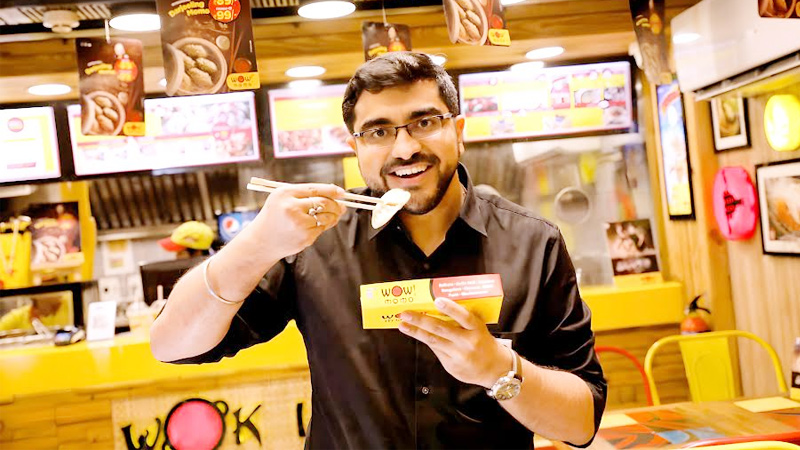
Mumbai: Wow! Momo Foods, the operator of Wow! Momo, Wow! China and Wow! Chicken has raised over Rs 350 crores from Khazanah Nasional Berhad (“Khazanah”), the sovereign wealth fund of Malaysia. The investment will be made through both primary infusion and secondary purchase from early-stage investors, the Indian Angel Network (“IAN”) and Lighthouse Funds.
In addition, the company’s existing investor, OAKS Asset Management, has also infused INR 60 crores of additional funding into Wow! Momo Foods.
Commenting on the announcement, Wow! Momo Foods CEO and co-founder Sagar Daryani said, “There is no greater joy for a founder than giving its initial investors (Indian Angel Network (IAN) and Lighthouse Funds) great partial exits. For us, the Bharat Story has just begun with a huge headway of growth. With Khazanah’s investment into the business and their long-term approach, we will strive to become the powerhouse of innovation and transformation in the food space while keeping a strong balance between sustainability, growth and backing breakthroughs”.

Khazanah MD Dato’ Amirul Feisal Wan Zahir said, “We are excited to be on the journey with Wow! Momo in their mission to build the largest QSR brand in India. We aim to encourage the growth of Wow! Momo through enhanced scalability, technological fortification, and focusing on building a strong back-end capability to support its growth.”
OAKS Asset Management founder and CEO Vishal Ootam said, “In our journey with investments in other F&B brands, we have realised that long-term thinking and dynamic leadership are essential. We feel that Wow! Momo has both. We feel that Wow! Momo will not only gain dominance in the domestic market but also be the first globalized QSR company from India. We are ready to scale with the brand.”
Launched in August 2008, Wow! Momo Foods is a multi-billion-rupee quick service restaurant (QSR) chain with more than 630 outlets in over 35 cities. It has a robust expansion plan of over 200 outlets in the coming fiscal year and steadfast growth of its FMCG business.
The primary fund will fuel the growth and expansion of the quick service restaurant (QSR) brand and help to strengthen the distribution foothold and research and development (R&D) for the FMCG arm. The entire round is a testimony to the brand’s vision, scalability, and rigor on profitability.
Wow! Momo, together with Wow! China and Wow! Chicken’s aim is to enter more than 100 cities and look at a footprint of over 1500 stores in the next three years. The brand is also expanding across various touchpoints in FMCG with over 1200 retail outlet presence across more than 50 cities in modern trade and quick commerce with its ready-to-eat momos and along with new path-breaking product launches lined-up in the coming fiscal year.
In the transaction, Investec acted as the financial advisors to Wow! Momo. With this latest round; Wow! Momo Foods has bought back Indian QSR to the map of formidable, & scalable businesses. Hunger for growth, strong muscle of right people and most importantly sustained control over unit economics is what makes Wow! Momo story a delectable portion of real growth story. Made in India; made by India.








Risk and return maintain inverse proportionality within mutual funds – higher potential rewards accompany elevated volatility, while stability demands lower expectations. SEBI’s Riskometer (1-5 scale) standardizes visualization, but quantitative metrics reveal nuanced relationships across categories and market cycles.
Fundamental Risk-Return Relationship
Equity funds (Riskometer 4-5) deliver historical 12-16% CAGR alongside 18-25% standard deviation—large-cap 15% volatility, small-cap 30%+. Debt funds (1-2) yield 6-8% with 2-6% volatility. Hybrids (3) average 9-12% returns, 10-14% volatility.
Sharpe ratio measures return per risk unit – equity 0.7-0.9, debt 0.5-0.7 over complete cycles. Higher risk categories compensate through return premium capturing economic growth.
Volatility Metrics Explained
Standard Deviation: Annual NAV return dispersion—equity 18-22%, debt 4-6%.
Maximum Drawdown: Peak-to-trough losses – equity 50%+ (2008), debt 8-12%.
Beta: Market sensitivity – equity 0.9-1.1, debt 0.1-0.3.
Sortino Ratio focuses downside volatility—equity 1.0-1.3 favoring recoveries.
Value at Risk (VaR) estimates 95% confidence, worst 1-month loss: equity 10-15%, debt 1-2%.
Category Risk-Return Profiles
Large-cap equity: 12-14% CAGR, 15% volatility, Sharpe 0.8.
Mid/small-cap: 15-18%, 22-30% volatility, Sharpe 0.7.
Corporate bond debt: 7-8%, 4% volatility, Sharpe 0.6.
Liquid funds: 6.5%, <1% volatility—capital preservation.
Credit risk debt: 8.5%, 6% volatility—yield pickup.
Hybrids: 10-12%, 12% volatility—balanced exposure.
Review types of mutual funds specifications confirming mandated asset allocations driving profiles.
Historical Risk-Return Tradeoffs (2000-2025)
Complete cycles: Equity 14% CAGR/18% volatility; 60/40 equity/debt 11%/11% volatility; debt 7.5%/5% volatility. Bull phases (2013-2021): equity 18%, debt 8%. Bear markets (2008, 2020): equity -50%/+80% swings, debt -10%/+10%.
Inflation-adjusted: Equity 8% real CAGR; debt 1.5% real—growth funding requires equity allocation.
Risk Capacity Assessment Framework
Short-term goals (1-3 years): Riskometer 1-2 (liquid/debt), 2-4% real returns. Medium-term (5-7 years): Level 3 (hybrid), 4-6% real. Long-term (10+ years): Level 4-5 (equity), 6-9% real.
Personal factors: Age (younger = higher risk), income stability, emergency fund coverage, other assets. Drawdown tolerance—20% comfortable vs 40% discomfort signals capacity limits.
Portfolio Construction Principles
Diversification: 60/40 equity/debt reduces volatility 40% versus equity-only while capturing 80% returns.
Correlation: Equity/debt 0.3 average enables smoothing.
Rebalancing: Annual drift correction sells outperformers (equity +25%), buys underperformers (debt -5%).
Style balance: Large-cap stability offsets mid-cap growth volatility.
Quantitative Risk Management Tools
Sharpe Ratio: >1.0 indicates efficient risk-taking.
Information Ratio: Alpha per tracking error.
Downside Deviation: Focuses losses only.
Stress Testing: 2008 scenario simulations reveal portfolio behavior extremes.
Conclusion
Higher mutual fund risk levels correlate with elevated return potential – equity 12-16% amid 18-25% volatility versus debt 6-8%/4-6%. Risk capacity matching, category diversification, rebalancing discipline, and quantitative metric interpretation align portfolios with personal tolerance across economic cycles.
Disclaimer: Investments in the securities market are subject to market risk, read all related documents carefully before investing.






