AD Agencies
Is it right of Congress to blame Denstu?

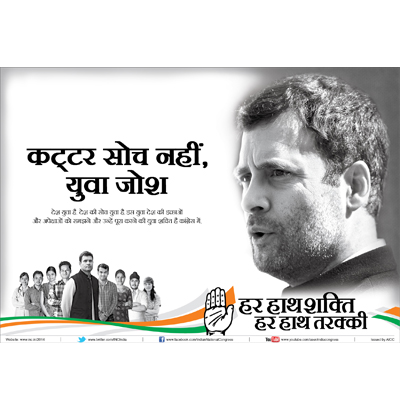
MUMBAI: It was early this year that Congress started its Rs 600 crore blitz ad campaign. The campaign started with the slogan ‘Mein Nahi, Hum’ which caught itself amidst allegations from the Bharatiya Janta Party (BJP) which said that the slogan was first used by Narendra Modi at a rally.
Then came ‘Har Haath Shakti, Har Haath Tarakki.’ The campaign conceptualised by Dentsu was meant to position Congress vice president Rahul Gandhi as a young and dynamic leader who could empower the common man.
BJP’s campaign, ‘Abki Baar, Modi Sarkar’, which went on floor a few months after Congress’ communication line, portrayed Modi as the saviour who could change the game of Indian politics.

Both the campaigns created a stir not only amongst the experts but also amongst the common man as everyone had something to say about them – good, bad or ugly.
The D-Day, 16 May, proved which ideology and promise voters believed in. BJP came out as a clear winner, while Congress’ performance was of sheer disappointment.
Since then, the Congress has been ‘introspecting’ to find what went wrong. However, its latest reason for the debacle is the campaign, itself. The party is now blaming the creative agency by saying that its campaign was weak.
When we contacted Dentsu India Group executive chairman Rohit Ohri, who is travelling abroad, sent an official statement of the agency through an email.
The statement reads, “Dentsu India was hired by the Congress party for their 2014 Lok Sabha campaign, for advertising services, after a publicly announced request for proposal by the Indian National Congress. Dentsu India bagged the mandate after a rigorous pitching process involving several iterations among top Indian agencies. While Dentsu India worked rigorously on an ad campaign as per the client’s brief with approvals at every stage, the other aspects of the campaign eco system such as PR, media relations and online strategy were not within the ambit of Dentsu’s scope of work as mandated by the client briefing. Throughout the campaign, Dentsu India enjoyed a good working relationship with the Congress party.”
“The agency maintains the highest standards of creativity and professionalism and adheres to global standards of ethics and compliance. The agency shares cordial relationship with all its clients, and shall endeavour to maintain the same.”
 |
We at Indiantelevision.com, ask creative fraternity if it is right to blame the agency for the dismal performance of the political party?
Bang in the Middle managing partner and chief creative officer Prathap Suthan
This is a bit of a deja vu for me. Considering that some leaders in the BJP did exactly the same thing when India Shining didn’t work as a political multiplier in 2004. That aside, elections are purely won on the basis of performance. On a limited scale, one could overcome inefficiency by hyperbole and exaggerating the potential of the future.
But this was the national elections. On the back of a long winded story of scams, misgovernance, corruption, lack of leadership, slow economy and what have you. However the campaign, for all its advertising polish and gloss, did not address issues that people wanted answered. There were no admissions. No apologies. No responsibility for incompetence.
Instead what we saw was campaign that was divorced from the need of the hour. They pushed a campaign that presented a hollow and shallow picture of supposed happiness. More importantly, Rahul Gandhi hardly came through as an honest, well meaning, and effective leader. His own media exposure wasn’t very kind to him.
So when you have invested in a campaign that didn’t speak what was required, and projected a story that was far away from the truth, it is bound to fail, and has obviously failed. It is absurd to blame an agency. They only delivered what they were contracted for. I am sure they advised otherwise, but ultimately the client is always right.
It is ridiculous to imagine that the party didn’t agree to the communication. Everyone saw it and everyone approved it surely, if they didn’t agree they wouldn’t have run the campaign. The agency doesn’t and will not create and release an unapproved campaign. There are a lot of signatures that need to approve media releases. And if they have spent all that money behind a donkey in a horse race, you really can’t turn around and blame the jockey.
 |
Lowe Lintas & Partners NCD Arun Iyer
One shouldn’t take too much credit if a campaign goes viral or flak if it flops. Of course, at the end of the day if a campaign doesn’t work then the agency is to be held responsible, but everyone is kept in the loop. It is a well kitted effort and everybody involved is responsible for the outcome. I don’t think what Congress is doing is right. It shouldn’t have done what they did, especially publically.
 |
Infectious director Nisha Singhania
It is not fair to blame an agency if the end product fails to deliver what it promises to the consumers. The purpose of an advertising campaign is to popularise a product but if consumers’ don’t have good experience rejection is obvious. The same thought applies in this situation too.
Curry-Nation director Priti Nair
 |
How can they blame anyone or anything for this except themselves? This goes for each and every product; if your product is bad even Santa Claus cannot help you. Agencies build a brand and make people choose so as to go and use it, so agencies help to choose. A product has to deliver on the use bit. Unfortunately here people had already experienced the product, and it had failed so miserably that no amount of brand building could resurrect it. In fact if you ask me the outdoor, the films (if that is what Dentsu did) were pretty good and looked and seemed even nicer than the BJP campaign, which looked more like the usual political campaign. Except that the BJP campaign thought was far more powerful and true. You can fool some people all the time or you can fool all people sometime but you can’t fool all the people all the time.
Origin Bean Stalk co-founder Upendra Thakur Singh
 |
I personally feel that the agency can be blamed only if it, for any reason, goes totally off the brief. Not if the client and agency have been hand-in-glove while developing the communication and approving the same before release. Today’s consumer is more aware and smart and doesn’t often buy into a bad product even if the campaign is good.
Having said that, fingers are always pointed when the campaign doesn’t give you the desired response or when you lose. Owning to that fact that your product offering is bad is a good thing but blaming the agency for sticking to the brief and executing such a high-cost visible campaign is very unfortunate.





AD Agencies
Microsoft shifts global media account from Dentsu to Publicis Groupe: Reports
Closed review ends decade-long tie-up; Xbox remit may remain with Dentsu

MUMBAI: Microsoft has reassigned its global media planning and buying business to Publicis Groupe, according to media reports, ending Dentsu’s long-standing stewardship of one of the advertising industry’s biggest accounts.
The move follows a closed review and marks a notable shake-up in the global media landscape. Dentsu, which managed the account through Carat, had held the mandate since 2014 and successfully defended it in a 2018 review.
While the broader business is shifting, Dentsu is expected to retain media responsibilities for Xbox, according to media reports, though the exact contours of that arrangement remain unclear. None of the parties involved have publicly outlined the transition timeline or the full structure of the handover.
The scale of the account underscores the significance of the change. Estimates from COMvergence, cited by Ad Age, peg Microsoft’s global media spend at roughly $700 million last year.
For Publicis Groupe, the win deepens an already expanding relationship with the tech giant. Earlier this year, Microsoft Advertising partnered with Publicis Media Exchange and Epsilon to integrate Epsilon’s data into its platform, aiming to sharpen targeting across search, native and display formats.
The decision reflects a broader industry shift, as large advertisers increasingly favour agency partners with strong first-party data capabilities, AI integration and platform-led solutions. Publicis Groupe has been leaning into this model, positioning its data assets and technology stack as a central differentiator.
For Dentsu, the loss is significant. Media remains a core pillar of its global business, and the development comes close on the heels of leadership changes, including the appointment of Takeshi Sano as global chief executive officer.
The shift also carries a touch of irony. Microsoft and Dentsu have worked closely beyond the client-agency relationship, including collaborations around AI tools such as Copilot to support media and creative workflows.
As the dust settles, the message is clear: in today’s data-driven, AI-powered media world, relationships may be long, but they are rarely permanent.






