Brands
Indian commercial office market hits record high, signals major shift in 2025


MUMBAI: India’s commercial office market has reached new heights, with leasing volumes hitting a record 66.4 million square feet in 2024, a 14 per cent year-on-year growth, according to the Ficci-Colliers report: India Office | Setting New Standards for 2025. The market is projected to grow further to 65-70 million square feet in 2025, marking a significant transition from a supply-led to an occupier-driven landscape.
Bengaluru led the charge with its highest-ever absorption of 21.7 million square feet, while Hyderabad recorded the strongest growth at 55 per cent. The dominance of the technology sector has declined from 40-50 per cent to 25 per cent , with engineering, manufacturing, financial services, and flexible workspaces now accounting for more than half of Grade A office demand.
Global capability centres (GCCs) have emerged as a key driver, leasing 25.7 million square feet in 2024, a 41 per cent increase year-on-year. Bengaluru captured 47 per cent of GCC leasing, while Mumbai saw a fourfold rise in uptake.

“Office leasing is expected to grow another 8-10 per cent in FY26, fuelled by demand from GCCs and the financial services sector,” said Ficci committee on urban development and real estate chairman & RMZ chairman Raj Menda.
Sustainability is also shaping occupier preferences, with over 70 per cent of leasing now in green-certified buildings, a figure expected to rise to 80-85 per cent by 2025. Menda added: “Nearly 80 per cent of new supply over the next two to three years will be green certified. By embracing sustainability and innovation, we can contribute to economic growth, enhance well-being, and leave a lasting impact on the environment.”
The real estate investment trust (Reit) landscape is expanding, with 80 million square feet currently under Reits and an additional 400 million square feet identified as potential Reit stock. The listing of India’s first small and medium Reit (SM-Reit) in 2024 has opened new avenues for retail investors.
Looking ahead, new office supply is expected to reach 60-65 million square feet in 2025, with vacancy levels projected to decline to 15-16 per cent. Average rental values are forecast to touch Rs 100-110 per square foot per month.
Ficci committee co-chairman and managing director and CEO Godrej Properties Gaurav Pandey highlighted the residential sector’s milestone in 2024, with demand hitting 1 billion square feet, valued at Rs 8.5 lakh crore, primarily concentrated in India’s top five cities.
“The sector needs execution build-up and brilliant talent across both white-collar and blue-collar jobs,” Pandey added, stressing the importance of labour strategy and talent management for sustained growth.
On the investment front, institutional inflows reached USD 4.7 billion in the first nine months of 2024, with over 60 per cent directed towards industrial, warehousing, and residential assets. The government’s Rs 1 lakh crore urban challenge fund aims to transform cities into growth hubs and improve infrastructure.
However, affordability concerns persist in the residential segment said Ficci committee co-chairman and managing director and CEO HDFC Capital Advisors Vipul Roongta: “With the average unit price at Rs 1 crore in major cities, home ownership remains out of reach for the emerging middle class, who can typically afford homes in the Rs 50-75 lakh range.”
Meanwhile, DLF vice chairman and managing director, rental business, Sriram Khattar, noted a shift in commercial real estate priorities: “Gone are the days when offices were built at 70-80 square feet per desk and simply filled up. The emphasis now is on quality workspaces that enhance occupier and employee experience.”
Looking ahead, Colliers India managing director office services Arpit Mehrotra stated: “The occupier-driven Indian office market will continue to diversify in 2025, and developers will need to remain agile to meet evolving preferences.”







Brands
Samsung certifies 1,000 Maharashtra students in AI and coding
The South Korean electronics giant marks its first large-scale skilling push in the state, with women making up nearly half the national programme’s enrolment
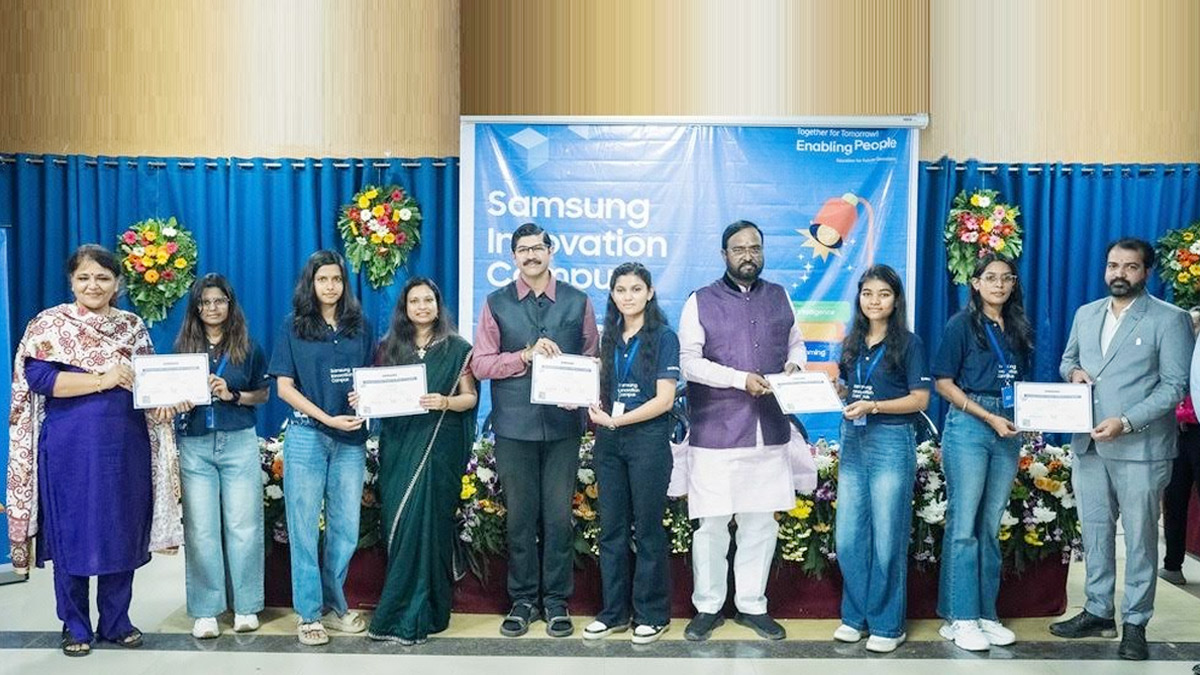
PUNE: Samsung has put 1,000 students in Maharashtra through a certified training programme in artificial intelligence and coding, the largest such drive the South Korean electronics company has run in the state and a signal that corporate India’s skilling ambitions are moving well beyond the boardroom brochure.
The certifications were awarded under Samsung Innovation Campus (SIC), the company’s flagship corporate social responsibility programme, which launched in India in 2022 with the stated aim of democratising access to future-technology education. The 1,000 graduates were drawn from four institutions: 127 from Savitribai Phule Pune University, 373 from Pimpri Chinchwad University, 250 from D.Y. Patil University’s Ramrao Adik Institute of Technology and 250 from Anjuman-I-Islam’s Kalsekar Technical Campus. All completed training in either AI or coding and programming, the two disciplines Samsung has identified as the critical pillars of the digital economy.
The programme does not stop at technical training. Soft-skills development and career-readiness modules are baked into the curriculum, a deliberate attempt to close the gap between what universities teach and what employers actually want.
“India’s digital growth story will ultimately be shaped by the quality of its talent pipeline,” said Shubham Mukherjee, head of CSR and corporate communications at Samsung Southwest Asia. “As technologies like AI move from the periphery to the core of industries, skilling must evolve from basic training to building real-world capability. This milestone in Maharashtra reflects how industry and academia can come together to create a future-ready workforce that is both globally competitive and locally relevant.”
The Maharashtra drive sits within a rapidly scaling national effort. Samsung Innovation Campus trained 20,000 young people across India in 2025, hitting its stated target for the year. Women account for 48 per cent of national enrolments, a figure the company cites as evidence of its push for an inclusive technology ecosystem. The programme is implemented in partnership with the Electronics Sector Skills Council of India and the Telecom Sector Skill Council.
Samsung, which is marking 30 years in India this year, runs SIC alongside two other initiatives, Samsung Solve for Tomorrow and Samsung DOST, as part of a broader effort to build what it calls a generation of innovators with both the technical depth and the problem-solving mindset to thrive in a fast-moving digital world.
A thousand certified students is a tidy headline. Whether they find jobs that match their new skills is the harder question, and the one that will ultimately determine whether corporate skilling programmes like this one are genuine pipelines or well-photographed gestures.






