MAM
Improving corporate reputation through enhanced reporting


MUMBAI: The 8th edition of the AR (Annual Report) Conclave, a signature event by AR Insight & ReportInsights took place at India’s commercial capital – Mumbai on 14th February 2019. The conclave witnessed the convergence of 200+ corporate reporting authorities and enthusiasts at a day-long event, that concluded with the launch of the world’s first ever coffee table book on annual reports, #trendsetters. The event was split into two parts, day-deliberation and evening-celebration.
Day-deliberation: The first part of the conclave witnessed a battery of 22 proven authorities deliver 4 keynote addresses and 3 panel discussions. The speaker galaxy included Mr. Nilesh Shah, Prof. R Narayanaswamy, Mr. Shriram Subramaniam, Mr. Sandeep Parekh, Mr. Nagesh Pinge, Mr. Prasanna Sankhe, Dr. Aditi Haldar, Ms. Beroz Gazdar, Mr. Kaushal Sampat, Mr. Makarand Lele, Mr. Naresh Patil, Mr. Nikhel Kochhar, Mr. Pramod Joshi, Mr. Prathmesh Raichura, Mr. R. Kannan, Ms. Roma Balwani, Sairam Prabhu Vedam, Mr. Shankar Jaganathan, Mr. Sudip Bandyopadhyay, Mr. Suhas Tuljapurkar, Dr. Y.K Saxena and Mr. Pravin K. Ujjain who spoke on three critical aspects; corporate governance, annual reports and sustainability.
Delivering the opening remarks, Chief Guest – Nilesh Shah, Managing Director of Kotak Mahindra AMC (Asset Management Company) said, “As a community we need to come together, the accountants, the auditors, the rating agents, the investors and the regulators where we have appropriate standards, appropriate governing mechanisms and appropriate punishments. I look forward to this conclave spreading awareness on truthful corporate reporting and we could usher in an era where all the accounting balance sheets can be trusted at their face value.”

Two highlights of the daylong conference were ‘Crystal Gazing Annual Report 2024’, where the panelist emphasized the role of storytelling, innovation and digital content curation to make future annual reports more engaging, crisp and objective; and ‘Business Case of Sustainability Reporting’, the session that emphasized the need for integrating environmental and social performance of a company along with its financial performance.
Evening-celebration: The second part of the conclave started on a much fashionable note with the launch of world’s first ever Coffee Table Book on Annual Reports, #trendsetters. The Coffee Table Book celebrates the trendiest annual reports released by Indian companies between a five-year period of 2014 and 2018. A visual treat that has been curated from a seemingly as mundane and uninspiring corporate document called annual report presents creative masterstrokes that Indian annual report designers and writers have delivered against all odds. #trendsetters acknowledges top-100 Indian companies for trendiness of their annual reports. Mid-cap and small-cap companies outsmart their large-cap counterparts in this unique list, highlighting their extra efforts in weaving extra stickiness and engagement value in their annual reports.
Unveiling the coffee table book, #trendsetters, Indian Annual Reports: 2014 -2018, evening session Chief Guest- Dr. Mukund Rajan said, “It is a new concept and I am delighted to be a part of such an innovation. AR Conclave has managed to revolutionize itself and the reporting world each passing year.”
Elaborating on the vast subject of the conclave Mr. Rajan also shared his views on ESG (Environment, Social and Governance), “Looking at the ESG what we noted was the need and opportunity for higher ESG standard in India is enormous. We constitute around 18% of the world’s population and are one of the most important geographies for the fulfillment of United Nations Sustainable Goals. We need new focus on ESG to offer a new and much needed mantra for sustainable investing and better returns for our investors. We have taken around 20 trillion dollars of funds that are backing an ESG approach. It is one of the fastest growing equity and there is strong and growing research that demonstrates strong correlation between ESG investment and good returns for investors.”
Expressing his gratitude on successful staging of 8th AR Conclave, CEO – AR Insight cum Managing Editor – ReportInsights, Mr. Pravin K Ujjain said, “What is heartening to note is that AR Insight has created an aspirational industry benchmark by instituting the AR Conclave. We are delighted and humbled to have put together the 8th edition of the AR Conclave for the entire corporate fraternity and are thankful to everyone who has joined us at the conclave. The Indian annual reports have made the sharpest improvement vis.a.vis. their western counterparts in the last 8 years and AR Conclave and our various research and rating publications have made their own contribution in catalyzing this change.”
He added, “After a successful conclave this year, we will be back with a new set of eclectic speakers and promise to deliver one of the most insightful and interactive conference next year. “
The AR conclave was a starry affair which brought together the crème de la crème of the corporate world. The event ended on a cheerful note with happy faces all around and a plenty of key takeaways for India Inc. to further improve their annual reports.



MAM
India’s financial sector spent less on TV ads in 2025 but flooded the internet
Banks, insurers and lenders cut tv ads as digital jumps, LIC and Muthoot lead tv and Axis Bank tops online
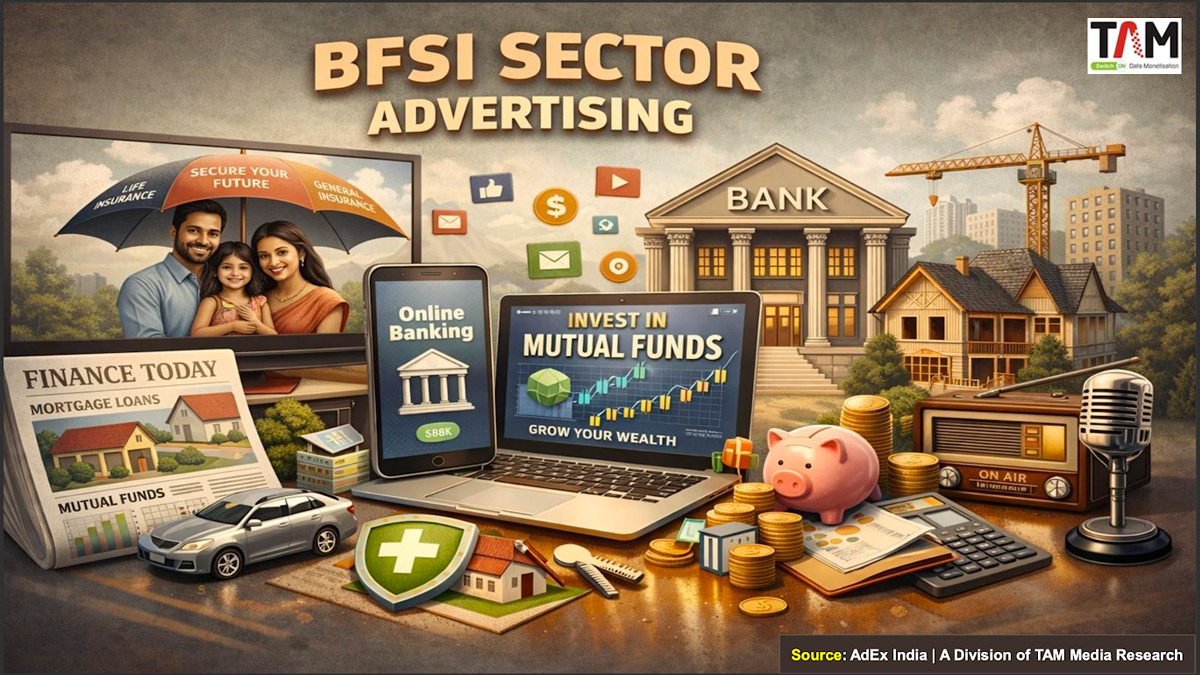
MUMBAI: India’s banking, financial services and insurance sector, one of the most prolific advertisers in the country, delivered a split verdict on media in 2025. It spent less on television, held its nerve in print, turned up the volume on radio and deluged the internet with a ferocity that left every other medium looking pedestrian. The picture that emerges from TAM AdEx’s cross-media report for the BFSI sector is of an industry in transition, still wedded to the news bulletin but increasingly seduced by the algorithm.
Television: a retreat with caveats
TV ad volumes for the BFSI sector fell 16 per cent in 2025 compared with 2024, a sharp reversal after two years of consistent growth that had pushed volumes 16 per cent above 2021 levels by 2023 and a further 7 per cent higher by 2024. Within 2025 itself, the drop was concentrated in the middle of the year: the second and third quarters saw ad volumes slide 35 per cent each against the first quarter, with a partial recovery of 13 per cent in the fourth.
The retreat did not reshuffle the deck. Life insurance retained first place among TV categories with 19 per cent of ad volumes, mortgage loans held second with 16 per cent, and the top ten categories together accounted for 82 per cent of all BFSI television advertising. The dominance of news channels was equally pronounced: news claimed 68 per cent of ad volumes, general entertainment channels a distant 14 per cent and movies 12 per cent. Together, news and GEC captured 82 per cent of the sector’s television spend. News bulletins alone took 48 per cent of programme-genre volumes, with feature films second at 12 per cent. Prime time, between 6pm and 11pm, drew 34 per cent of ad volumes, followed by afternoon at 22 per cent and morning at 20 per cent. A full 82 per cent of all ads ran between 20 and 40 seconds.
Life Insurance Corporation of India was the sector’s biggest TV spender with 11 per cent of ad volumes. Muthoot Financial Enterprises came second with 9 per cent, followed by National Payments Corporation of India at 6 per cent, Tata AIG General Insurance at 5 per cent and State Bank of India at 5 per cent. The top ten advertisers together accounted for 51 per cent of total TV volumes. Three names were new to the top ten in 2025: Tata AIG General Insurance, IIFL Finance and Tata Capital. At brand level, Muthoot Finance Loan Against Gold led with 9 per cent share, Tata AIG Health Insurance entered the top ten for the first time, and the top ten brands together contributed 35 per cent of ad volumes.
Print: the long climb continues
Print told a different story. Ad space for the BFSI sector has grown every year since 2021, rising 16 per cent in 2022, 30 per cent in 2023, 51 per cent in 2024 and 64 per cent in 2025, all measured against a 2021 baseline. Within 2025, ad space was flat in the second quarter but surged 46 per cent in the third and 33 per cent in the fourth compared with the first. Life insurance led print categories with 21 per cent of ad space, followed by mutual funds and banking services and products at 13 per cent each, and corporate financial institutes at 11 per cent. The top ten categories together took 82 per cent of print ad space. LIC led print advertisers with 6 per cent share, and the top ten together covered just 19 per cent of ad space, a reflection of how fragmented print spending remains. Three new entrants joined the top ten in 2025, with Billion Brains Garage Ventures the only exclusive presence not seen in 2024’s list. In the top ten brands, LIC dominated with a 2 per cent share, while Nippon India Mutual Fund rose to third position from fourth in 2024. English accounted for 62 per cent of print ad space, Hindi for 20 per cent. Business and finance publications took 59 per cent of the genre split. The south zone led regional spending with 33 per cent of print ad space, Bangalore topping that zone, while New Delhi and Mumbai were the leading cities nationally.
Radio: louder than ever
Radio ad volumes for the BFSI sector have climbed steadily, rising 12 per cent above 2021 levels in 2023, 36 per cent in 2024 and 45 per cent in 2025. The quarterly pattern within 2025 was volatile: a sharp drop of 43 per cent in the second quarter and 42 per cent in the third, followed by a near-full recovery in the fourth. Life insurance led radio categories with 22 per cent of volumes, banking services and products second at 14 per cent and corporate NBFCs third at 11 per cent. LIC of India held its position as the leading radio advertiser with 20 per cent of ad volumes; the top ten radio advertisers together covered 69 per cent. Muthoot Financial Enterprises led radio brands with 10 per cent share, five of the top ten brands belonged to LIC alone, and SBI Mutual Fund made a remarkable leap to fifth position from 272nd in 2024. Evening and morning time-bands together captured 84 per cent of radio ad volumes, with evenings at 44 per cent and mornings at 40 per cent. Maharashtra was the leading state for radio BFSI advertising with 18 per cent share; Maharashtra, Gujarat and Uttar Pradesh together accounted for 43 per cent.
Digital: the five-times surge
If one number defines the 2025 BFSI advertising story, it is five. Digital ad impressions for the sector multiplied fivefold between 2021 and 2025, having already doubled in 2023 and doubled again in 2024 before the 2025 leap. Within the year, impressions dipped 19 per cent in the second quarter and 12 per cent in the third before recovering 8 per cent above the first quarter by the fourth. Banking services and products led digital categories with 27 per cent of impressions, life insurance and credit cards tied at 19 per cent each, and securities and sharebroking organisations fell from first place in 2024 to fourth in 2025. Axis Bank was the runaway leader among digital advertisers with 12 per cent of impressions, followed by ICICI Bank at 9 per cent, IDFC First Bank at 7 per cent and Kotak Mahindra Bank at 6 per cent. The top ten digital advertisers covered 59 per cent of impressions, and seven of them were new entrants compared with 2024, signalling rapid churn in the digital spending hierarchy. At brand level, Axis Bank led with 9 per cent, ICICI HPCL Super Saver Credit Card vaulted to third place from 921st in 2024, and six of the top ten digital brands were new to the list. Programmatic buying accounted for 91 per cent of all digital BFSI transactions; combined with ad networks, it captured 96 per cent.
The data from TAM AdEx paints the portrait of a sector that still believes in the power of the television news bulletin to sell insurance to the masses, but increasingly knows that the next generation of borrowers, investors and cardholders is scrolling, not watching. The race is now on to reach them before the algorithm serves up someone else’s loan offer first.






