Ad Campaigns
IFC, Karo Sambhav launch “E-waste Hum Le Jayenge”

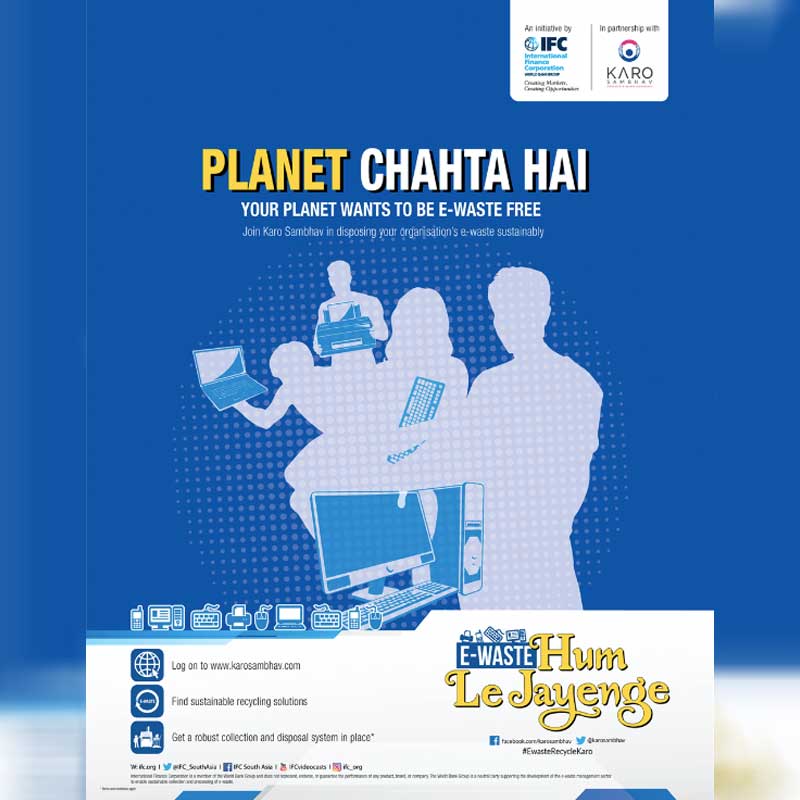
MUMBAI: International Finance Corporation, a member of the World Bank Group, and Karo Sambhav, a tech-enabled Producer Responsibility Organization (PRO), have collaboratively launched a consumer awareness campaign titled ‘E-waste Hum Le Jayenge’.
The campaign has been designed by J Walter Thompson and aims to create top-of-the-mind recall by building relevance for Indian consumers while providing a clear call-to-action to dispose e-waste responsibly through e-waste collection channels set up by Karo Sambhav.
J. Walter Thompson, Delhi managing partner Joy Chauhan said, “E-waste management is a complex ecosystem with multiple stakeholders, involved in the generation of e-waste and its unsafe disposal. Our campaign’s objective was to cut through all segments in a way that is simple to understand and easy to follow. To resonate with all the different stakeholders and the public at large, and to reframe the technology/environment conversation in order to make it more exciting, more relevant and more engaging – we took to pervasive cinema culture of India. We believe it would help create a positive dialogue for the program and bring the issue to fore.”

Karo Sambhav founder Pranshu Singhal said, “Discussions on e-waste management have largely been confined to experts and industry stakeholders and it is yet to become a mainstream topic. We need to engage creatively with people and drive long-term behavioural shifts. This campaign aims to build an e-waste movement in India.”
IFC’s India E-waste Program program manager Sarina Bolla said, “E-waste is the fastest growing waste stream globally; building awareness about proper management of e-waste is essential to meeting our goal of building a sustainable long-term solution for India. The campaign will engage with multiple stakeholders to change how we address the current challenges in this sector.”
The campaign will be promoted through digital, social media, and radio platforms to create widescale awareness around responsible and effective e-waste management across the country. The campaign will engage with individual consumers, bulk consumers (universities, corporates, etc.) and policy makers so that all stakeholders in the ecosystem can collectively address the e-waste crisis. The campaign will be initially promoted in Delhi, Chandigarh, Bengaluru, and Chennai and will be adapted in four languages (Hindi, English, Kannada, and Tamil) during the outreach.
During the build-up to the campaign, a consumer immersion was undertaken amongst multiple stakeholders involved in creating, hoarding, and collecting e-waste. It was observed that not only was awareness of e-waste management low but it also was fascinating to discover that people had an unsullied mindset, where they didn’t realise they were doing anything wrong by not disposing off e-waste responsibly. We needed an approach that would make people want to participate in the cause, create an intent to mend their ways and be more conscious of the right way to dispose of.


NATIONAL: Amazon Ads has laid out a sharply tech-led vision for the advertising industry in 2026, arguing that artificial intelligence, streaming TV and creator partnerships will combine to turn brand building into a more precise, performance-driven business.
At the heart of the shift, the company says, is the fusion of AI with Amazon’s vast trove of shopping, browsing and streaming signals, allowing advertisers to move beyond blunt reach metrics to campaigns designed around real customer behaviour.
“The future of advertising is not about reaching more people, but the right people with messages that resonate,” said Amazon Ads India head and vice president Girish Prabhu. “By combining AI with deep customer insights, we help brands move from broadcasting campaigns to having meaningful conversations wherever audiences spend their time.”
One of the biggest changes, according to Amazon Ads, will be the collapse of the wall between media planning and creative development. Retail media, powered by first-party data, is increasingly shaping everything from brand discovery to final purchase, pushing marketers to design campaigns around audience insight rather than internal instinct.
AI is also moving from a support tool to a creative engine. Agentic AI, which automates and accelerates production, is expected to make high-quality creative accessible even to small businesses, compressing weeks of work into hours and giving challengers the ability to compete with larger brands on speed and scale.
Behind the scenes, AI-driven analytics will take on a bigger role in campaign optimisation, identifying patterns, spotting opportunities and recommending actions that would previously have required teams of analysts.
Streaming TV is another big battleground. With India’s video streaming audience now above 600 million and connected TV users at 129.2 million in 2025, advertisers are set to treat streaming not just as a branding channel but as a performance engine, measured increasingly by sales, sign-ups and bookings rather than just reach.
Finally, Amazon Ads sees creators and contextual advertising reshaping how brands tell stories. Creators will act less like influencers and more like long-term partners, while scene-aware ads on streaming platforms will allow brands to insert hyper-relevant offers into the flow of what viewers are watching.
Taken together, Amazon Ads argues, these shifts mark a move towards advertising that is both more human and more measurable, where AI handles the complexity, and creativity does the persuading.







