Brands
IBS: Building the MarTech stack for digital India

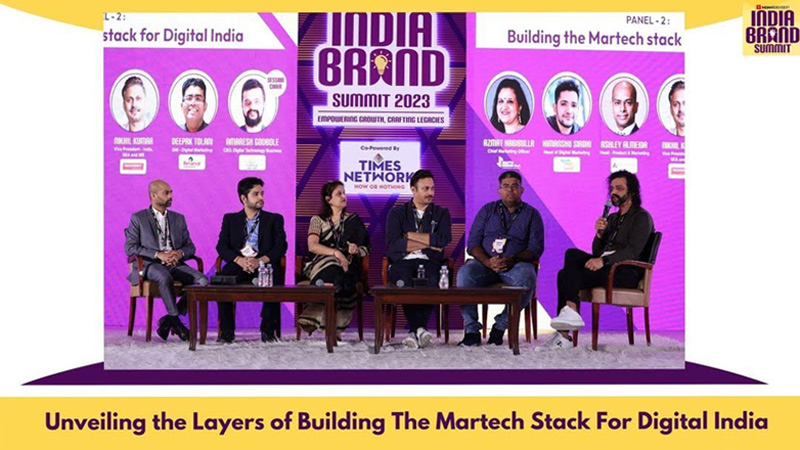
Mumbai: The India Brand Summit held on 28 November 2023 at The Lalit Mumbai, convenes leaders, marketers, entrepreneurs, and experts to explore current trends, challenges, and opportunities in the dynamic brands and marketing arena.
The session focuses on the implementation of marketing technology (MarTech) to drive digital transformation in India. The session delves into how organisations are leveraging Martech tools and strategies to navigate the digital landscape and connect with consumers in a rapidly evolving technological environment.
The key highlights of this session are: To explore Martech stack components, reaching India’s diverse population, personalised experiences, challenges, competing with larger players, and aiding digital transformation in businesses.

The panel moderated by Publicis Groupe India CEO, digital technology business Amaresh Godbole had panelists including South Indian Bank CMO Azmat Habibulla, Apollo 24|7 head of digital marketing Himanshu Sirohi, Axis Securities head – product & marketing Ashley Almeida, mediasmart VP – India, SEA and ME Nikhil Kumar and Reliance Retail GM digital marketing Deepak Tolani.
The session began by Godbole asking a question to all the panellists, “Given the evolution that we’ve seen with the MarTech world over the last decade, how have you seen the investment drive? how has it changed your life? What is the single biggest benefit that you’ve seen from you MarTech stats? How has it changed you as a marketeror the program that you take and what are the challenges there is?”
Tolani said, “The concept of MarTech itself is so new. A lot of people are actually not familiar within the system of what MarTech is. So I think, we need to have more of making this a non-jargonish kind of a thing and let the entire organisation know. Because when you are actually talking about MarTech and its implementation while you can get the best of the best tools onboarded. The most critical part is how it is getting used and how the data is actually getting collected. Then if the data is getting collected cleanly in a manner in which will help you. That’s when the MarTech could actually be utilised. So I think as marketers our role has become to be more of people who are actually spokesperson for how you go and adopt technology and make it easy for adoption within the organisation. Whether it is a supply chain who has their own systems, or it is the operations at the stores, or it is whether it is your end delivery logistics partner who is actually handling over the product to the customers. I think for us, the role as marketers has become how do you ensure that people are not afraid who this entire MarTech. It’s something that will help business become more efficient, help better conversation and also ensure that it will give insights which may not be available five or ten years back. So I think it’s very important for us to educate the entire environment inside our organisations.”
Thereafter Kumar said, ”Marketing and technology coming together in a short form word which is cool and we’re having a panel today celery talks how we’ve evolved. I think technology is going to play a role not just today but in the future and how its evolving is where we need to put our focus on. I represent an organisation which started as an SMS organisation. Today we’re one of the world’s leading global Ad-tech companies.”
He then went on to talk about the evolution from single screen, SMS once being the best way to reach consumers to smart screens and all these giving birth to technologies. He then added saying, “As a marketer myself, I think every marketing insight comes from a consumer or from a need generated by the consumer or just the need of the current hour. I think that’s where MarTech is heading.”
Slightly changing the question for Azmat Habibulla, Godbole asked, “How is MarTech playing a role in marketing for banks?”
To which Habibulla replied, “In the earlier days there was no concept of MarTech and now nothing can be done without technology. We’re all living in a technology advanced world. What MarTech does for all brand in generali: you get all your customer data in one place which becomes a central data repository. It was never the case earlier. We had lot of data silos and every channel was a separate channel, not even talking to each other. This is the biggest advantage that I feel of MarTech today is. The level of personalisation and sub segmentation that you can do. You can talk to very specific cohorts and personas and do highly personalised communication. All this is only because of the MarTech technology that exists today. Banking is a very very regulated industry. Fortunately there is lots of security and processes around data which helps BFSI. Being regulated really helps us and the way we collect data from customers as in consent driven, be transparent, what will be the use of the data, etc, all of these goes into building trust. When it comes to the trust that a customer has with a brand: it’s attached to personalisation; it’s attached to data security. Thanks to MarTech.”
Thereafter, Sirohi said, “Now if you breakdown MarTech into 3 core elements, one of the biggest element would be a customer 360° view. You have data coming into all kinds of engines. It can be a back-end engine which is upper order, which is created 10 years back. It could be a new engine like an app supplier or Adobe Analytics or a Google Analytics where you’re tracking data and it’s a very new age engine. How do you get data across all of these traditional landing sources and create that customer 360° view? That is one very, very important part of MarTech, which again to a lot of degree has been solved by a lot of new age market getting stacks. The second aspect what I would call is hyper-personalisation. So personalisation 10 years back used to be many to one. I would have a customer cohort of maybe thousands of users and I would probably send an e-mail, SMS or a push to that entire cohort. Now that is big-time award. Now it’s very one-to-one. You can have all those variables coming out of that customer’s 360° view and you can personalize everything the way you want to.
The third aspect is real-time campaign orchestration, real time campaign orchestration across channels. Now you have the customer 360° view. You know what to probably send to the customer. How do you personalize it. Now the third aspect is how do you kind of send it to the user across multiple channels in a profitable manner so that there is no fatigue via your communication and you orchestrate your campaigns in real time. Now 10 years back, I will tell you a use case, there was no way for doing that that now and at Apollo we do that use case almost day in and day out. We run one of the biggest key pharmacies in the country. Now imagine someone ordering in Delhi in winter and my customer 360° view telling me, ‘OK, this person ordered something is based out of Delhi. Should I send him/her an informative mailer or an offer around sub-interventions? Now imagine this person now moving to Bangalore and that e-mail, if this person opens in out of Bangalore, this e-mail is absolutely not relevant while all the data points suggested that this was the right e-mail to be sent to. Via our marketing stack, what we can do is when this individual opens their e-mail boxes, we capture the IP location. We send it back to our dynamic creative optimizer. Understand, OK which location is it coming from changing the creative on the go. So someone sitting out of maybe Delhi in winters would be seeing a different creative to someone sitting out of Bombay or Bangalore or Hyderabad. So these sort of interesting use cases kind of very, very interesting to us. Imagine sending someone an offer, a Diwali offer code and this individual opening that e-mail five days after Diwali. That offer and that e-mail is kind of waste to this individual now. But what you can do via these marketing stacks these days is, you can change the offer on the go. So if there is a date counter, you check it out and then you send a revised offer as per the latest trends or whatever is happening. So that I believe is a big, big play wherein one you can have all of the data in your system, you can create personalised offers or emails or products for this individual and on real time orchestrate, basis the location, time, segment. So that I think is very interesting for us in terms of marketing stacks.”
After which, Almeida went on to say, ”Three years back we realised that AI is going to be such a huge part in what we do. Therefore I upskilled myself and spent two years in learning AI, etc. The reason is, the name itself MarTech – marketing in tech. I think the tools are all there but I think the most important thing as marketers is how do I make it useful to the company and also useful to the consumer in the end. So this personalisation etcetera, but personalization also can mean, you know, personalisation at different levels for the industry that I’m in stockbroking, I’ve spent most of my time in stockbroking and I think the most important thing that people are looking for is getting something that is really relevant to them. In the stock market, it’s almost to the degree of one. We need to speak to each person individually because each need is so different. So how can you understand that user using his behavior and then give him something that he can use to make, you know, wise investment decisions? That’s where we really want to take MarTech to.”




Brands
ITC Sunfeast Farmlite launches Sugar Free Cookies range
New variants offer guilt-free indulgence for health-conscious snackers.

MUMBAI: ITC Sunfeast Farmlite is sweetening the deal for biscuit lovers who want to have their cookie and eat it too without the sugar. The better-for-you biscuits range from ITC Foods has expanded its portfolio with the launch of an all-new Sugar Free Cookies line, aligning with the company’s vision of ‘Help India Eat Better’. The range is designed for consumers who are rethinking sugar in their daily snacking but refuse to compromise on taste and indulgence.
The collection debuts with two tempting variants: Choco Nut Cookies and Hazelnut & Oats Cookies. Both are a source of protein and contain no trans-fat, while the Hazelnut & Oats variant is also lactose-free.
ITC Ltd. vice president (marketing), biscuits, foods division, Suraj Kathuria said, “At Sunfeast Farmlite, we believe mindful snacking should never come at the cost of indulgence. With this launch, we are catering to the growing need for guilt-free snacking while delivering a rich, satisfying cookie experience.”
ITC Ltd. vice president & head of food sciences for foods division Dr Shantanu Das added, “We have applied robust food science to develop cookies that are sugar-free while preserving the taste and texture consumers love.”
Each cookie comes in convenient single-serve packs to maintain texture and freshness. Both variants are available in 100g packs priced at ₹100 and can be found on quick-commerce platforms including Blinkit, Swiggy Instamart, and Zepto.
In a market increasingly leaning towards healthier choices, ITC Sunfeast Farmlite’s new Sugar Free Cookies prove that cutting sugar doesn’t mean cutting joy. For the health-conscious yet indulgent snacker, this could be the perfect bite-sized solution.






