Digital
How Working Professionals Are Using Online AI Courses to Switch Careers

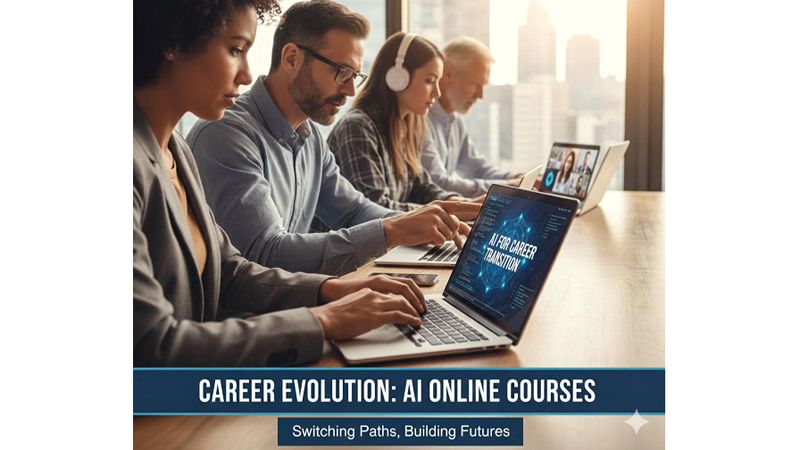
According to recent industry data, 90% of Indian professionals now view generative AI skills as critical for career growth, and 42% are actively seeking training or considering career pivots.
Working professionals are leveraging online AI courses to fundamentally transform their career trajectories, with a significant shift currently underway in the workplace landscape.
The key difference from traditional tech transitions is that these professionals are not learning programming languages. Instead, they’re mastering AI tools like ChatGPT, prompt engineering, and automation workflows to enhance their productivity and become invaluable to their organisations.

The AI Skills Gap: Why Now is the Perfect Time
Organisations across industries are racing to adopt AI, yet they face a critical problem: there aren’t enough skilled professionals who understand how to implement these technologies effectively. This creates a golden opportunity for working professionals who are willing to upskill.
Unlike traditional career transitions that require years of study and financial strain, AI learning for professionals is remarkably accessible. You don’t need to abandon your current job or go back to school.
You can learn at your own pace, apply what you learn immediately to your current role, and gradually position yourself for advancement or lateral movement into AI-focused positions.
According to Microsoft and LinkedIn’s Work Trend Index, 75% of knowledge workers are already using generative AI for work.
Workers using AI tools report saving approximately 5-6 hours per week on routine tasks, freeing up significant time for strategic work that actually matters.
Real Productivity Gains Translate to Career Value
When using ChatGPT for document writing, professionals completed tasks 59% faster while also improving the quality of their work. In practical terms, this means a professional who typically writes 17 documents in a workday could produce nearly 28 documents using AI assistance.
AI courses in Delhi are not just about acquiring random skills. You’re learning frameworks that apply directly to your industry. Whether you’re in marketing, finance, human resources, customer support, or operations, AI has specific applications that solve real problems in your field.
How Working Professionals Integrate Learning Into Their Schedules
The practical concern every working professional faces: where does this learning fit? The answer lies in the design of modern AI education.
Unlike traditional degree programs or bootcamps requiring full-time commitment, structured online AI courses for professionals operate differently.
Quality programs recognise that working professionals have existing commitments. They structure content in modular formats, offer flexible pacing, include asynchronous learning options, and provide practical projects you can work on alongside your current job.
Many professionals report dedicating 5-10 hours weekly to learning while maintaining their full-time employment..
Why AI Courses Without Coding Matter
The historical barrier to tech careers was coding. It required distinct cognitive skills, extended learning periods, and often felt alien to professionals from non-technical backgrounds. This barrier created the “tech career vs. everything else” divide.
No-code AI courses have democratised AI education in a meaningful way. You can genuinely develop professional-grade AI capabilities without learning Python or Java.
You can architect sophisticated workflows, interpret complex data analysis, and lead AI implementation projects while remaining fundamentally non-technical.
This matters because it means your existing professional experience becomes an asset rather than a liability. Your domain knowledge in marketing, finance, HR, or operations?
That’s precisely what these AI projects need. The learning curve focuses on AI-specific concepts rather than programming fundamentals.
Common Fears and What Actually Happens
“I’m too old to learn new technology” — Yet many professionals in their 40s, 50s, and beyond are successfully making this transition. Age brings advantages: deeper business understanding, existing professional networks, and clearer perspective on what problems matter most.
“I don’t have the technical background” — This is precisely why no-code AI courses exist. Hundreds of thousands of non-technical professionals now have meaningful AI skills. Your background in marketing, sales, operations, or customer service is actually valuable context for AI work.
Frequently Asked Questions
Q: Do I really need to learn programming to become proficient in AI?
A: Absolutely not. While some AI roles require programming, a significant and growing portion don’t. No-code AI platforms, prompt engineering, workflow automation, and business analysis roles don’t require coding knowledge. Many working professionals advance into high-value AI roles without ever writing a line of code. Your professional domain knowledge is often more valuable than programming ability.
Q: How long does it typically take to develop job-ready AI skills?
A: Most working professionals develop foundational AI competency in 2-3 months with consistent effort. Building specialised expertise and a portfolio of real projects typically takes 4-6 months of focused learning while working. The timeline depends on your starting experience level, how much time you invest weekly, and your specific career goals. The advantage is you don’t need to wait until you’re “done learning” to add value—practical skills become immediately applicable.
Q: Will learning AI actually improve my career prospects?
A: The evidence strongly suggests yes. Nearly 90% of Indian professionals view generative AI skills as critical for career growth. Organizations are actively seeking professionals who understand both business problems and AI solutions. Many professionals report promotions, salary increases, or better opportunities within 6-12 months of developing AI skills. The scarcity of AI-capable working professionals means those who acquire these skills are in high demand.






Digital
AI drives 92 per cent surge to 15M views across India’s open web
Taboola data shows rising AI curiosity reshaping digital consumption trends
MUMBAI: Artificial intelligence is fast becoming the internet’s favourite topic in India, with fresh data showing a sharp spike in audience interest across the open web.
Insights from Taboola’s Taboola Newsroom reveal that AI-related content generated more than 15 million pageviews over the past 90 days, marking a striking 92 per cent jump compared to the previous 45-day period. The surge signals a clear shift, with AI moving from niche tech chatter to mainstream digital curiosity.
The broader technology category is also seeing momentum, clocking around 1.7 million pageviews and a 27 per cent rise in engagement. However, much of that growth appears to be riding on the AI wave, as developments in artificial intelligence increasingly dominate tech narratives.
Within the AI ecosystem, newer players are quickly capturing attention. Content linked to Anthropic alone drew roughly 2.5 million pageviews, registering a dramatic 2,096 per cent surge. The spike reflects growing interest in alternative AI models and emerging competitors in the space.
Meanwhile, familiar names continue to hold steady ground. Coverage around ChatGPT generated about 1.2 million pageviews, underlining sustained curiosity as users explore practical applications, updates, and everyday use cases for generative AI tools.
Big Tech is firmly in the spotlight too. Content related to Meta attracted approximately 2.2 million pageviews, up 30 per cent, as audiences track its expanding role in AI infrastructure and innovation.
Taken together, the data points to a deeper shift in how audiences engage with AI. Interest is no longer tied only to big announcements but is evolving into a steady stream of exploration around tools, platforms, and real-world uses.
For publishers, this opens the door to richer storytelling through explainers and practical insights. For advertisers, it presents a chance to tap into a highly engaged, tech-savvy audience.
If the numbers are anything to go by, AI is not just part of the conversation anymore, it is leading it.