MAM
GUEST COLUMN: What marketers will need to learn about voice and audio


New Delhi: A renowned Content and Marketing Strategist, Lee Odden says “Content isn’t the king, it’s the Kingdom”.
In a world of digitization and technological advancements, there are certainly no bounds to evolution in any industry. And, the content space is one such area that has seen a major evolution in the marketing landscape, especially in the audio space.
Audio messaging has been around for a long time but the approach and outlook towards it has changed over the years. Consumer’s interests keep changing and their form of convenience too. Earlier, people were dependent on the radio for entertainment and news, and then TV took over the role. And now audio is back as the preferred medium of content consumption.

With technological advancements and the demand for convenience, audio has become the forerunner in not only the marketing world but also in our regular lives.
Audio – An old form of communication gaining popularity in modern times
Audio holds great prominence in the world of social media and digital marketing. The audio-only feature has the power to eliminate all the distractions that are usually faced by a consumer consuming content on a visual medium, thus improving their attention span.
With busy lifestyles and hectic schedules, people prefer consuming information or experiencing entertainment on the go. Tuning in to a podcast or live audio session on your topic of interest while driving, is a preferred option than being glued to TV and laptop screens or mobile screens for consuming the same information. Be it in a car, or at a gym, or in a public vehicle, access to an audio form of information and entertainment has become convenient. Audio mediums allow a consumer to consume content with ease while multitasking. It allows them to listen to their favourite audiobooks or podcasts while walking, cooking, doing laundry, or traveling.
Voice-based technology – A better companion or convenient dependency?
Audio mediums offer highly immersive experiences, and also make us perceive the depth of emotions. We all still have the voice of Vidya Balan’s ‘Good Morning, Mumbai’ from the Munnabhai MBBS movie playing fresh in our ears. It is this connection created by audio mediums with characters and hosts, which has led to the rise of the podcast wave and voice-based technology hardware.
Consumer behaviour has evolved over the years, and there is an innate desire to adopt a relaxing and luxurious lifestyle. This explains why consumers opt for more enhanced sound systems at home for a theater-like experience to an increased dependency on virtual assistants. ‘Alexa, switch on the lights’ or ‘Hey Google, Play the latest music tracks’ has become a more convenient way of getting work done.
Voice-controlled devices also provide a personalized experience, and marketers as well as brands and businesses use voice search interfaces to connect with consumers. Whether it is voice assistant applications or smart products like smart TV and speakers, voice search has great significance.
Types of Voice Marketing tactics:
● Sonic Branding – Sound and music have a recall factor. Audio branding will be common and marketers will be seen creating audio logos to create a unique audio identity for audio-based content and to strengthen brand recognition, like the Nokia’s ringtone or Nirma’s iconic “washing powder Nirma”.
● Podcasts – The wave of podcasts has created a buzz. A few marketers have already created their market space with their branded podcasts, which have proven to be one of the highly engaging forms of audio marketing.
● Audiograms – Audiograms is the evolving fad and brands have started making the most of it by overlaying images with audio-based elements
● Voice Search Optimization (VSO) – The era of digital marketing saw brands market search engine optimization (SEO) based content for enhanced search results. With the evolution of search optimization, the voice-based search will be the next frontier, and voice traffic will soon be witnessed as an advantage for brands.
Future of Audio and Voice-based technology
The future of marketing will be based on voice recognition and audio formats. With more and more advancements in artificial intelligence and machine learning, we will soon see a revolution in the world of audio and voice-based technology. An increasing number of marketers and brands are using voice marketing tactics and using audio-based mediums to increase customer engagement.
This is the sole reason why there have been new players in the market that offer only audio and voice features. Even existing social media platforms have realized the need for audio and are evolving their platforms accordingly. Clubhouse disrupted the live social audio market and it has been phenomenally adopted by the Indian audience. Twitter Spaces has also gained popularity and seen an increase in user base. Facebook has also launched live audio rooms and Spotify has come up with Spotify Greenroom.
Voice and audio are certainly the future of social media and the digital world and can be leveraged by a country like India, where there are still limitations in context to writing. Audio content eliminates the barrier of writing appropriately and opens up a plethora of languages for a marketer to produce content for different audiences. Marketers now have an added advantage to reach a wider audience, which otherwise was restricted due to the limitations offered by visual mediums.
Hence, voice-enabled search and audio-based technology open a whole new dimension for marketers to bank on. It will be interesting to see how marketers leverage audio content and voice marketing strategies for brands to create a buzz in the market.
(Sowmya Iyer is the founder & CEO of DviO Digital. The views expressed in the column are personal and Indiantelevision.com may not subscribe to them.)






Brands
KKR sixes to power EV charger rollout under VIDA campaign
Cricket meets clean mobility as big hits spark India’s charging growth
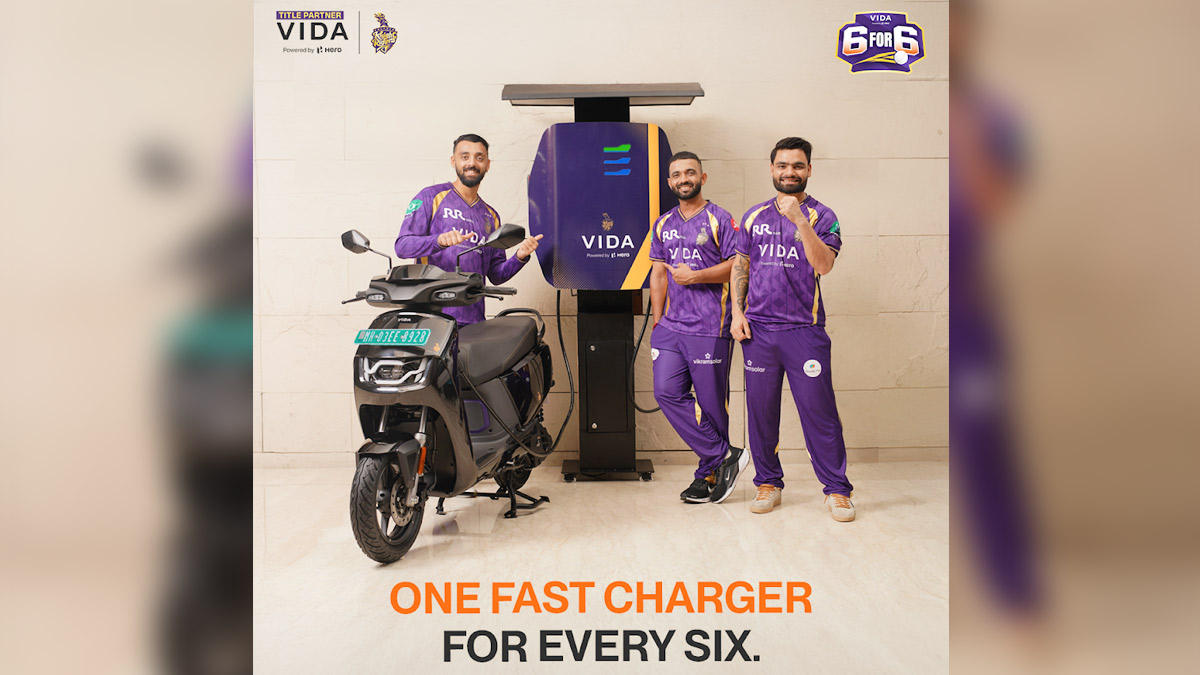
NEW DELHI: VIDA, the electric mobility arm of Hero MotoCorp, has teamed up with Kolkata Knight Riders to launch a campaign that turns cricketing flair into real-world impact.
Titled ‘6 for 6’, the initiative promises to install a 6kW fast EV charger for every six hit by KKR during the ongoing Indian Premier League season. The idea is simple but powerful, as each big hit on the field contributes directly to expanding India’s fast-charging infrastructure.
The campaign builds on VIDA’s growing network, which already spans over 5,300 fast-charging points across more than 430 cities. With EV adoption gaining pace, the brand is using cricket’s mass appeal to accelerate both awareness and infrastructure growth.
Explaining the thinking behind the move, Hero MotoCorp emerging mobility business unit chief business officer Kausalya Nandakumar said, “Cricket has an incredible ability to unite and inspire millions across the country. With the ‘6 for 6’ campaign, we are turning every big hit on the field into a step towards a cleaner and a more accessible mobility future.”
She added that VIDA’s expanding fast-charging network and removable battery technology are designed to make EV ownership more convenient and practical for everyday users.
From the franchise’s side, the campaign is also about giving on-field moments a larger purpose. Kolkata Knight Riders chief executive officer Venky Mysore said, “The ‘6 for 6’ campaign exemplifies the potential of sport as a platform for meaningful, real-world impact. By linking every six to the expansion of EV charging infrastructure, this partnership transforms fan excitement into tangible progress.”
As part of the rollout, VIDA has introduced co-branded charging stations in KKR’s signature colours, with a flagship installation unveiled alongside team players. The chargers are designed for quick top-ups, powering VIDA scooters from zero to 80 percent in about an hour, while also being positioned along key highways to support longer journeys.
The initiative also taps into VIDA’s removable battery system, which allows users to charge using standard household plug points, adding flexibility to the charging ecosystem.
By blending the thrill of cricket with the urgency of clean mobility, VIDA and KKR have found a neat way to make every six count twice, once on the scoreboard and again on India’s road to an electric future.








