MAM
GUEST COLUMN: The real content crisis is not writing, it is decision-making
As content creation accelerates, risk-averse approvals and stakeholder overload are quietly weakening creative outcomes


MUMBAI: The rapid evolution of content production has made speed and scale the new normal, but it has also exposed a less visible constraint within organisations. While teams today can create polished, publish-ready content faster than ever, the real challenge has shifted beyond execution to the decisions that shape what finally goes live. For Abhijeet Modi, founder of Beyond Words Writing, this gap between efficient creation and diminishing distinctiveness signals a deeper structural issue. In this piece, Modi examines how approval-heavy workflows, risk-averse decision-making, and consensus-driven processes are diluting creative impact, why more content is failing to stand out despite better tools, and what organisations must rethink to restore clarity, conviction, and memorability in their content strategies.
Over the last decade, content teams have quietly solved for production. What once took days or even weeks now happens within hours. Campaign copies are drafted faster, formats are standardised, and most teams have access to tools and processes that make execution far more efficient than before. From social media to long-form content, the ability to produce polished, publish-ready material has become widely accessible.
Yet, this improvement has not translated into stronger outcomes. Across media, OTT platforms, and digital-first brands, there is a noticeable gap between how efficiently content is being produced and how little of it actually stands out. More content is going live, but less of it is remembered. Engagement may still come in bursts, but recall and distinctiveness are steadily declining. This disconnect points to a deeper shift in how content is being created and evaluated inside organisations.

The constraint is no longer writing. It is decision-making.
The shift from execution to approval
Earlier, the primary challenge in content was getting the draft right. Writing required time, clarity of thought, and iteration. The quality of output depended heavily on the individual or team creating it, and that made writing the central bottleneck in most workflows. If the draft was weak, the outcome was weak. Improvement in writing directly improved results.
Today, that constraint has largely disappeared. Most teams are capable of producing competent, well-structured content at speed. What has taken its place is a different kind of bottleneck that sits further down the pipeline. The difficulty now lies in deciding what to say, how strongly to say it, and whether it is aligned enough to be approved.
This shift has changed the nature of content workflows. Drafts are no longer the hardest part of the process. Approval is. The path from idea to publish is shaped less by writing ability and more by internal alignment, stakeholder comfort, and perceived risk. As a result, the final output often reflects collective agreement rather than a clear, singular point of view.
Faster creation, slower progress
In industries like OTT and digital media, where content demand is constant, teams have become highly efficient at producing material quickly. Campaigns for show launches, platform promotions, and social engagement are executed with speed and consistency. The creation layer has adapted well to the pressure of always being active.
However, once a draft is ready, momentum slows down. Content enters review cycles that involve multiple stakeholders, each bringing a different lens to the same piece. Marketing, brand, legal, and leadership often contribute feedback, and while each input is valid in isolation, the combined effect tends to dilute the original idea.
A campaign that begins with a strong, distinctive angle often gets softened through successive revisions. Sharp language is toned down, bold statements are rephrased, and anything that feels slightly risky is adjusted. By the time the content is approved, it is structurally sound but strategically weaker. The system produces content that is correct, but not necessarily compelling.
The emergence of safe content
One of the clearest outcomes of this shift is the growing prevalence of safe content. This is content that meets all formal requirements. It is grammatically clean, visually aligned, and consistent with brand guidelines. It does not make obvious mistakes, but it also does not leave a strong impression.
In OTT marketing, for example, show promotions are executed with high production quality, yet the tonality across platforms often feels interchangeable. Different brands begin to sound similar because the decision-making process filters out anything that could create sharp differentiation. The same pattern can be seen in consumer brands, where messaging is refined but rarely distinctive.
This is not due to a lack of creative thinking within teams. It is a reflection of how decisions are made. When multiple stakeholders are involved, the safest version of an idea is usually the easiest to approve. Over time, this creates a pattern where content avoids risk and, in doing so, avoids memorability.
Iteration without direction
Another layer to this problem is the increasing number of iterations in content workflows. Feedback loops are longer and more frequent than before, which should ideally improve quality. In practice, however, these iterations often move the content sideways rather than forward.
Each round of feedback introduces small adjustments that make the content more acceptable to different stakeholders, but not necessarily more effective. Strong lines are moderated, distinct voices are neutralised, and clear positions are softened to maintain alignment. The intent behind these changes is to refine the content, but the outcome is often a loss of clarity.
Instead of sharpening the idea, iterations tend to average it out. What remains is a version that satisfies internal expectations but struggles to stand out externally. The process optimises for approval, not impact.
Decision fatigue and pattern dependence
As content volumes increase, teams are required to make a larger number of decisions across campaigns, formats, and platforms. Not all of these decisions receive the same level of attention, which leads to a gradual reliance on patterns and templates.
Previously approved language becomes a default. Formats that have worked before are reused. Ideas that require deeper discussion or carry higher uncertainty are often deprioritised because they slow down the process. This creates a cycle where content becomes easier to produce but harder to differentiate.
Over time, this pattern dependence reduces the range of expression available to a brand. Even when teams attempt something new, the decision system pulls it back toward familiarity. The result is consistency without distinction.
What is actually breaking
The issue is not a lack of capability. Most organisations today have stronger content teams than they did a few years ago. Writers are better trained, tools are more advanced, and workflows are more structured. The execution layer has evolved significantly.
What has not evolved at the same pace is the decision layer. The way content is evaluated, approved, and finalised still relies heavily on consensus and risk avoidance. This creates a mismatch where modern execution is constrained by traditional decision-making frameworks.
As long as this mismatch exists, improvements in writing quality will continue to have limited impact on outcomes. The system will produce more content, but not necessarily better-performing content.
Rebuilding how decisions are made
If decision-making has become the primary constraint, then improving content outcomes requires rethinking how decisions are structured within teams. This begins with clarity of ownership. When too many people are responsible for a decision, the final output tends to reflect compromise rather than conviction. Assigning clear ownership allows for stronger, more decisive outcomes.
There is also a need to distinguish between input and direction. Feedback is valuable, but not all feedback should shape the final output equally. Without prioritisation, content becomes a collection of edits rather than a coherent idea. Teams need mechanisms to filter feedback and preserve the core intent of the piece.
Another important shift is the willingness to take calculated risks. Brands that are remembered are rarely the ones that sound the most balanced. They are the ones that communicate with clarity and confidence. This does not mean being provocative for the sake of it, but it does require a conscious decision to avoid over-sanitising ideas.
Finally, approval processes need to be designed for both speed and intent. Reducing unnecessary layers, setting clearer evaluation criteria, and aligning stakeholders earlier in the process can help ensure that strong ideas are not diluted before they reach the audience.
Rethinking what quality means
Content quality today is often judged by how well something is written. While this remains important, it is no longer the defining factor. In an environment where most content meets a certain standard of execution, the real differentiator is whether it creates a lasting impression.
Does the content carry a clear point of view. Does it sound distinct from others in the category. Does it create a memory for the audience. These are the questions that matter more than grammatical precision or structural neatness.
Answering these questions requires stronger decisions, not just better writing.
A clear takeaway for industry stakeholders
For content leaders, the implication is direct. The next level of improvement will not come from refining writing processes further. It will come from strengthening decision-making frameworks.
Organisations that can move away from consensus-heavy approvals and towards clearer, conviction-led decisions will be better positioned to create content that stands out. In a landscape where execution has been largely standardised, distinctiveness becomes the only meaningful advantage.
And distinctiveness is not written into content. It is decided.
Note: The views expressed in this article are solely the author’s and do not necessarily reflect our own.

MAM
Allen Online releases new ‘Rise to the Top’ episode with MS Dhoni
Cricketing legend shares wisdom on second chances with NEET and JEE Advanced toppers.
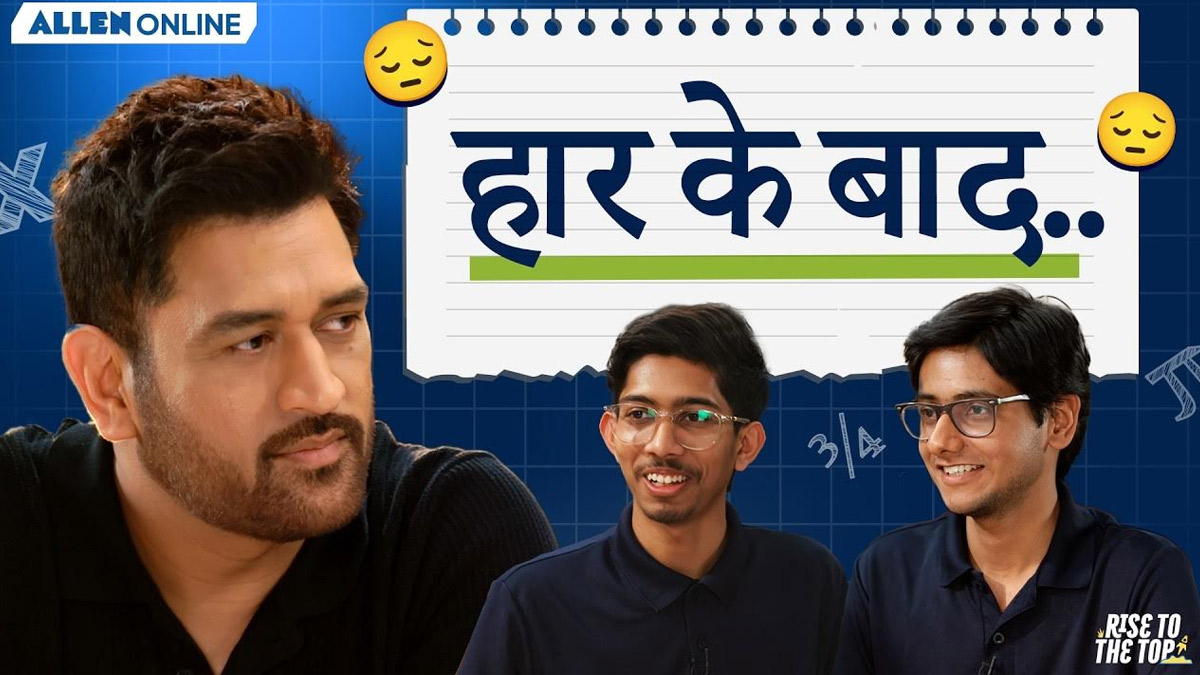
MUMBAI: When life gives you a second innings, even MS Dhoni knows the real game begins after you’re exhausted. Allen Online has released the fourth episode of its inspiring podcast series Rise to the Top, featuring former India cricket captain Mahendra Singh Dhoni in conversation with two determined students who cracked competitive exams on their second attempt.
Hemant Sharma from Bhiwani, Haryana, improved his NEET rank dramatically from AIR 29,284 to AIR 2,095 in just one year and is now pursuing MBBS at AIIMS Raebareli. Veeram Shah from Mumbai raised his JEE Advanced rank from AIR 8,068 to AIR 2,600 and is currently studying Mechanical Engineering at IIT Kanpur.
The episode, available on the Allen Online YouTube channel from 7 PM today, dives deep into what a genuine second attempt demands not just academically, but mentally and emotionally.
Hemant talks about rebuilding after a rank that haunted him, focusing only on his weak areas instead of starting from scratch. Veeram shares how he battled FOMO by quitting social media entirely and relying on one trusted friend while his peers celebrated college life.
When the students asked Dhoni about handling setbacks, the cricketing icon delivered a powerful message, “If life is giving you a second chance, then utilise it. Hard work counts only when you are fully exhausted… How much hard work you did after that, that defines you.”
Dhoni also spoke about treating criticism as useful information rather than judgement advice that resonated strongly with the students’ own journeys of stopping comparisons and focusing on self-improvement.
Through Rise to the Top, Allen Online continues to create a valuable platform where aspiring students can learn directly from role models about the mindset, discipline and resilience required to succeed in India’s fiercely competitive exam landscape.
In a conversation packed with candid stories and life lessons, this episode proves that second attempts aren’t just about trying again, they’re about rising stronger. Perfect timing for students gearing up for their own comeback stories.






