MAM
GUEST COLUMN: The harm that good ads do


Mumbai: If you want to greet somebody in the morning, two things are essential. First, you have to say ‘Good Morning,’ not ‘Good Night’ or ‘Good Afternoon.’ And second, you should say it pleasantly. If this combination goes haywire, you won’t get the other person to say ‘Good Morning’ to you, and with a smile.
What to say is the ‘strategy’. How to say is the ‘creative’. Effective communication is a perfect blend of content and presentation.
The job of strategy is to set the message right. And to do that, it has to get the objective right. It should be a precise and well-defined objective. The objective must be in terms of a shift in feeling with reference to the brand in question. And then, to achieve that, the specific message has to be precise like the tip of an arrow. Sharp.

A creative’s job is to say ‘Good Morning’ but in a way that is interesting and engaging. Saying it with a blank face and with a serious voice won’t cut any ice. At the same time, a creative cannot say ‘Good Night’ in the morning howsoever enchanting the way it is said in. Your audience will like the smile and the charm but won’t get that you wanted to greet them with a ‘Good Morning.’
When the strategy is right, it may be basic, it may be obvious, but if it is right, the job of the creative is to engage the audience in a powerful manner. And only an emotional approach can engage the audience in a powerful way. Emotions can be of any kind, including humour, which is one of the most powerful emotions used for communication.
Things start behaving like life when we forget this basic principle. When we create ads that are very engaging but they don’t say ‘Good Morning’ or ‘Good Afternoon,’ they might confuse people but in a very engaging and charming way. The road to disaster is paved with charming ads. God forgive them for they know not what they were supposed to convey.
And while they don’t communicate what they were supposed to, they obviously don’t get the right result, which is primarily contributing to the brand image and secondarily, helping sell the product. When the batsman doesn’t score the runs in spite of hitting some beautiful shots, the selectors start believing that those shots must not be used again. While the real culprit is the strategic miscalculation while executing these shots.
Clients start believing that since these charming ads aren’t working in the long run, charming ads don’t work. They don’t see the bigger picture and become wary of ads that are highly creative. And they go back to dull and boring ads which they believe work for the brand.
We need to understand and distinguish between four kinds of ads:
1. Boring ads based on wrong strategies.
2. Boring ads based on the right strategies.
3. Highly engaging ads based on the right strategies.
4. Highly engaging ads based on wrong strategies, and
No 1) Boring ads based on wrong strategies are certified and guaranteed disasters. Nothing can save them. Everything is wrong with them. Life looks quite pointless after watching them. Something immediately dies inside you.
No 2) Boring ads based on the right strategies are mediocre and will bring average results for the image. Look around, the world is full of them. These are donkeys walking in the right direction. But they are donkeys.
No 3) Highly engaging ads based on the right strategies are the darlings of the industry. Everybody wants them. Though, not everybody recognizes them. There is no debate on these. They build factories.
No 4) These are highly engaging ads based on wrong strategies. These are the good-looking villains which do the real harm. They are like ‘Asurs’ in the guise of ‘Apsaras’. Because of them, you don’t get the message right. They say “Good Evening” in a beautiful voice at 7 am, leaving the audience charmed, confused, and lost.
These ads give a bad name to the really good, charming, engaging, and creative ads. Clients become wary of all creative and clutter-breaking ads. Once bitten, twice shy. The Cred Rahul Dravid ad is the epitome of this category. Highly engaging and disruptive, but leave the audience asking “Arre kehna kya chaahte ho bhai?”
(Kapil Mishra is a brand and creative Consultant at Indiassetz, where he oversees the entire marketing, social media communication, and advertising. The views expressed in this column are personal, and Indiantelevision.com may not subscribe to them.)






Brands
CEAT signs Yashasvi Jaiswal as brand ambassador in multi-year deal
The tyre giant is backing one of Indian cricket’s brightest young stars, deepening a sporting association that goes to the heart of its brand strategy
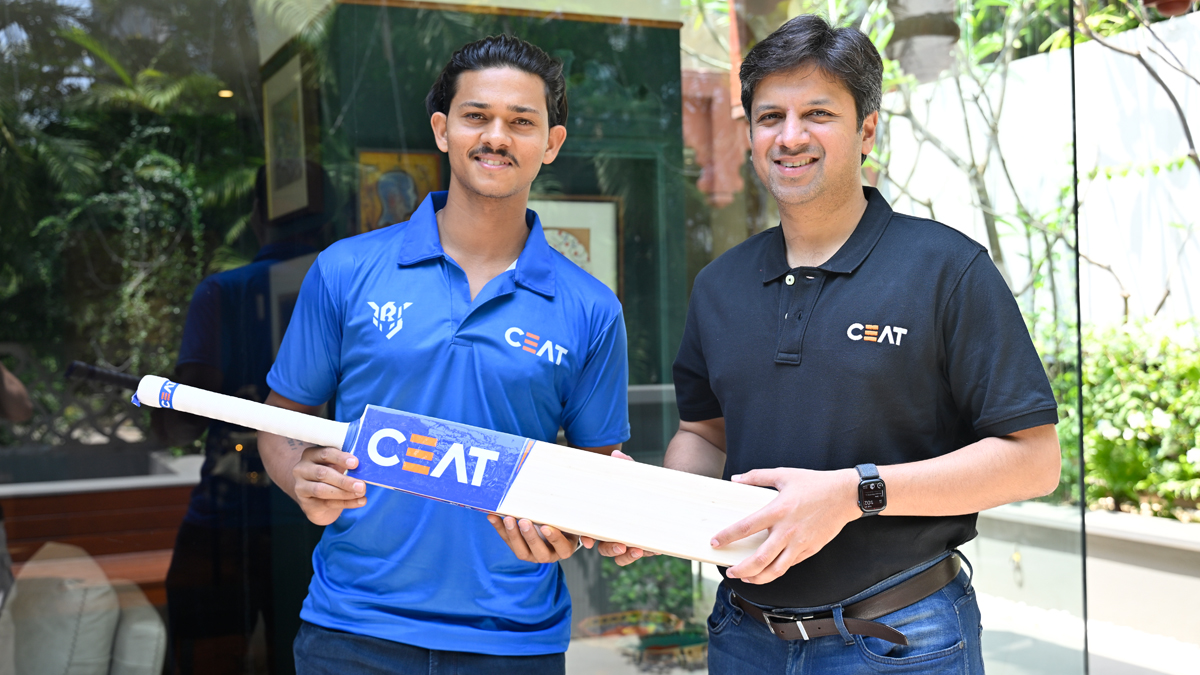
MUMBAI: CEAT Limited has signed a multi-year partnership with Yashasvi Jaiswal, one of Indian cricket’s most electrifying young batters, effective 1st April 2026. The deal adds fresh muscle to the Mumbai-based tyre maker’s long-running bet on cricket as its primary marketing canvas.
Jaiswal’s rapid rise in international cricket made him a coveted name in the sponsorship market. His composure under pressure, consistency across formats and an almost unnerving adaptability at the crease are precisely the qualities CEAT wants consumers to associate with its tyres. The brand has historically aligned itself with cricketers who embody control and dependability, and Jaiswal fits that template with little coaxing.
Anant Goenka, vice-chairman of RPG Group, framed the signing in the language of shared values. “Cricket has always been an integral part of CEAT’s brand journey, and we are delighted to welcome Yashasvi Jaiswal to the CEAT family,” he said. “He is one of the most exciting young talents in Indian cricket today, and the qualities he brings to the game — control, dependability and adaptability — align strongly with the values we stand for as a brand. We believe Yashasvi has the potential to lead across tournaments and formats in the years ahead.”
Jaiswal, for his part, was equally enthusiastic. “I am excited to begin this association with CEAT, a brand that has such a strong legacy in cricket and has been associated with several respected names in the game over the years,” he said. “It is always special to partner with a brand that shares your passion for cricket.”
CEAT, founded in Italy in 1924 and now the flagship company of the US$5.2 billion RPG Group, produces more than 41 million tyres a year and sells across 110 countries. It is the first tyre brand to receive both the Deming Grand Prize from the Union of Japanese Scientists and Engineers and the World Economic Forum’s Lighthouse Designation for its use of fourth industrial revolution technologies — credentials that suggest a company comfortable playing the long game.
And that, perhaps, is why Jaiswal makes such sense. He is 23, already a Test opener for India, and almost certainly just getting started. For CEAT, signing him now is less a sponsorship and more an investment — in a career, and in a cricket-obsessed market, that has plenty of overs left to play.






