MAM
Gruner + Jahr expands into New Delhi


MUMBAI: European media conglomerate Bertelsmann AG‘s publishing arm Gruner + Jahr opened is expanding its news corporate in New Delhi to cater the needs of recently acquired companies, MaXposure Media Group and Networkplay.
Gruner+Jahr‘s entered India in 2008 through the launch of Geo magazine through a license contract and has since then been strategically advancing to build a strong portfolio of print and digital media activities. As part of the expansion strategy in India, the company also acquired majority stakes in digital ad network Networkplay and magazine publisher Maxposure.
Gruner + Jahr International executive board member and president Torsten-Jörn Klein said, “The opening of Gruner+Jahr‘s new office is an important step in streamlining our operations and building a strong platform in India. Looking at attractive market growth rates and having gathered the two fast growing companies of their respective industry, emphasizes G+J‘s & Bertelsmann long term commitment to India and strong belief in the growth of the media industry.”

The new office will provide employees of both Maxposure and Networkplay the opportunities of closer interaction and support on personnel and business level and motivate them to jointly achieve greater heights in their respective industry.
Gruner + Jahr has over 300 magazines and 150 websites in more than 30 countries. In fiscal year 2011, the company generated revenues of euro 2.3 billion and employed around 11,800 people worldwide. 74.9 percent of Gruner + Jahr is owned by Bertelsmann AG, 25.1 percent by the Hamburg publishing family Jahr.







Brands
Samsung certifies 1,000 Maharashtra students in AI and coding
The South Korean electronics giant marks its first large-scale skilling push in the state, with women making up nearly half the national programme’s enrolment
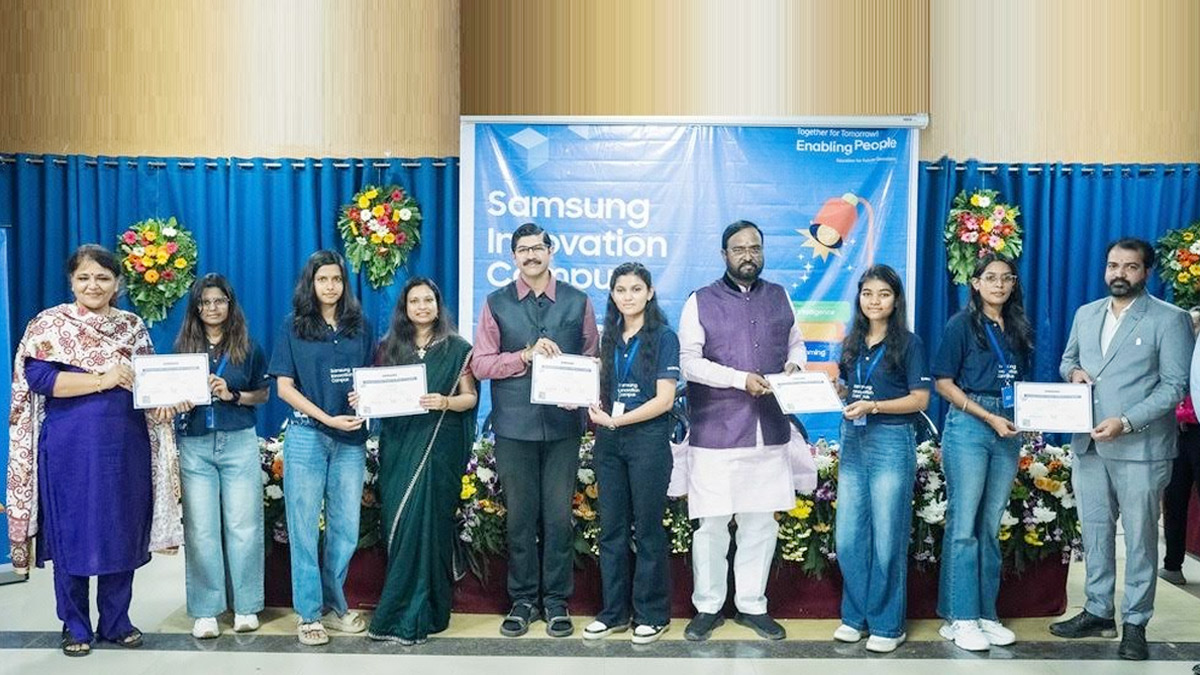
PUNE: Samsung has put 1,000 students in Maharashtra through a certified training programme in artificial intelligence and coding, the largest such drive the South Korean electronics company has run in the state and a signal that corporate India’s skilling ambitions are moving well beyond the boardroom brochure.
The certifications were awarded under Samsung Innovation Campus (SIC), the company’s flagship corporate social responsibility programme, which launched in India in 2022 with the stated aim of democratising access to future-technology education. The 1,000 graduates were drawn from four institutions: 127 from Savitribai Phule Pune University, 373 from Pimpri Chinchwad University, 250 from D.Y. Patil University’s Ramrao Adik Institute of Technology and 250 from Anjuman-I-Islam’s Kalsekar Technical Campus. All completed training in either AI or coding and programming, the two disciplines Samsung has identified as the critical pillars of the digital economy.
The programme does not stop at technical training. Soft-skills development and career-readiness modules are baked into the curriculum, a deliberate attempt to close the gap between what universities teach and what employers actually want.
“India’s digital growth story will ultimately be shaped by the quality of its talent pipeline,” said Shubham Mukherjee, head of CSR and corporate communications at Samsung Southwest Asia. “As technologies like AI move from the periphery to the core of industries, skilling must evolve from basic training to building real-world capability. This milestone in Maharashtra reflects how industry and academia can come together to create a future-ready workforce that is both globally competitive and locally relevant.”
The Maharashtra drive sits within a rapidly scaling national effort. Samsung Innovation Campus trained 20,000 young people across India in 2025, hitting its stated target for the year. Women account for 48 per cent of national enrolments, a figure the company cites as evidence of its push for an inclusive technology ecosystem. The programme is implemented in partnership with the Electronics Sector Skills Council of India and the Telecom Sector Skill Council.
Samsung, which is marking 30 years in India this year, runs SIC alongside two other initiatives, Samsung Solve for Tomorrow and Samsung DOST, as part of a broader effort to build what it calls a generation of innovators with both the technical depth and the problem-solving mindset to thrive in a fast-moving digital world.
A thousand certified students is a tidy headline. Whether they find jobs that match their new skills is the harder question, and the one that will ultimately determine whether corporate skilling programmes like this one are genuine pipelines or well-photographed gestures.






