MAM
Govt ad spends on print down 51 per cent from last year

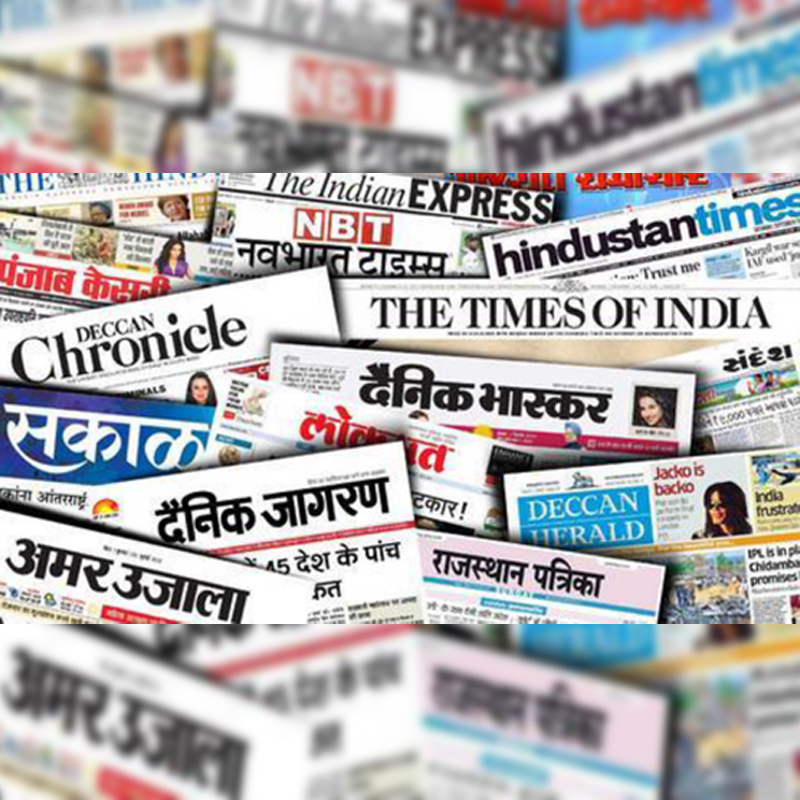
New Delhi: Print publications received a hard wallop with the outbreak of Covid2019 last year – circulation dropped, subscribers cut ties, and revenue dried up as advertisers tightened their purse strings. Now, it has emerged that the government, which is one of the biggest newspaper advertiser, slashed its spends on the medium by more than half during 2020.
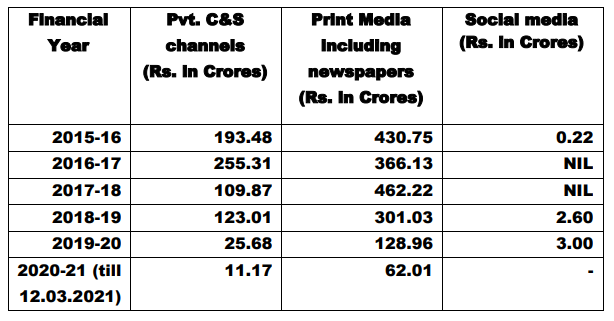
The NDA-led Centre spent roughly Rs 62 crore on print advertisements to publicise its activities and programmes during the pandemic ravaged 2020-21, which is 51 per cent down from last year. In 2019-20, the government’s total ad spend was Rs 128.96 crore.
The information was shared by union minister for information and broadcasting Prakash Javadekar in the Rajya Sabha on Monday.

According to the data, the government had spent Rs 430.75 crore in publishing print advertisements in 2015-16, which came down to Rs 366 crore in 2016-17, and increased substantially to Rs 462.2 crore in 2017-18. However, the downward trend began in 2018, when the print ad spends decreased from Rs 301 crore in 2018-19 to Rs 128.96 crore in 2019-20 and further shrunk to Rs 62 crores last year.
 The plummeting ad spends by the government come at a time when the print industry is struggling to survive the pandemic’s severe blow. Print media thrives on advertisement expenditure of industries including e-commerce, automobiles, and BFSI, which were also impacted by the lockdown. Many businesses ended up pulling out advertisements, as part of budget cuts and also due to a drastic fall in the circulation of newspapers and magazines. The prolonged lockdown restrictions forced several publications to limit the number of pages, shut their editions and resort to layoffs .
Last year, the Indian Newspaper Society (INS) had also raised concerns over the rising newsprint and logistics costs and increasing preference for online content.
The data shared also showed that the Centre spent relatively less money on advertising its programmes and policies on private satellite and cable TV channels compared to 2017. The overall ad spend on television came down from Rs 123 crores in 2018-19 to 25.68 crores in 2019-20 and just Rs 11 crores in 2020-21. The ad spends on social media remained a miniscule part of the total budget, the data indicated.
The Bureau of Outreach and Communication (BOC), which acts as an advisory body to the government on its media strategy, undertakes information, education, and communication (IEC) campaigns of the government through its empanelled media platforms as per the policy guidelines.
Javadekar also informed the Parliament that BOC adopted a media mix approach and it is also using digital cinema, internet websites, SMS, and social media along with print, radio and television advertisements for dissemination. He said that BOC had also conducted an all-India survey – an impact assessment study of multi-media campaigns covering 722 districts to study the impact of the campaigns run on various media platforms.
When asked if the government plans to increase the ad spend over the next few years, the I&B minister said, “BOC releases advertisements keeping in view the campaign requirements, target audience, availability of funds, and preferences indicated by the client departments.”





Brands
Jubilant Foodworks to end Dunkin’ franchise in India
Pizza chain operator will not renew agreement when it expires at end of 2026.

MUMBAI: When the doughnuts stop turning and the coffee goes cold, even a global giant like Dunkin’ can find the Indian market a tough brew to crack. Jubilant Foodworks has decided not to renew its franchise agreement with Dunkin’ when the pact expires on 31 December 2026, according to a Reuters report. The operator, best known for running Domino’s outlets in India, said it would evaluate options for its existing Dunkin’ stores, including a potential sale or transfer of franchise rights, in consultation with the US-based brand.
The decision follows years of underperformance in a market where local tastes and intense competition have made it difficult for international coffee-and-doughnut formats to gain traction. Jubilant, which has increasingly focused on its core pizza business and newer bets like Popeyes, indicated that the exit would not materially affect its financial or operational position.
Dunkin’ accounted for just 0.61 per cent of Jubilant’s revenue in the fiscal year ending 2025 and recorded a loss of approximately Rs 191 million, according to a regulatory filing. The company operated 27 outlets as of December 2025, having shuttered seven stores over the preceding year.
The retreat comes even as Jubilant’s broader business shows signs of momentum. The company reported a 65 per cent rise in quarterly profit for the October to December period, reaching Rs 70.9 crore, up from Rs 42.91 crore a year earlier.
For Jubilant, the exit reflects a sharpening strategic focus. For Dunkin’, it marks another setback in a market that has proven resistant to imported café concepts without significant localisation.
In the cut-throat world of Indian quick-service restaurants, sometimes the sweetest deals are the ones you quietly walk away from leaving more room for the brands that truly rise to the occasion.