Ad Campaigns
Godrej’s #DeoReborn and #DeoCalculator campaigns for Cinthol DeoStick

MUMBAI: Angels falling and women chasing men are the kind of commercials that are conventionally seen for deodorants. For a fairly significant amount time deo promotions have revolved around opposite gender fantasies and attractions. But today, with digitization and social media, promotion campaigns have become much more interactive with consumers.
Godrej Consumer Products Limited Head – India and SAARC Sunil Kataria says that consumers have matured in today’s times and even while chasing image building for brands, the campaigns have to be rooted firmly to the ground.
Recently, Godrej launched Cinthol DeoStick in the market. The campaign for the product is majorly focused on digital platforms. It started with the #DeoReborn campaign and then the #DeoCalculator was run as a sub campaign. Kataria says that the basic idea of the promotion comes from the product. As most products in the market are spray or gas based, Cinthol DeoStick is a deodorant for solving real problems. Even after so many brands marketing them heavily, the market penetration of deodorants is only 18 percent. Cinthol Deostick aims at increasing the users for deodorants in the country.

Cinthol deostick started with #DeoReborn campaign whereby the three barriers of deodorants were promoted. Contrary to norm, the campaign’s message was that Cinthol DeoStick was non-alcoholic, lasted long and was cost effective. Playing on the ‘price quotient’, the social platform offered a great medium for Cinthol to reach out to its consumers.
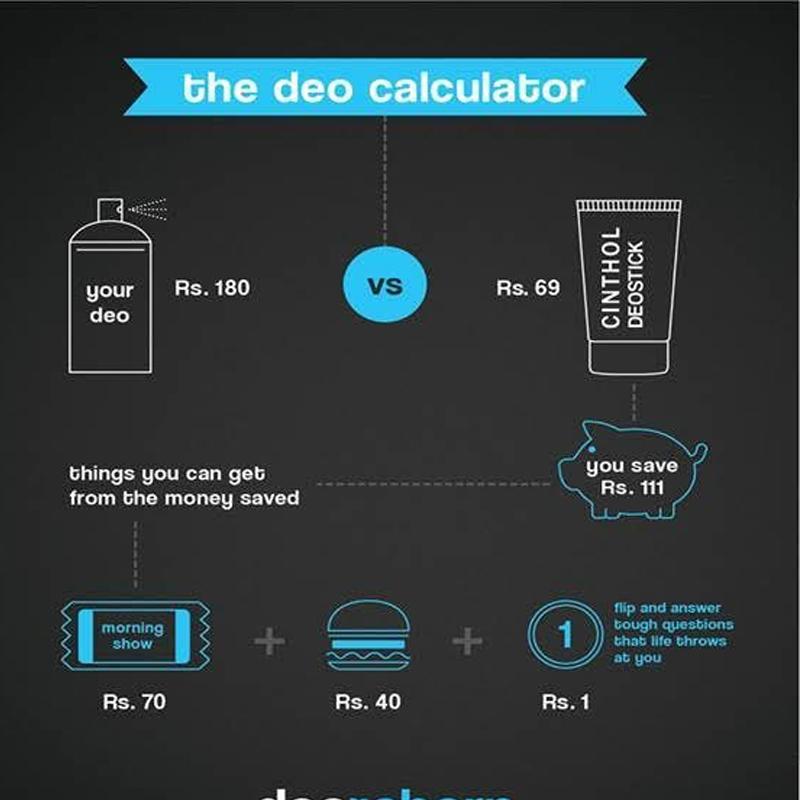
The idea was to show consumers what they could do with the money they saved if they bought Cinthol DeoStick. This triggered the concept of #DeoCalculator. All that the consumers had to do was to share the price of their deodorant on Twitter using hashtags #DeoReborn and #DeoCalculator. The #DeoCalculator generated a quirky customized infographic giving them options on how they could put the money saved to better use.
The Twitter campaign was run for 2 days. This campaign is also running on other platforms like television and radio. The brand has also taken up activation events focusing on college campuses for better product interaction with the target audience.
The DeoCalculator campaign has been designed by Creative Land Asia. According to the brand, the campaign received 2274 tweets and 2443 posts. 169 tweets were posted from the official handle @GodrejCinthol in response to Twitter users tweets.
Kataria says that Godrej has been involved with many other audience engagement campaigns earlier also with products like HIT by launching a mobile app with dengue stories. He says that any brand that intends to reach out to the youth has to adopt the digital platform. His company has increased spends over the last two years on the digital platform and has plans to further double spends on the digital medium, he informs.






NATIONAL: Amazon Ads has laid out a sharply tech-led vision for the advertising industry in 2026, arguing that artificial intelligence, streaming TV and creator partnerships will combine to turn brand building into a more precise, performance-driven business.
At the heart of the shift, the company says, is the fusion of AI with Amazon’s vast trove of shopping, browsing and streaming signals, allowing advertisers to move beyond blunt reach metrics to campaigns designed around real customer behaviour.
“The future of advertising is not about reaching more people, but the right people with messages that resonate,” said Amazon Ads India head and vice president Girish Prabhu. “By combining AI with deep customer insights, we help brands move from broadcasting campaigns to having meaningful conversations wherever audiences spend their time.”
One of the biggest changes, according to Amazon Ads, will be the collapse of the wall between media planning and creative development. Retail media, powered by first-party data, is increasingly shaping everything from brand discovery to final purchase, pushing marketers to design campaigns around audience insight rather than internal instinct.
AI is also moving from a support tool to a creative engine. Agentic AI, which automates and accelerates production, is expected to make high-quality creative accessible even to small businesses, compressing weeks of work into hours and giving challengers the ability to compete with larger brands on speed and scale.
Behind the scenes, AI-driven analytics will take on a bigger role in campaign optimisation, identifying patterns, spotting opportunities and recommending actions that would previously have required teams of analysts.
Streaming TV is another big battleground. With India’s video streaming audience now above 600 million and connected TV users at 129.2 million in 2025, advertisers are set to treat streaming not just as a branding channel but as a performance engine, measured increasingly by sales, sign-ups and bookings rather than just reach.
Finally, Amazon Ads sees creators and contextual advertising reshaping how brands tell stories. Creators will act less like influencers and more like long-term partners, while scene-aware ads on streaming platforms will allow brands to insert hyper-relevant offers into the flow of what viewers are watching.
Taken together, Amazon Ads argues, these shifts mark a move towards advertising that is both more human and more measurable, where AI handles the complexity, and creativity does the persuading.






