MAM
Goa Fest: Rajdeep Sardesai in talks with Arjuna Ranatunga


Goa: For the first session on the day two of Goafest, the audience were amused with the presence of minister of ports and shipping and former Sri Lanka cricket captain Arjuna Ranatunga in conversation with senior journalist, author and founder of the IBN Network Rajdeep Sardesai.
The session kick-started with Sardesai asking Ranatunga about ICC World Cup win in 1996, at a time the country was faced with internal issues. Recalling the mindset at the time of the tournament, “I wanted a team of 14 cricketers who would give their life and dedication to the country. Winning the World Cup did not happen overnight. I asked my players if they wanted to win. I only picked committed players and not the best players. We didn’t care about the money. I led the team like a school principal. I would order my players to get back to their rooms at 10 pm, even if they couldn’t get sleep early, said Captain Fantastic.
It could be well remembered that during the Sri Lanka-Australia final of the World Cup, Ranatunga hit Shane Warne for a six and then stuck his tongue out. A puzzled Sardesai asked the reason behind his reaction and whether the captain is supposed to be this aggressive. Putting blame on his size which makes him pant, pretending to be innocent he riddled, “I don’t remember sticking a tongue out to Warne. I walk between the wickets”.

He further noted that this issue was created by two Indian journalists who had come to interview him. “Two journalists met me post our semi-finale win and said ‘Rana you need to give Australia a short before you start. The two guys told me where they’ll be sitting in the audience, during the press conference and told me to answer their questions. One of them asked me about Shane Warne. I said he was mediocre bowler, highly rated in his country and I don’t think he’s a match winner against us.Then the other asked me about the Waugh brothers. I said the same about them and said that there were better cricketers in Asia”.
Ranatunga used to analyse all his reactions and believes that a captain has to be aggressive. “If they push us, you have to push them twice or thrice. If I do something like that now, I would be suspended. At that time, we did not have such realistic rules at that time. I knew if all of us left, the match would be abandoned and they’d win. I don’t want young guys to do this. I love and respect the way Kapil Dev and Imran Khan managed their teams. I have learned a lot from them. Even they were aggressive captains.”
Going further, Sardesai asked Ranatunga whether a captain in the subcontinent needs to be a politician. “We have created unhappiness to a lot of western teams but that did not hamper my credibility back home.”
When asked about which job is the most challenging that being a captain for a cricket team winning a world cup or a minister who ensures policy change. He asserted, “Being a minister is the toughest assignment. Ports is one of the most corrupt industries with more than 90 per cent people being corrupt. But I love challenges and want to have them in life; to go on bad roads and not the highways”.
The question on different ways to deal with corruption has never been answered. Rana strongly opposes any kind of corruption done by the 10,000 people working in the industry. “I’m not going to go to the past and drag things out. But from the day I join, I want you to be clean. Don’t make me push you to the wall. I feel I can get things right provided I don’t get shot”, he said.
A buddhist follower by nature, Ranatunga trusts that Buddhism does bring calmness to him despite all the controversies and pressure. “When I was struggling or went through pressure, I used to talk to the top priests and still do that. I do a bit of meditation. It’s not just Buddhism. All religions have enough good areas where you can learn and observe.”
Majority of the players endorse brands which could affect a cricketers game. A question that often strikes our mind is whether endorsements affect performances. “I have never done an ad.”
Recalling his first test at the at of 18, he said that a boss from a leading company had approached him for a commercial. Going back to that time, he remarked, “I don’t know anything about this; why don’t you talk to my mum? My mother was a teacher and listened to him for half an hour. Her answer was ‘sorry Michael, my son is not for sale.’”
One thing that my mother told me at that time was, “Don’t sell your talent or body for money.”
“There are players who are interested in sacrificing play time or family time to do ads. I believe you need to identify what you are good at. Don’t do toilet ads to earn more. I’ve done three charity ads. I may have lost a lot of money not doing ads but these are the things that kept me going”, asserted the minister.
At the end of the session, the table was made open for Q&A sessions. One of the questions asked was on the T20 format. Ranatunga compared 20-20 to a brand of instant noodles. “T20 matches are quick, and filling but not healthy. Test cricket is what a mother cooks. It’s healthy, but might not be very filling.”
He further added, “We will lose our identity because of T20. India and Pakistan were among the best at hockey but now they play on artificial grass, it’s all about power. These days you don’t need brains and technique. Behind the walls they are creating another sort of cricket for them to go to the top”.
A question was thrown at Sardesai whether he will choose to become a cricketer or continue with being a journalist. Answering the question, he commented, “Cricket needs talent, journalists don’t need talent.” Ranatunga added further, “If you have money, you can be the president but cricket needs talent.”
The session concluded with Sardesai questioning Ranatunga whether he would endorse a brand ever to which he replied, “Only if you convince the three important ladies in my life i.e. my mother, wife and daughter, I will do anything that you want me to do.”





Brands
KKR sixes to power EV charger rollout under VIDA campaign
Cricket meets clean mobility as big hits spark India’s charging growth
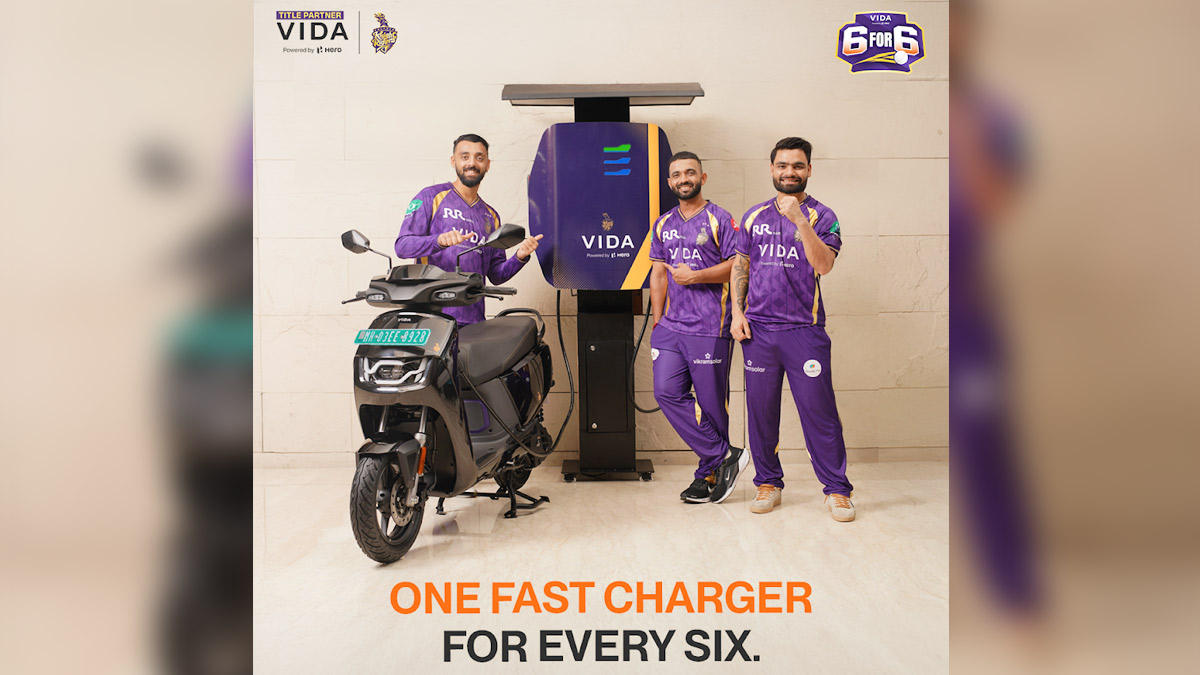
NEW DELHI: VIDA, the electric mobility arm of Hero MotoCorp, has teamed up with Kolkata Knight Riders to launch a campaign that turns cricketing flair into real-world impact.
Titled ‘6 for 6’, the initiative promises to install a 6kW fast EV charger for every six hit by KKR during the ongoing Indian Premier League season. The idea is simple but powerful, as each big hit on the field contributes directly to expanding India’s fast-charging infrastructure.
The campaign builds on VIDA’s growing network, which already spans over 5,300 fast-charging points across more than 430 cities. With EV adoption gaining pace, the brand is using cricket’s mass appeal to accelerate both awareness and infrastructure growth.
Explaining the thinking behind the move, Hero MotoCorp emerging mobility business unit chief business officer Kausalya Nandakumar said, “Cricket has an incredible ability to unite and inspire millions across the country. With the ‘6 for 6’ campaign, we are turning every big hit on the field into a step towards a cleaner and a more accessible mobility future.”
She added that VIDA’s expanding fast-charging network and removable battery technology are designed to make EV ownership more convenient and practical for everyday users.
From the franchise’s side, the campaign is also about giving on-field moments a larger purpose. Kolkata Knight Riders chief executive officer Venky Mysore said, “The ‘6 for 6’ campaign exemplifies the potential of sport as a platform for meaningful, real-world impact. By linking every six to the expansion of EV charging infrastructure, this partnership transforms fan excitement into tangible progress.”
As part of the rollout, VIDA has introduced co-branded charging stations in KKR’s signature colours, with a flagship installation unveiled alongside team players. The chargers are designed for quick top-ups, powering VIDA scooters from zero to 80 percent in about an hour, while also being positioned along key highways to support longer journeys.
The initiative also taps into VIDA’s removable battery system, which allows users to charge using standard household plug points, adding flexibility to the charging ecosystem.
By blending the thrill of cricket with the urgency of clean mobility, VIDA and KKR have found a neat way to make every six count twice, once on the scoreboard and again on India’s road to an electric future.








