MAM
Five days that could change your professional life: AdAsia 2003

The Advertising Council of India (ACI), apex body of advertising, media and allied associations in India, held its road show for the biennial Asian Advertising Congress at the Oberoi Towers on 21 August 2003.
After 21 years, the 23rd Asian Advertising Congress or AdAsia 2003 will be held in India – more specifically the pink city of Jaipur between 10-14 November 2003. It is a matter of great pride and prestige for India’s A&M fraternity since the opportunity to be a part of AdAsia comes once in a blue moon. The previous two AdAsia congress sessions were held in India in 1970 and 1982.
Aditya Birla Group is the lead sponsor and Videocon group is the associate sponsor for AdAsia 2003. In fact, AdAsia organising committee president Pradeep Guha announced that the sponsors have contributed an amount of Rs 40 million for AdAsia 2003. The other sponsors include Reliance India Mobile, Sony Entertainment Television, CNBC, Jet Airways, Citibank, Infosys, Heinz, Toyota, Ramada, Mont Blanc, Lakme, Star TV, Tata group, UB group, Chateau Indage, Hindustan Lever Limited, Philips, Samsung and Coca Cola.

 Addressing the cr?me de la cr?me of Mumbai’s advertising fraternity at the Oberoi Towers were AdAsia organising committee president Pradeep Guha, Asian Federation of Advertising Associations (AFAA) and ACI chairman Gautam Rakshit, AdAsia planning committee chairman Ramesh Narayan and other committee members such as Lowe Lintas and Partners MD Prem Mehta, AdAsia media relations chairman Peter Mukerjea and vice chairman Bharat Kapadia amongst others.
The cost of sponsoring a delegate is as follows:
|
Type
|
Early bird
|
Normal
|
With spouse
|
|
Indian delegates
|
Rs 25,000
|
Rs 30,000
|
Rs 15,000
|
|
Foreigner delegates
|
$1,000
|
$1,100
|
$550
|
Guha estimates that the cost of sending a delegate to Jaipur would work out to a sum between Rs 40,000-50,000 for the entire AdAsia 2003.
The AdAsia 2003 logo that breaks rules
 In sync with the theme – organisations that anticipate discontinuity, prepare for discontinuity and exploit discontinuity become successful companies of tomorrow – O&M India group president and national creative director Piyush Pandey created the match box logo. Pandey’s message to the AdAsia 2003 committee was: “The intention is to stay away from the logos that were created for the previous Ad Asia congresses. The matchbox is a symbol of discontinuity – the idea of breaking the rules is encapsulated in the visual’s potential energy that has the power to spark off and explode; and usher in a new mindset.” Whew, that’s clearly out of the ‘box’ thinking!
Matter of prestige and pride – Pradeep Guha
 In his keynote address, Guha stated that all the associations such as INS (Indian Newspaper Society), ISA (Indian Society of Advertisers), IBF (Indian Broadcasting Foundation), AAAI (Advertising Agencies Association of India), ICIAA (Indian Chapter of the International Advertising Association) and The Advertising Club, Bombay had joined hands to ensure that AdAsia 2003 was a resounding success.
Guha reminded the assembled audience that India had been trying to host the biennial AdAsia 2003 since 1996. “We failed in the past because the AAFA committee felt that India couldn’t attract good speakers; the Indian ad fraternity wasn’t competent enough to put on a good show; and would seek AFAA funds as it wouldn’t be able to find sponsors. In 1999, we went prepared for the pitch presentation and did everything right – the presenting team comprised a large delegation including a Miss World winner. Today, I can proudly announce that India is the only country in Asia that hasn’t asked the AFAA for a single dollar for AdAsia 2003.”
High power AdAsia 2003 Advisory Board
A high profile advisory committee – AdAsia Advisory Board – was formed in early 2000 to conceptualise an elaborate plan for the convention. Headed by Hindustan Lever Limited chairman MS Banga, the high powered Board had members such as Anand Mahindra (MD and VC, Mahindra and Mahindra), MK Khanna (CEO, JWT India), Rajeev Bakshi (chairman, Pepsico India), Rajeev Chandrashekhar (chairman, BPL Innovision group), Nandan Nilekani (MD, Infosys) amongst others. The members of the Board unanimously decided that AdAsia 2003 should ‘Break the rules’ and this was selected as the theme of the congress. The board also felt that AdAsia 2003 should go beyond the confines of the advertising fraternity and address the needs of management, media, advertising and marketing professionals.
Sessions that will help you break the rules
The sessions that are targeted at CEOs who would like to drive change; marketing wizards who want to build memorable brands; ad professionals who want to explore the power of advertising; creative mavericks who want to shape up the future of Asian advertising; media hotshots who want a new world of access.
The schedule is as follows:
Day Zero – Monday, 10 November
Maharaja welcome dinner
Day 1 – Tuesday, 11 November
Session I – Inauguration; Session II – Perspectives; Session III – Cult Branding; Session IV – Taking on the market leader; Session V – Shaping the future of communication; Session VI – celebrating the best of Asian Advertising.
Day 2 – Wednesday, 12 November
Chairman’s round table session featuring the helmsmen of Indian conglomerates such as Reliance group’s Mukesh Ambani and AV Birla group’s Kumar Mangalam Birla. The session will be moderated by Ian Batey.
Discover Jaipur Day and Dentsu – AdAsia Jaipur Golf tournament.
Day 3 – Thursday, 13 November
Session I – Perspectives; Session II – Building great brands; Session III Asia – the making of the new super power; Session IV and V – Delivering audiences; Session VI – celebrating the best of Asian advertising.
Day 4 – Friday, 14 November
Session I – Perspectives; Session II and III – Campaigns that build great brands; Session IV – marketing to the entire consumer pyramid and social marketing; Session V – celebrating the best of Asian advertising (names such as Yukio N from Japan, Woong Hyun Pak from Korea, Ramon Jimeng from the Philippines, Piyush Pandey from India, Jureeporn Thaidumrong from Singapore); Session VI – summing up -the future shape of work
Venue that will break the rule
 The theme of breaking the rules was apparent even in the choice of venues. New Delhi was the venue for the previous AdAsia congresses held in India (1970 and 1982). This time, the venue chosen was the pink city of Jaipur. AdAsia 2003 would be held at the Birla Convention Centre located in the heart of Japur. The centre is a blend of old and contemporary Indian architecture and is built on a sprawling 9.5 acre plot (25,000 sq ft). The fully air conditioned auditorium has a capacity of 1,300 people in a two tier seating arrangement and is well equipped with state of the art modern facilities.
Participants will cherish memory of their interactions at AdAsia 2003: AFAA and ACI chairman Gautam Rakshit
 In his inimitable style laced with humourous anecdotes and customary jibes, Asian Federation of Advertising Associations (AFAA) and ACI chairman Gautam Rakshit made a preview presentation on AdAsia 2003.
Excerpts from Rakhsit’s presentation:
* AdAsia 2003 advisory board members felt that the canvas of the congress must be enlarged to encompass professionals from marketing, media, management and advertising. In fact, Vindi Banga (HLL chairman) felt that there was a need to raise the bar and surpass the standards set by the previous congress conventions. Raising the bar would entail making AdAsia 2003 an effective way of changing the way in which business leaders look at their business.
* The strong consensus was that the five days (10-14 November 2003) must also result in changing the way in which the Asian industry looks at itself. India has the potential to play a significant part in making Asia the next economic super power. However, there is a need to imbibe new learnings that will ensure that India becomes a mass consumer economy in the true sense. AdAsia 2003 will give a clarion call or an awakening alarm that will empower Indian professionals to prepare for the future.
* There is a strong need to separate the “urgent” from the “important”. Most professionals get bogged down in the “urgent” and forget the “important”. This misplaced preoccupation sets a wrong precedent for the next generation.
* Since the challenge was to look at rare species (looking beyond ordinary mortals), compiling the list of speakers was a difficult task. The committee felt the need to choose a rare breed of speakers who would urge the participants to break the rules. The purpose is not to lull but to provoke; to disturb and challenge preset notions.
* The speakers – rather agitators or agents of revolution – would be people who have invented the concept of continuity; resulting in a quantum growth in business; which in turn would result in a growth in the economy.
Some of the ‘Agitators’ or ‘Agents of Revolution’ for helping you break every rule:
The names that have been chosen after intense deliberations include names such as Jack Trout (president Trout & Partners), Ricardo Semler (president, Semco), Irwin Gotlieb (chairman and CEO, MindShare), CK Prahalad (professor, university of Michigan Business School), Jeff Goodby (co- chairman, creative director, Goodby Silverstein & Partners), Trevor Beattie (chairman and creative director TBWA Worldwide), MS Banga (chairman, HLL), Lester Wundermann (worldwide director, Wunderman’s marketing lab and president), Rajat Gupta (former MD, McKinsey & Company), David Droga (worldwide creative director, Publicis Worldwide), Piyush Pandey (group president and national creative director, O&M India), Clyde Fessler (former V-P, business development, Harley Davidson Motor Company) amongst others.
Five days of intense debates and cross-fire of ideas to challenge; themes that are relevant to practitioners; drastic innovations, an ability to break out of the existing cycle of growth and propel oneself to another level altogether; stimulating the ideal mixture of chutzpah, foresight, acumen and guts. This constitutes the spirit that AdAsia 2003 seeks to salute and celebrate!

MAM
India’s financial sector spent less on TV ads in 2025 but flooded the internet
Banks, insurers and lenders cut tv ads as digital jumps, LIC and Muthoot lead tv and Axis Bank tops online
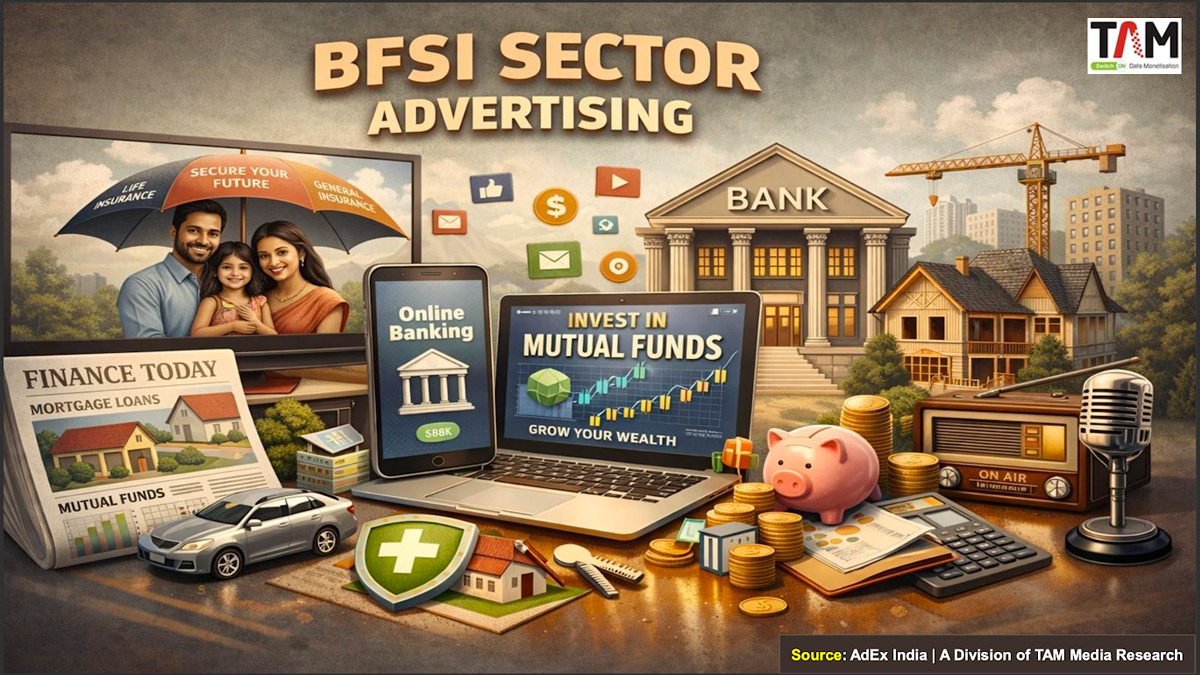
MUMBAI: India’s banking, financial services and insurance sector, one of the most prolific advertisers in the country, delivered a split verdict on media in 2025. It spent less on television, held its nerve in print, turned up the volume on radio and deluged the internet with a ferocity that left every other medium looking pedestrian. The picture that emerges from TAM AdEx’s cross-media report for the BFSI sector is of an industry in transition, still wedded to the news bulletin but increasingly seduced by the algorithm.
Television: a retreat with caveats
TV ad volumes for the BFSI sector fell 16 per cent in 2025 compared with 2024, a sharp reversal after two years of consistent growth that had pushed volumes 16 per cent above 2021 levels by 2023 and a further 7 per cent higher by 2024. Within 2025 itself, the drop was concentrated in the middle of the year: the second and third quarters saw ad volumes slide 35 per cent each against the first quarter, with a partial recovery of 13 per cent in the fourth.
The retreat did not reshuffle the deck. Life insurance retained first place among TV categories with 19 per cent of ad volumes, mortgage loans held second with 16 per cent, and the top ten categories together accounted for 82 per cent of all BFSI television advertising. The dominance of news channels was equally pronounced: news claimed 68 per cent of ad volumes, general entertainment channels a distant 14 per cent and movies 12 per cent. Together, news and GEC captured 82 per cent of the sector’s television spend. News bulletins alone took 48 per cent of programme-genre volumes, with feature films second at 12 per cent. Prime time, between 6pm and 11pm, drew 34 per cent of ad volumes, followed by afternoon at 22 per cent and morning at 20 per cent. A full 82 per cent of all ads ran between 20 and 40 seconds.
Life Insurance Corporation of India was the sector’s biggest TV spender with 11 per cent of ad volumes. Muthoot Financial Enterprises came second with 9 per cent, followed by National Payments Corporation of India at 6 per cent, Tata AIG General Insurance at 5 per cent and State Bank of India at 5 per cent. The top ten advertisers together accounted for 51 per cent of total TV volumes. Three names were new to the top ten in 2025: Tata AIG General Insurance, IIFL Finance and Tata Capital. At brand level, Muthoot Finance Loan Against Gold led with 9 per cent share, Tata AIG Health Insurance entered the top ten for the first time, and the top ten brands together contributed 35 per cent of ad volumes.
Print: the long climb continues
Print told a different story. Ad space for the BFSI sector has grown every year since 2021, rising 16 per cent in 2022, 30 per cent in 2023, 51 per cent in 2024 and 64 per cent in 2025, all measured against a 2021 baseline. Within 2025, ad space was flat in the second quarter but surged 46 per cent in the third and 33 per cent in the fourth compared with the first. Life insurance led print categories with 21 per cent of ad space, followed by mutual funds and banking services and products at 13 per cent each, and corporate financial institutes at 11 per cent. The top ten categories together took 82 per cent of print ad space. LIC led print advertisers with 6 per cent share, and the top ten together covered just 19 per cent of ad space, a reflection of how fragmented print spending remains. Three new entrants joined the top ten in 2025, with Billion Brains Garage Ventures the only exclusive presence not seen in 2024’s list. In the top ten brands, LIC dominated with a 2 per cent share, while Nippon India Mutual Fund rose to third position from fourth in 2024. English accounted for 62 per cent of print ad space, Hindi for 20 per cent. Business and finance publications took 59 per cent of the genre split. The south zone led regional spending with 33 per cent of print ad space, Bangalore topping that zone, while New Delhi and Mumbai were the leading cities nationally.
Radio: louder than ever
Radio ad volumes for the BFSI sector have climbed steadily, rising 12 per cent above 2021 levels in 2023, 36 per cent in 2024 and 45 per cent in 2025. The quarterly pattern within 2025 was volatile: a sharp drop of 43 per cent in the second quarter and 42 per cent in the third, followed by a near-full recovery in the fourth. Life insurance led radio categories with 22 per cent of volumes, banking services and products second at 14 per cent and corporate NBFCs third at 11 per cent. LIC of India held its position as the leading radio advertiser with 20 per cent of ad volumes; the top ten radio advertisers together covered 69 per cent. Muthoot Financial Enterprises led radio brands with 10 per cent share, five of the top ten brands belonged to LIC alone, and SBI Mutual Fund made a remarkable leap to fifth position from 272nd in 2024. Evening and morning time-bands together captured 84 per cent of radio ad volumes, with evenings at 44 per cent and mornings at 40 per cent. Maharashtra was the leading state for radio BFSI advertising with 18 per cent share; Maharashtra, Gujarat and Uttar Pradesh together accounted for 43 per cent.
Digital: the five-times surge
If one number defines the 2025 BFSI advertising story, it is five. Digital ad impressions for the sector multiplied fivefold between 2021 and 2025, having already doubled in 2023 and doubled again in 2024 before the 2025 leap. Within the year, impressions dipped 19 per cent in the second quarter and 12 per cent in the third before recovering 8 per cent above the first quarter by the fourth. Banking services and products led digital categories with 27 per cent of impressions, life insurance and credit cards tied at 19 per cent each, and securities and sharebroking organisations fell from first place in 2024 to fourth in 2025. Axis Bank was the runaway leader among digital advertisers with 12 per cent of impressions, followed by ICICI Bank at 9 per cent, IDFC First Bank at 7 per cent and Kotak Mahindra Bank at 6 per cent. The top ten digital advertisers covered 59 per cent of impressions, and seven of them were new entrants compared with 2024, signalling rapid churn in the digital spending hierarchy. At brand level, Axis Bank led with 9 per cent, ICICI HPCL Super Saver Credit Card vaulted to third place from 921st in 2024, and six of the top ten digital brands were new to the list. Programmatic buying accounted for 91 per cent of all digital BFSI transactions; combined with ad networks, it captured 96 per cent.
The data from TAM AdEx paints the portrait of a sector that still believes in the power of the television news bulletin to sell insurance to the masses, but increasingly knows that the next generation of borrowers, investors and cardholders is scrolling, not watching. The race is now on to reach them before the algorithm serves up someone else’s loan offer first.






