MAM
FCB India in partnership with Networkbay launches ‘Retail: Day 1’


MUMBAI: FCB India in collaboration with Networkbay today announced the launch of ‘Retail: Day 1’ a special initiative to work with brands and retailers to ‘manage, redefine and transform’ their retail experiences in the post-COVID era.
It’s time, we adapt to the new normal, unlearn the old formulas, redefine the business of brands and brand communication with the evolving consumption pattern. The launch of ‘Retail: Day 1’ therefore beckons the first day of contactless retail experience. Through this collaboration FCB India and Networkbay will work with brands and retailers to quickly adapt to this new scenario. By leveraging digital tools and spatial design innovation, ‘Retail: Day 1’ is aimed at creating enhanced new retail virtual experiences which are engaging and at the same time fulfilling business requirements of conversion and sales for brands.
Follow Tellychakkar for the consumer facing news & entertainment.

A recent survey by National Retail Federation (NRF) deduced:
· Nine in 10 consumers have changed their traditional shopping habits
· More than 50 per cent of consumers have ordered products online that they would normally purchase at the store
· Nearly six in 10 consumers say they are worried about going to the store due to fear of being infected
Some of these changes would be temporary while others will be permanent. As the community moves beyond the survival mode, the digital-adoption momentum is likely to carry forward and become permanent. As a matter of fact, consumer behaviour will be dependent on two factors – the reluctance to mingle in crowded public places and higher propensity for digital adoption. While the survey by NRF represents finding in America, but the human sentiments resonate with the changing behaviour across the globe.
A study by Deloitte published on 30 March 2020 shared an outlook on the retail industry with the emphasis on changing behaviour.
· Non-contact demand during the pandemic is expected to boost sales at smaller stores that can host smaller crowds at a time. However, supermarket chains have ensured supply of products at regular prices
· Due to the pandemic‘s impact on consumer behaviour and habits, “online-sales” are expected to witness a significant surge, even after the industry recovers
· The establishment of online platforms is expected to become indispensable for offline stores, and online–offline service integration is expected to increase
A Nielsen study unveiled in March 2020 looked at the retail purchase in traditional, modern and e-commerce channels, and evaluated consumer attitudes. It tracked this behaviour for several weeks from the time the disease first surfaced in India till the country went under a lockdown. First, it observes an increase in consumer interest in health and hygiene products, leading to purchase of safety items such as hand sanitizers and face masks. As the disease spread, consumers started stockpiling their pantry with shelf-stable food and broader assortment of health and safety products. Store visits went up and the basket size expanded. The quarantine stage, followed by restrictive living, led to a rise in online shopping, fewer store visits, purchase of essential goods.
A story published by Mint gave a deep dive into the auto sector, ‘Executives at automobile companies said their mass market cars may see a spike in sales in a post covid-19 scenario. They argue that customers will shun shared cabs and public transport as the fear of the disease, a global pandemic that has killed thousands, lingers. Some car companies are expecting their affordable hatchbacks to do well as the middle-class consumer puts hygiene and safety above all else.’- Source Mint newspaper dated 2 April 2020
The recent McKinsey study in China suggests, consumers are likely to opt for online shopping even after the outbreak ends, especially for categories such as groceries and personal care. This trend is likely to continue long after the lockdowns are called off as people would still be apprehensive to visit crowded areas like malls or supermarkets.
The aforesaid data and research excerpts imply that it is time for contactless retail experience for brands and it is here to stay. Even after the lockdown is lifted, consumers will still be apprehensive about stepping out and visiting stores. The footfall would be very low. China is a precedent for this consumer behaviour pattern. With the emergence of the online platforms that empower the consumer whilst ensuring their safety, engagement will be driven more on the basis of the ‘experiential’ rather than ‘material’. The post-covid retail environment will surely be a default online retail preference. And with the launch of ‘Retail Day: 1’, we announce our day one at the new normal, as we adapt to the new game.
Speaking on current challenges, FCB India group chairman and CEO Rohit Ohri said, “This lockdown period will change our world forever. When we emerge on the other side of this crisis, retail experiences will be redefined. Our research shows that shopper behaviour will dramatically change. Even though retail stores may be open, customers who shop there will not engage with the stores as they used to. Retail needs to urgently reinvent itself for the post-COVID world. We’re hoping that our Retail Day 1 initiative, we are able to help our clients rapidly build back their business.”
Adding, Networkbay co-founder Hozefa Attari said, “Our platform combines the strengths of some of the leading retail design, technology and service brands to develop every retailer’s Store of the Future. Project ‘Retail: Day 1’ will allow us to work closely with FCB, taking advantage of their deep expertise in brand and customer behaviour, to develop radical customer journeys, be it contactless automotive dealerships, virtual stores or even connected packaging and Augmented Reality.”



Brands
Samsung certifies 1,000 Maharashtra students in AI and coding
The South Korean electronics giant marks its first large-scale skilling push in the state, with women making up nearly half the national programme’s enrolment
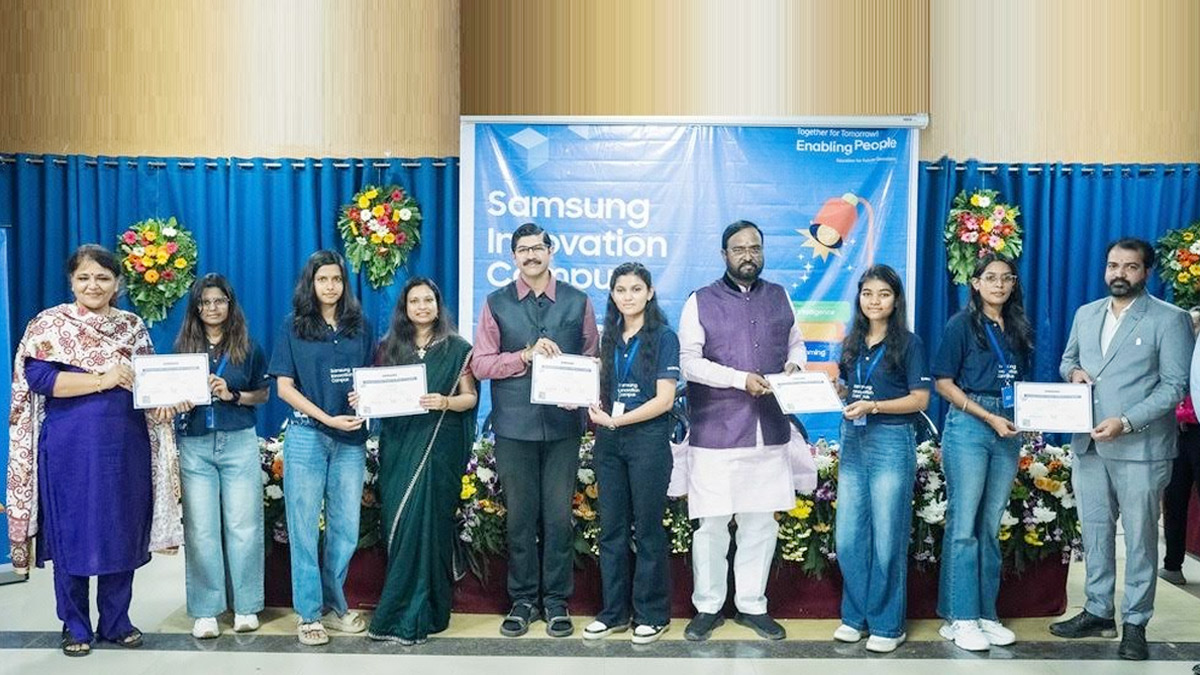
PUNE: Samsung has put 1,000 students in Maharashtra through a certified training programme in artificial intelligence and coding, the largest such drive the South Korean electronics company has run in the state and a signal that corporate India’s skilling ambitions are moving well beyond the boardroom brochure.
The certifications were awarded under Samsung Innovation Campus (SIC), the company’s flagship corporate social responsibility programme, which launched in India in 2022 with the stated aim of democratising access to future-technology education. The 1,000 graduates were drawn from four institutions: 127 from Savitribai Phule Pune University, 373 from Pimpri Chinchwad University, 250 from D.Y. Patil University’s Ramrao Adik Institute of Technology and 250 from Anjuman-I-Islam’s Kalsekar Technical Campus. All completed training in either AI or coding and programming, the two disciplines Samsung has identified as the critical pillars of the digital economy.
The programme does not stop at technical training. Soft-skills development and career-readiness modules are baked into the curriculum, a deliberate attempt to close the gap between what universities teach and what employers actually want.
“India’s digital growth story will ultimately be shaped by the quality of its talent pipeline,” said Shubham Mukherjee, head of CSR and corporate communications at Samsung Southwest Asia. “As technologies like AI move from the periphery to the core of industries, skilling must evolve from basic training to building real-world capability. This milestone in Maharashtra reflects how industry and academia can come together to create a future-ready workforce that is both globally competitive and locally relevant.”
The Maharashtra drive sits within a rapidly scaling national effort. Samsung Innovation Campus trained 20,000 young people across India in 2025, hitting its stated target for the year. Women account for 48 per cent of national enrolments, a figure the company cites as evidence of its push for an inclusive technology ecosystem. The programme is implemented in partnership with the Electronics Sector Skills Council of India and the Telecom Sector Skill Council.
Samsung, which is marking 30 years in India this year, runs SIC alongside two other initiatives, Samsung Solve for Tomorrow and Samsung DOST, as part of a broader effort to build what it calls a generation of innovators with both the technical depth and the problem-solving mindset to thrive in a fast-moving digital world.
A thousand certified students is a tidy headline. Whether they find jobs that match their new skills is the harder question, and the one that will ultimately determine whether corporate skilling programmes like this one are genuine pipelines or well-photographed gestures.






