MAM
‘Deccan Chronicle’ IPO to open on 25 Nov with 8m shares


NEW DELHI: Media company Deccan Chronicle’s initial public offer is set to open on 25 November with the price of share price being in the band of Rs 162 – Rs 194 per share. This IPO marks the first time in India that a mainline broadsheet newspaper will be publicly owned.
The IPO, comprising 8.01 million shares, closes on 2 December, 2004, according to an announcement made by Deccan Chronicle Holdings Limited, publishers of Andhra Pradesh based newspaper Deccan Chronicle.
The Red Herring Prospectus, dated 8 November has been filed with the Registrar of Companies, Andhra Pradesh. While the final price of the shares will be determined through the book-building route, the company expects to net between Rs 1.3 billion and Rs 1.55 billion.

ICICI Securities Limited have been appointed as the book running lead managers to the issue.
In order to operate a post issue price stabilisation, the issue will have a green shoe option of 1,201,960 equity shares and ICICI Securities Limited have been appointed as the stabilisation agent in this regard.
Deccan Chronicle Holdings Limited is one of the leading newspaper publishing companies in India and claims to be market leaders in the state of Andhra Pradesh with its flagship brand, Deccan Chronicle.
The capital raised by the IPO will be used for financing new printing facilities and for venturing into new territories and future strategic initiatives and acquisitions. The company has announced that it will be launching Deccan Chronicle in Tamil Nadu shortly.
The issue will constitute approximately 20 per cent of the fully diluted post offer paid-up capital assuming that the green shoe option is not exercised, and approximately 22 per cent assuming that the option is exercised in full.
An official statement from Deccan Chronicle quoted company executive director (finance) P K Iyer as saying, “Deccan Chronicle is a leading news brand and we intend to leverage our competitive strengths in other markets. Tamil Nadu will be our first destination for leveraging the Deccan Chronicle beyond Andhra Pradesh and we will be continually looking at new markets and opportunities.”
According to Iyer, the global newspaper industry is characterised by an increased level of consolidation and the belief is that this is what will happen in the Indian newspaper industry also. “The IPO, therefore, is our chosen route of funding expansion, acquisition and modernisation for the group,” he added.
During the current year, the company has set-up a modern print facility at Kodapur (Hyderabad), which increases the group’s ability to print colour pages from four per copy to 16 pages per copy. Deccan Chronicle is circulated in Hyderabad and Andhra Pradesh with seven editions printed from Vijayawada, Rajmundry, Vizag, Anantapur, Karimnagar and Nellore. The group has successfully withstood competition from most of the leading English newspapers in India and continues to be No. 1 in Andhra Pradesh.
Deccan Chronicle also publishes Andhra Bhoomi in Telugu (daily, weekly and monthly) and several supplements like Hyderabad Chronicle, Vizag Chronicle, Teen Chronicle and Coastal Chronicle, targeted at niche readers.







Brands
Samsung certifies 1,000 Maharashtra students in AI and coding
The South Korean electronics giant marks its first large-scale skilling push in the state, with women making up nearly half the national programme’s enrolment
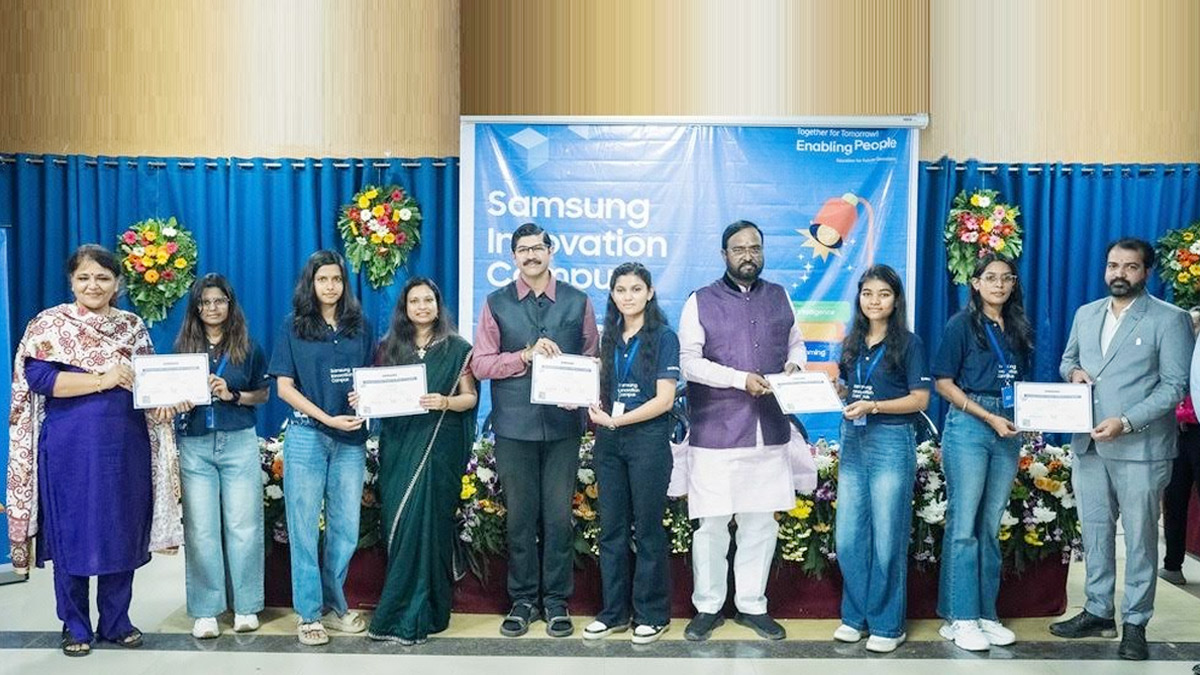
PUNE: Samsung has put 1,000 students in Maharashtra through a certified training programme in artificial intelligence and coding, the largest such drive the South Korean electronics company has run in the state and a signal that corporate India’s skilling ambitions are moving well beyond the boardroom brochure.
The certifications were awarded under Samsung Innovation Campus (SIC), the company’s flagship corporate social responsibility programme, which launched in India in 2022 with the stated aim of democratising access to future-technology education. The 1,000 graduates were drawn from four institutions: 127 from Savitribai Phule Pune University, 373 from Pimpri Chinchwad University, 250 from D.Y. Patil University’s Ramrao Adik Institute of Technology and 250 from Anjuman-I-Islam’s Kalsekar Technical Campus. All completed training in either AI or coding and programming, the two disciplines Samsung has identified as the critical pillars of the digital economy.
The programme does not stop at technical training. Soft-skills development and career-readiness modules are baked into the curriculum, a deliberate attempt to close the gap between what universities teach and what employers actually want.
“India’s digital growth story will ultimately be shaped by the quality of its talent pipeline,” said Shubham Mukherjee, head of CSR and corporate communications at Samsung Southwest Asia. “As technologies like AI move from the periphery to the core of industries, skilling must evolve from basic training to building real-world capability. This milestone in Maharashtra reflects how industry and academia can come together to create a future-ready workforce that is both globally competitive and locally relevant.”
The Maharashtra drive sits within a rapidly scaling national effort. Samsung Innovation Campus trained 20,000 young people across India in 2025, hitting its stated target for the year. Women account for 48 per cent of national enrolments, a figure the company cites as evidence of its push for an inclusive technology ecosystem. The programme is implemented in partnership with the Electronics Sector Skills Council of India and the Telecom Sector Skill Council.
Samsung, which is marking 30 years in India this year, runs SIC alongside two other initiatives, Samsung Solve for Tomorrow and Samsung DOST, as part of a broader effort to build what it calls a generation of innovators with both the technical depth and the problem-solving mindset to thrive in a fast-moving digital world.
A thousand certified students is a tidy headline. Whether they find jobs that match their new skills is the harder question, and the one that will ultimately determine whether corporate skilling programmes like this one are genuine pipelines or well-photographed gestures.






