MAM
Crypto platforms ramp up ad spends this festive season


Mumbai: As the market pins its hope on the festive season for a hike in sales, the crypto exchange platforms too aren’t lagging behind in wooing users to invest in the digital asset class. In an evident change from last year when the platforms were cautious and muted in their approach, they are all set to make the most of the opportunity this year, with an increase in ad-spend across all media.
Apart from the digital, crypto brands are also opting for mass mediums such as TV and print as they plan an advertising salvo. The fledgling industry is trying to mark a dent in the market with promotions and marketing activities involving audio-visual podcasts and even full front-page displays in leading dailies.
One such platform, which has been investing heavily in print is CoinSwitch Kuber, which claims to have onboarded as many as 10 million users already. The brand has come out with full front-page ads in leading newspapers in the last few days. “Print is always a viable medium. While digital media enables us to target a certain set of audiences, print has the accessibility to the most basic audience group which finds credibility in the print news,” said CoinSwitch Kuber chief business officer Sharan Nair.

The brand is also constantly connecting and engaging with local newspapers, media, and prominent ‘finfluencers’ (finance-influencers) on social media platforms to reach its target set.
“Traditional media can make audiences search and engage with them on the website, while digital media through apps can be used to continue re-targeting the interested segment,” said Havas Media India managing partner – South Saurabh Jain, highlighting that crypto platforms need to focus on “building the top of the funnel first” to attract new retail investors since the penetration of this category is currently low. Jain recommends a 65 per cent spend on traditional media and 35 per cent on digital display plus programmatic spends in this phase, as the threshold costs associated with traditional media remains high.
A recent study by Havas Media Group India also highlighted how print remains one of the most trusted mediums to influence brand perceptions on critical factors like quality, price, and trust, despite the short-term interrupted circulations and de-growth of newspapers during the initial wave of the Covid-19 pandemic.
“Especially for new-age categories like crypto exchanges who are in their next phase of growth in India, it becomes even more crucial to target beyond the early adopters of this digital world by associating with traditional mediums like television and print,” added Jain. “Building trust will be key as a lot of uncertainty and risk has been associated with cryptos in the past. So, print will definitely be a viable medium to build credibility and trust.”
CoinSwitch Kuber is also planning to reach the audiences via emerging OTT platforms. It has already been working with Amazon Prime Video, and SonyLIV, and has partnered with Disney+ Hotstar for the current edition of the Indian Premier League (IPL) which resumed on Sunday. “Considering the huge traction we witnessed after the last IPL campaign, we are looking to promote crypto assets through upcoming sports events as it perfectly captures our target group, which is – upwardly, young and tech savvy-mobile Indians,” added the CoinSwitch Kuber chief business officer.
On the other hand, crypto trading platform Mudrex is completely targeting digital. The focus of the brand’s marketing campaigns for the coming months is primarily through influencers and creators on different platforms across the social spectrum.
“We believe the demographics of the investors and traders in the crypto market are such that the digital medium is best able to reach the target audience,” said CEO and co-founder Edul Patel. “At Mudrex, we usually associate with influencers who have a deep interest in cryptocurrencies and believe in the idea of smart investing and trading in the crypto market.”
Cryptocurrencies have gained traction over the past few months, and the subsequent interest from the investor sentiment, leading to rising trading volumes despite the regulatory uncertainty. As the brands try to cash in on this crypto gold rush ahead of festivals, there is also a need, however, to create more awareness and to share knowledge on the finer aspects of the virtual currency. And that is what CoinDCX is aiming at, through ‘DCX learn’ during the festive season.
“We have always tried to find fresh ways to entice and educate new investors through our marketing efforts. One of our main objectives is to raise awareness about the cryptocurrency business and urge Indians to consider it as a viable investment option,” said CoinDCX head of brand and communication Ramalingam Subramanian.
The brand has recently come out with a campaign #BitcoinLiyaKya, which was in line with its direction of raising investor awareness and CoinDCX plans to build on that. “We are offering coupon codes of Rs 100 worth of bitcoins to everyone who signs on the exchange for the first time to raise curiosity among prospective new users. This encourages them to learn more about crypto, and interests them to enter the space,” explained Subramaniam adding that the brand is also looking to form new brand alliances to enable the users.
According to the crypto platforms, the interest in dealing in the new asset class is definitely increasing among Indians.
To put it in perspective, India today ranks second in terms of crypto adoption worldwide, ahead of countries such as the US, UK, and China, according to the 2021 Global Crypto Adoption Index by blockchain data platform Chainalysis. This is chiefly led by crypto adoption in the smaller towns of India. Currently, active crypto users in the country are around 15 million with the number of blockchain startups going up to over 300 in the current year.



MAM
India’s financial sector spent less on TV ads in 2025 but flooded the internet
Banks, insurers and lenders cut tv ads as digital jumps, LIC and Muthoot lead tv and Axis Bank tops online
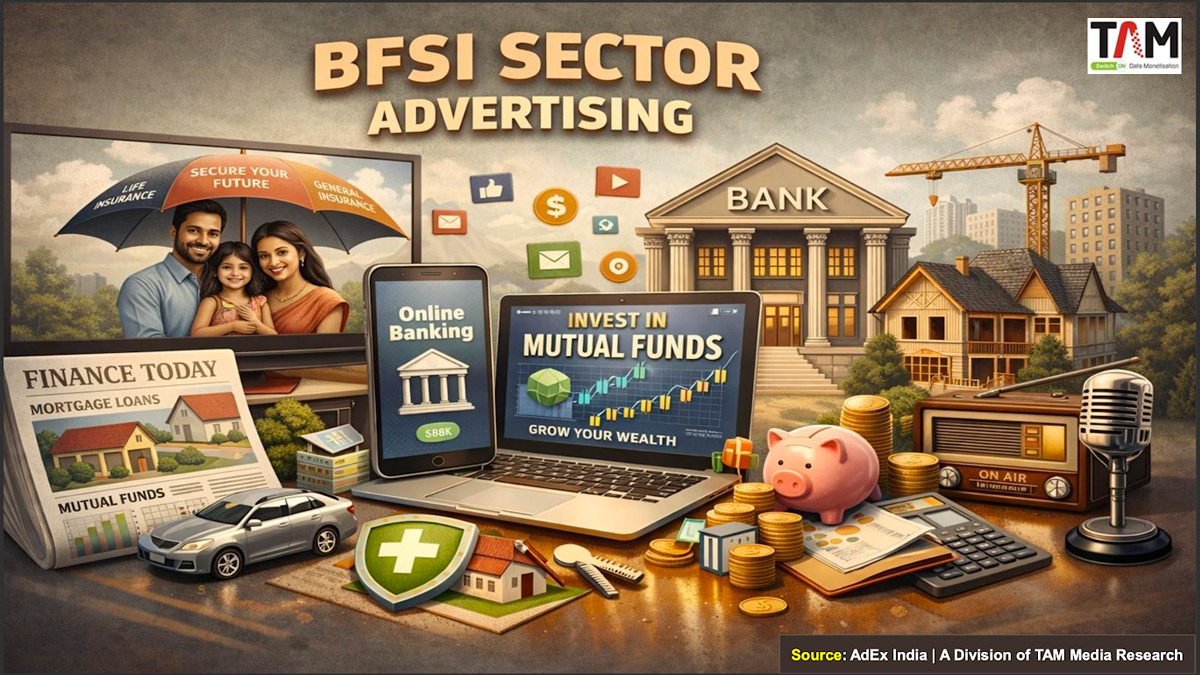
MUMBAI: India’s banking, financial services and insurance sector, one of the most prolific advertisers in the country, delivered a split verdict on media in 2025. It spent less on television, held its nerve in print, turned up the volume on radio and deluged the internet with a ferocity that left every other medium looking pedestrian. The picture that emerges from TAM AdEx’s cross-media report for the BFSI sector is of an industry in transition, still wedded to the news bulletin but increasingly seduced by the algorithm.
Television: a retreat with caveats
TV ad volumes for the BFSI sector fell 16 per cent in 2025 compared with 2024, a sharp reversal after two years of consistent growth that had pushed volumes 16 per cent above 2021 levels by 2023 and a further 7 per cent higher by 2024. Within 2025 itself, the drop was concentrated in the middle of the year: the second and third quarters saw ad volumes slide 35 per cent each against the first quarter, with a partial recovery of 13 per cent in the fourth.
The retreat did not reshuffle the deck. Life insurance retained first place among TV categories with 19 per cent of ad volumes, mortgage loans held second with 16 per cent, and the top ten categories together accounted for 82 per cent of all BFSI television advertising. The dominance of news channels was equally pronounced: news claimed 68 per cent of ad volumes, general entertainment channels a distant 14 per cent and movies 12 per cent. Together, news and GEC captured 82 per cent of the sector’s television spend. News bulletins alone took 48 per cent of programme-genre volumes, with feature films second at 12 per cent. Prime time, between 6pm and 11pm, drew 34 per cent of ad volumes, followed by afternoon at 22 per cent and morning at 20 per cent. A full 82 per cent of all ads ran between 20 and 40 seconds.
Life Insurance Corporation of India was the sector’s biggest TV spender with 11 per cent of ad volumes. Muthoot Financial Enterprises came second with 9 per cent, followed by National Payments Corporation of India at 6 per cent, Tata AIG General Insurance at 5 per cent and State Bank of India at 5 per cent. The top ten advertisers together accounted for 51 per cent of total TV volumes. Three names were new to the top ten in 2025: Tata AIG General Insurance, IIFL Finance and Tata Capital. At brand level, Muthoot Finance Loan Against Gold led with 9 per cent share, Tata AIG Health Insurance entered the top ten for the first time, and the top ten brands together contributed 35 per cent of ad volumes.
Print: the long climb continues
Print told a different story. Ad space for the BFSI sector has grown every year since 2021, rising 16 per cent in 2022, 30 per cent in 2023, 51 per cent in 2024 and 64 per cent in 2025, all measured against a 2021 baseline. Within 2025, ad space was flat in the second quarter but surged 46 per cent in the third and 33 per cent in the fourth compared with the first. Life insurance led print categories with 21 per cent of ad space, followed by mutual funds and banking services and products at 13 per cent each, and corporate financial institutes at 11 per cent. The top ten categories together took 82 per cent of print ad space. LIC led print advertisers with 6 per cent share, and the top ten together covered just 19 per cent of ad space, a reflection of how fragmented print spending remains. Three new entrants joined the top ten in 2025, with Billion Brains Garage Ventures the only exclusive presence not seen in 2024’s list. In the top ten brands, LIC dominated with a 2 per cent share, while Nippon India Mutual Fund rose to third position from fourth in 2024. English accounted for 62 per cent of print ad space, Hindi for 20 per cent. Business and finance publications took 59 per cent of the genre split. The south zone led regional spending with 33 per cent of print ad space, Bangalore topping that zone, while New Delhi and Mumbai were the leading cities nationally.
Radio: louder than ever
Radio ad volumes for the BFSI sector have climbed steadily, rising 12 per cent above 2021 levels in 2023, 36 per cent in 2024 and 45 per cent in 2025. The quarterly pattern within 2025 was volatile: a sharp drop of 43 per cent in the second quarter and 42 per cent in the third, followed by a near-full recovery in the fourth. Life insurance led radio categories with 22 per cent of volumes, banking services and products second at 14 per cent and corporate NBFCs third at 11 per cent. LIC of India held its position as the leading radio advertiser with 20 per cent of ad volumes; the top ten radio advertisers together covered 69 per cent. Muthoot Financial Enterprises led radio brands with 10 per cent share, five of the top ten brands belonged to LIC alone, and SBI Mutual Fund made a remarkable leap to fifth position from 272nd in 2024. Evening and morning time-bands together captured 84 per cent of radio ad volumes, with evenings at 44 per cent and mornings at 40 per cent. Maharashtra was the leading state for radio BFSI advertising with 18 per cent share; Maharashtra, Gujarat and Uttar Pradesh together accounted for 43 per cent.
Digital: the five-times surge
If one number defines the 2025 BFSI advertising story, it is five. Digital ad impressions for the sector multiplied fivefold between 2021 and 2025, having already doubled in 2023 and doubled again in 2024 before the 2025 leap. Within the year, impressions dipped 19 per cent in the second quarter and 12 per cent in the third before recovering 8 per cent above the first quarter by the fourth. Banking services and products led digital categories with 27 per cent of impressions, life insurance and credit cards tied at 19 per cent each, and securities and sharebroking organisations fell from first place in 2024 to fourth in 2025. Axis Bank was the runaway leader among digital advertisers with 12 per cent of impressions, followed by ICICI Bank at 9 per cent, IDFC First Bank at 7 per cent and Kotak Mahindra Bank at 6 per cent. The top ten digital advertisers covered 59 per cent of impressions, and seven of them were new entrants compared with 2024, signalling rapid churn in the digital spending hierarchy. At brand level, Axis Bank led with 9 per cent, ICICI HPCL Super Saver Credit Card vaulted to third place from 921st in 2024, and six of the top ten digital brands were new to the list. Programmatic buying accounted for 91 per cent of all digital BFSI transactions; combined with ad networks, it captured 96 per cent.
The data from TAM AdEx paints the portrait of a sector that still believes in the power of the television news bulletin to sell insurance to the masses, but increasingly knows that the next generation of borrowers, investors and cardholders is scrolling, not watching. The race is now on to reach them before the algorithm serves up someone else’s loan offer first.






