MAM
Crocodile to launch home collection segment

MUMBAI: The internationally renowned Crocodile brand known for its “relax” wear at “value for money” positioning is expanding its range. Crocodile Products India (CPPL) a joint venture between the Rs 640 million Shivrams Associates of Coimbatore and the US $2.6 billion Singapore based Crocodile International Pte (CIPL), is planning to launch five new products during the current year.
In addition to four new launches in the garments category, CPPL will also be launching the home collection. The new product line up includes womenswear, childrenswear, two variants of men’s shirst and home furnishings.
CPPL currently markets 11 product lines, which are available all India now. The product lines will be increased to 30 by the end of 2003, according to a release. Internationally, Crocodile retails over 240 products. The release also adds that the brand’s USP lies in the fact that its products are priced 30 per cent lower than the competition.

“We continue to foresee a rapid growth in both knits and wovens, as we expand our customer base. Our obsession is to take Crocodile to every nook and corner of India and make our consumers experience Crocodile as a complete lifestyle brand. Looking forward, we will continue to increase the retail store network to 90 by the end of 2003. We would also step up our presence in multibrand outlets and convenience stores,” adds CPPL MD Venkatesh Sivaraman.
Recently, the Images Fashion Awards, instituted by a retail trade magazine placed the Crocodile brand among the top four brands in the country for its superior retail chain development, even as the CPPL MD Venkatesh Sivaraman was nominated among the top four professionals in the branded garments industry.
The awards instituted by Images Magazine aims to honour outstanding performers in the business of Fashion. The third edition of the award ceremony was held in Mumbai recently.
Sivaraman was quoted as saying: “We are honoured with this recognition. This is a strong reflection of our industry response. We are pleased with our performance, particularly with the retail sales of our core product categories.”
Nominations were judged on the following parameters: IFA Jury honoured outstanding performances amongst fashion, brand and retail professionals, companies, campaigns and new launches. These awards were based on over 15,000 nominations received from the industry followed by a systematic selection process wherein the verdict of jury would be considered as final.
IFAs include two categories of awards: popular awards and industry awards. The popular awards identify the top fashion brands of the country. For this, Images undertook a nationwide consumer survey with CVOTER, wherein more than 6500 up-market buyers give their verdict on their favourite brands. The final outcome was a scientific aggregation of factors based on top-of-mind recall, actual purchases and consumers’ choice for the next buy.
The brand has been positioned on its international retail philosophy of “value for money”. As a result, Crocodile has clearly emerged as a quality lifestyle brand which provides its customers lasting value in terms of quality, style as well as pricing.
CPIL is a premier garment house of South Asia with accent on casuals and relaxed life style products. This global player based in Singapore has its brands and businesses spread over the continents. Japan, Singapore, Malaysia, Taiwan, China, Nepal, Thailand and South East Asia are its strong holds with a combined turnover of over 2.6 billion Singapore dollars.
The Images Fashion Awards claims to be the sole voice of India’s brand-driven fashion retail market, felicitates the country’s most admired fashion brands, companies, stores and professionals for their outstanding achievements. With recognition from the government and the trade, Images Awards are regarded as the highest accolade in the business of fashion, a release claims.



MAM
One Hand Clap acquires Agenseed to enter distribution space
Creative agency expands into full-stack services with strategic buyout.
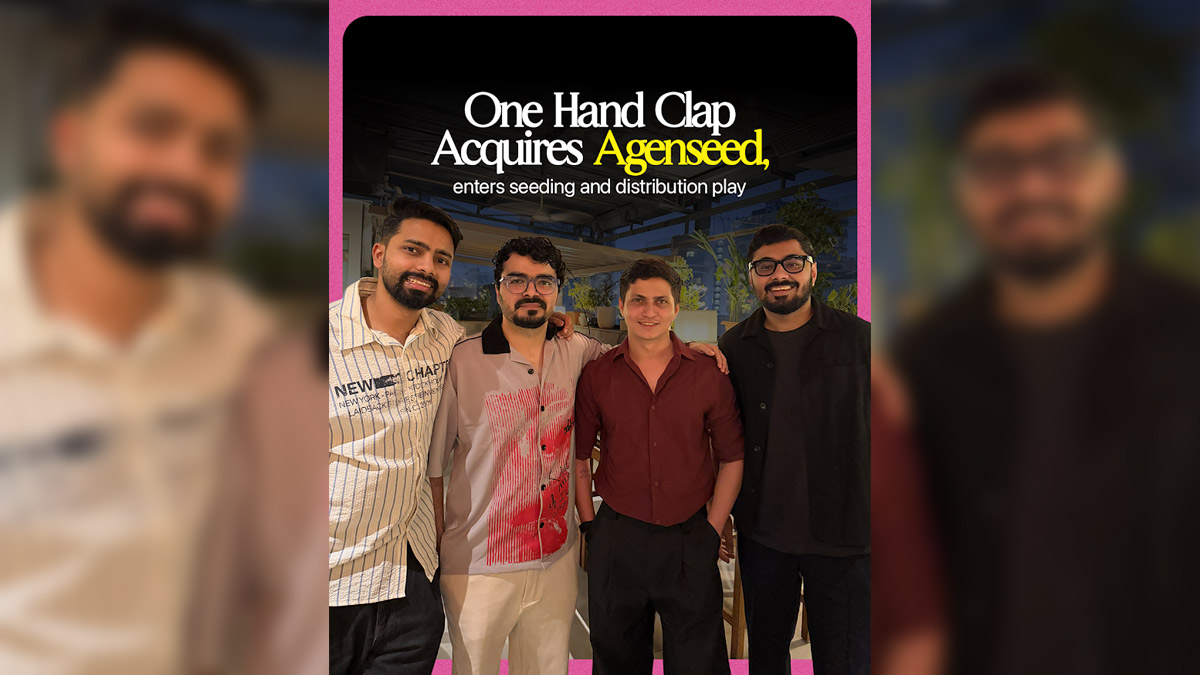
MUMBAI: One Hand Clap has decided to stop just clapping for great ideas now it wants to make sure they actually travel. The leading new-age creative agency and production house has acquired Agenseed, a seeding and distribution firm, marking its formal entry into the distribution segment. The move is aimed at expanding its role across the entire marketing value chain and unlocking new growth opportunities.
One Hand Clap expects the new distribution vertical to contribute up to 15 per cent of its overall revenues over the next 12–18 months, signalling a clear strategic shift beyond pure creative services.
Agenseed, founded by Monish Hardasani and Akram Malik, will function as the agency’s dedicated distribution arm. This acquisition strengthens One Hand Clap’s position as it aims to become a full-stack creative and distribution company in India’s rapidly growing digital advertising market.
With over 90 million posts shared daily on Instagram and brands allocating 25–35 per cent of their digital budgets to distribution and creator-led reach, amplification has become critical to campaign success. By integrating distribution early into the creative process, the agency hopes to help campaigns gain stronger cultural traction and momentum.
One Hand Clap founder Aakash Shah said, “The future of advertising is not just about executing great ideas, but about placing them intelligently. By owning both storytelling and distribution, we can drive greater impact for brands while opening up new revenue streams.”
Agenseed co-founder Monish Hardasani added, “The future belongs to ideas designed to travel. This partnership allows us to integrate distribution thinking at the source.”
Founded in 2019 by former AIB leaders Aakash Shah and Naveed Manakkodan, One Hand Clap has worked with major brands including Swiggy, Google, Netflix India, Crocs, Duolingo, CRED, Bumble, BGMI and Chetak. The agency also secured investment from Zerodha co-founder Nikhil Kamath last year.
In an increasingly fragmented attention economy, this acquisition reflects a broader industry shift where agencies are building end-to-end capabilities to stay competitive. One Hand Clap is clearly clapping louder and ensuring its ideas now reach much further.






