MAM
Cheil India rebrands as Cheil SWA Group, builds full-funnel marketing arsenal for the future

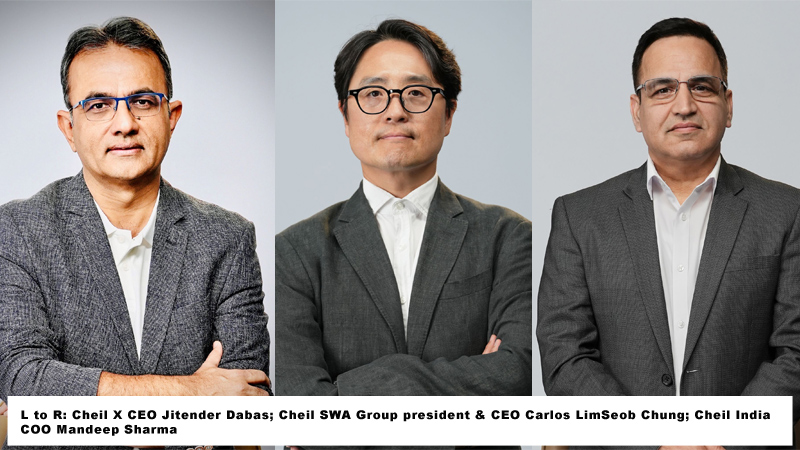
MUMBAI: Cheil India just hit refresh. On 1 May 2025, the agency formally announced its rebranding into the Cheil SWA Group, marking a strategic expansion of its services to meet the evolving needs of modern marketers. From being Samsung’s in-house agency in 2003 to becoming a multi-pronged marketing ecosystem, the transformation signals its ambition to own the entire value chain—creativity, commerce, content, and conversion.
At the helm is Cheil SWA Group president & CEO Carlos LimSeob Chung. Jitender Dabas joins as Cheil X CEO, the creative and strategy wing serving non-Samsung clients, while Mandeep Sharma takes over as Cheil India COO, driving CRM and customer experience across the group.
Guided by the philosophy ‘Impact Every Moment’, Cheil SWA Group now operates through seven specialised companies:

1 Cheil India (Samsung Business): Continues as Samsung’s integrated agency, delivering on creative, retail, digital, and brand experiences.
2 Cheil X: Expands creative and strategy solutions to global and Indian brands beyond Samsung, with a recent footprint added in Mumbai.
3 Experience Commerce: The digital marketing and tech arm acquired in 2017. Houses an Offshore Development Center (ODC) for the global Cheil network and boasts consistent double-digit growth.
4 Cylndr: The content production studio for VFX, CGI, and end-to-end video creation.
5 Digital media and influencer marketing: A 300+ member strong vertical specialising in performance marketing, influencer engagement, and D2C solutions.
6 NewRx: The retail design and store innovation unit handling everything from concept to execution.
7 Cheil GDC: The data analytics hub that drives automated marketing through real-time consumer insights.
Together, these arms position Cheil SWA Group at the confluence of creativity, commerce, and data—ready to deliver fully integrated campaigns that are not just pretty, but performance-driven.
“Today’s marketing landscape demands integrated thinking and specialised execution,” said Chung. “Our transformation into Cheil SWA Group is a natural evolution of our capabilities, allowing us to offer clients seamless access to world-class expertise across every touchpoint of the consumer journey.”
From a Samsung-only outfit to a group built for tomorrow’s marketing challenges, Cheil SWA Group is laying claim to the full funnel—pixel to purchase.




Brands
Maharashtra panel orders Lodha to refund Rs 5 crore to homebuyers
Consumer court flags unfair practices in long-running property dispute case
MUMBAI: In a sharp rebuke to one of India’s biggest real estate players, the Maharashtra State Consumer Disputes Redressal Commission has directed Macrotech Developers to refund nearly Rs 5 crore to a senior citizen couple, Uttam and Anindita Chatterjee. The ruling, delivered on March 13, 2026, calls out the developer for “deficiency in service” and “unfair trade practices”, bringing closure to a dispute that has stretched over a decade.
The case traces back to 2015, when the couple booked a 3-BHK flat at World Towers in Lower Parel for Rs 12.22 crore, with possession promised within a year. What followed was a series of changes that complicated matters. After deciding to exit the project, they were persuaded to shift to a 4-BHK in another development priced at Rs 8 crore, with delivery scheduled for 2018. However, within months, the price was allegedly increased to Rs 10 crore. After demonetisation reshaped the market, similar flats were reportedly being offered at lower prices, but the couple were not given the benefit.
Despite paying over Rs 2.83 crore, the couple neither received possession nor clarity. Instead, in 2018, the developer unilaterally cancelled the booking, retained part of the amount as earnest money, and argued that the buyers were investors rather than consumers. The commission rejected this claim, observing that casual references to “investment” do not take away consumer rights when the purchase intent is residential.
The bench also held that the developer could not penalise buyers for payment delays while failing to meet its own delivery commitments. It noted the lack of formal documentation for revised terms and termed the prolonged retention of funds without delivering a home as exploitative.
As part of its order, the commission directed the developer to refund Rs 2.83 crore paid by the couple, along with interest at 10 per cent per annum, amounting to around Rs 2.12 crore. In addition, Rs 1 lakh has been awarded for mental agony and Rs 50,000 towards litigation costs, taking the total payout to over Rs 5 crore. The developer has been asked to comply within two months.
For now, the ruling serves as a reminder that in real estate, shifting terms and delayed promises can carry a significant cost.