MAM
Call to experiment with new platforms, technologies: CII seminar


MUMBAI: While new technologies have the risk of copyright violation it is important for the Indian entertainment industry to explore the possibilities offered by new delivery platforms whether it is IPTV, mobile, DTH.
At the same time the rights situation particularly for the film industry needs to be made clearer.
This was one of the points stressed at a panel discussion organised as part of the Confederation of Indian Industries (CII) Legal Workshop this morning. The speakers were Sony head – licensing and telephony Kaushal Modi, Hutchison Essar VP value added services S.P. Narayanan, UTV VP international Ashoka Holla and consultant Raj Tilak. The session was moderated by Tata Teleservices VP value added services Pankaj Sethi.

Modi pointed out that with new distribution platforms emerging the rights situation for the older film titles is not clear. There is more clarity regarding the newer titles but there is more work to be done. Definitions need to be clear like Vod, Pay per view.
Tilak says that the film industry needs to come together and form a common standard that will be adhered to by both buyers and sellers. A common body needs to be set up who will interpret the rights situation in a uniform manner. In the US for instance video on demand is not a right by itself. It is segmented in different platforms. Unfortunately among some Indian filmmakers there is a lack of understanding about the emerging technologies. So perhaps distributors of content need to sit down with content creators and explain to them the different ways in which content can be exploited for the mutual benefit of both parties.
He also suggests a robust system of arbitration be put in place. So any dispute over revenue sharing or who has the rights can be brought before a panel whose word in the matter will be final.
Holla said that content creators compound the situation by sometime abusing the rights of their own property. So sometimes the DVD release date is brought forward and is available before the film has had a decent run in theatres. For UTV which distributes its own films and those of other producers this poses a problem he says. Creators need to respect the different windows of release.
Modi spoke about the need for content owners to experiment with new platforms and modes of distribution. He gave the example of music ringtones which have become very profitable despite the music industry’s fear of copyright issues in new media.
The situation though requires planning on the part of the content creator and provider says Modi. It is not that there is a simply readymade new media platform that a content owner whether it is film or television can just put his offerings on and then start making money. The platform has to be grown and content has to be tailored. He says that Sony is experimenting with its own content rather than what is aggregated. When it acquires content like formats it is usually for all formats to avoid confusion later on.
Sure some people try to use software to forward ringtones and wallpapers on the mobile but that is small compared to the opportunity that exists. Another area of new media is mobile. Here too there are grey areas. A case in point is SMS updates on cricket news scores. While cricket news is available if it is used by a mobile operator for commercial purposes then a case can be made that there is a copyright issue. Right now a lot of operators offer cricket scores and updates. However the BCCI is wisening up and is looking at the mobile as a huge opportunity.
After all if news channels pay for news clips of cricket matches then why shouldn’t mobile firms pay for using scores to boost their SMS facility. There is a case going on in the Madras High Court regarding the use of SMS to offer cricket scores. The Formula One body got strict on use of SMS alerts on race status.
Another new media arena that can be looked at as a friend rather than a foe are the community sites like myspace. There are videos uploaded some of which are copyrighted. At the same time content creators can use community sites which attract millions of users as a place to sell their product offerings in the form of paid downloads.
Narayanan dwelt on how compression techynology has helped the mobile become a tool for value added offerings. Now one can download full music tracks. Java and bluetooth has taken mobile gaming to another level. The memory storage in handsets will grow. Therefore mobile games can afford to become more complex and content rich. data connections speeds have grown. So content can be relayde to diffeernt devices.






Brands
KKR sixes to power EV charger rollout under VIDA campaign
Cricket meets clean mobility as big hits spark India’s charging growth
NEW DELHI: VIDA, the electric mobility arm of Hero MotoCorp, has teamed up with Kolkata Knight Riders to launch a campaign that turns cricketing flair into real-world impact.
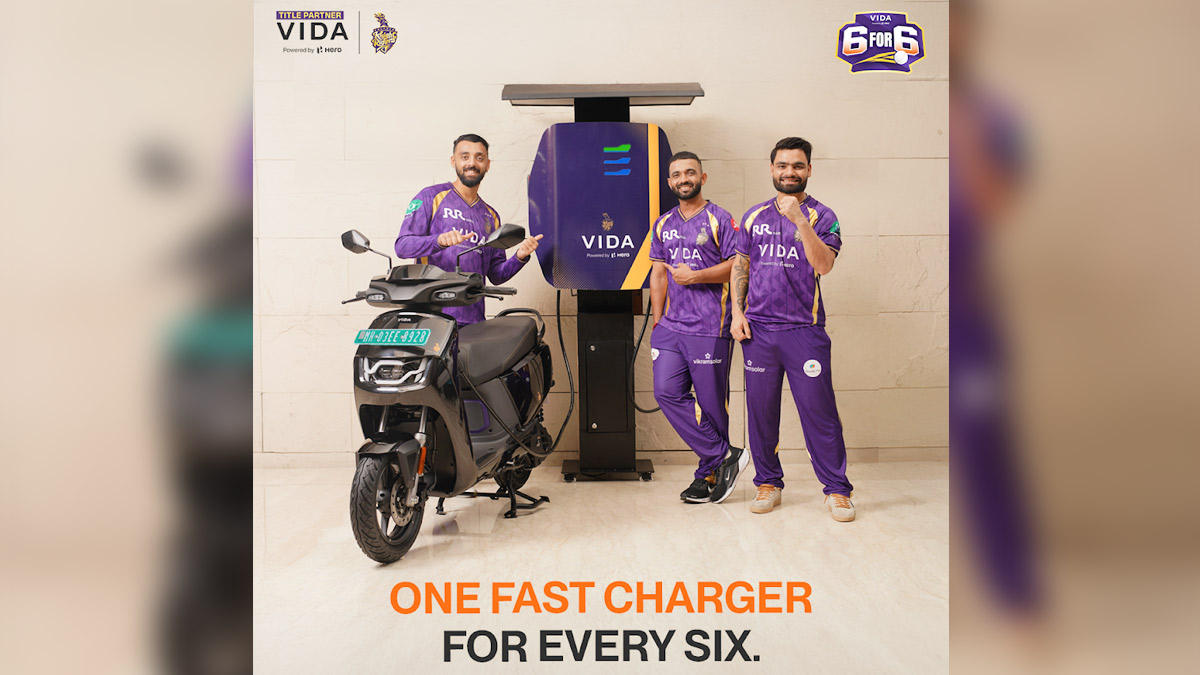
Titled ‘6 for 6’, the initiative promises to install a 6kW fast EV charger for every six hit by KKR during the ongoing Indian Premier League season. The idea is simple but powerful, as each big hit on the field contributes directly to expanding India’s fast-charging infrastructure.
The campaign builds on VIDA’s growing network, which already spans over 5,300 fast-charging points across more than 430 cities. With EV adoption gaining pace, the brand is using cricket’s mass appeal to accelerate both awareness and infrastructure growth.
Explaining the thinking behind the move, Hero MotoCorp emerging mobility business unit chief business officer Kausalya Nandakumar said, “Cricket has an incredible ability to unite and inspire millions across the country. With the ‘6 for 6’ campaign, we are turning every big hit on the field into a step towards a cleaner and a more accessible mobility future.”
She added that VIDA’s expanding fast-charging network and removable battery technology are designed to make EV ownership more convenient and practical for everyday users.
From the franchise’s side, the campaign is also about giving on-field moments a larger purpose. Kolkata Knight Riders chief executive officer Venky Mysore said, “The ‘6 for 6’ campaign exemplifies the potential of sport as a platform for meaningful, real-world impact. By linking every six to the expansion of EV charging infrastructure, this partnership transforms fan excitement into tangible progress.”
As part of the rollout, VIDA has introduced co-branded charging stations in KKR’s signature colours, with a flagship installation unveiled alongside team players. The chargers are designed for quick top-ups, powering VIDA scooters from zero to 80 percent in about an hour, while also being positioned along key highways to support longer journeys.
The initiative also taps into VIDA’s removable battery system, which allows users to charge using standard household plug points, adding flexibility to the charging ecosystem.
By blending the thrill of cricket with the urgency of clean mobility, VIDA and KKR have found a neat way to make every six count twice, once on the scoreboard and again on India’s road to an electric future.








