Brands
“Build systems where women don’t have to fight to survive”: Crossword director Nidhi Gupta ahead of Women’s Day
The director of India’s best-loved bookstore chain talks shelf life, staying power and why a good book still beats a same-day delivery


MUMBAI: There is something quietly subversive about walking into a Crossword bookstore. In an age when algorithms tell us what to read, wear and watch, here is a place that still trusts you to browse, wander and be surprised. Nidhi Gupta, director at Crossword, is very much a product of that philosophy: thoughtful, unhurried and refreshingly direct. In a wide-ranging conversation, she spoke about leading in a room that does not always expect you, selling books in the age of Amazon, and why resilience, for women at the top, is as much a symptom of the system as it is a virtue.
That idea of resilience surfaces quickly when the conversation turns to women in leadership. It is a word that seems to follow female executives everywhere. Why, one wonders, is it always resilience? Is it because the system demands more of them? Gupta thinks so, and she is precise about it. “Resilience is often associated with women’s leadership because the path hasn’t always been equally structured for them,” she says. “Many women navigate additional expectations and balance multiple roles to access the same opportunities.” She is not complaining; she is diagnosing. The real ambition, she adds, is something bigger: “The goal should be to build systems where resilience becomes a strength to thrive, not just a requirement to survive.” The difference, she implies, is everything.
Has she ever felt that gap personally? In a boardroom, say, where the room wasn’t quite ready for her? “At times, yes,” she concedes. But rather than bristle or over-explain, she says she learnt to treat those moments as openings. “I’ve grown to see it as an opportunity to let perseverance and preparation do the talking. Over time, consistent performance and thoughtful decision-making build credibility. Ultimately, the most effective response is to focus on the work and let results speak for themselves.” It is, delivered quietly, rather a formidable answer.

“The goal should be to build systems where resilience becomes a strength to thrive, not just a requirement to survive.”
Away from the boardroom and back to the bookshop floor, Gupta is animated by a different kind of challenge: keeping reading itself alive in a world of fifteen-second videos and next-day delivery. Her answer is instinctive. “In a fast-paced digital world, reading has become a safe haven, a respite from screens and the constant overflow of content,” she says. “Creating spaces where people can unwind, connect and discover books helps make reading feel aspirational again. When people find stories that resonate with them, the habit naturally finds its way back into their lives.” Crossword, in her telling, is less a shop and more a cure.
Running that shop, of course, is the harder part. Physical retail has a formidable rival in the form of a website that will deliver your book by morning, often cheaper. Gupta does not flinch from the reality. “One of the toughest challenges is competing with the convenience and speed that online platforms offer,” she says. But she is equally clear about her answer: stop trying to out-Amazon Amazon. “Physical retail has to go beyond just selling products and focus on creating meaningful in-store experiences. The real opportunity lies in building spaces that offer discovery, community and human connection, things that algorithms cannot easily replicate.”
The pandemic, oddly, handed her a piece of evidence for exactly that argument. Consumer behaviour shifted in ways that surprised even seasoned retailers. “A noticeable shift has been the renewed desire for real-world experiences,” she observes. After long months online, people began gravitating back towards physical spaces, slower rhythms and meaning. “In retail, this means customers are not just looking to buy something but to discover, connect and spend time in meaningful environments.” For a bookstore, that is rather good news.
“Impact, to me, means making a difference in the lives of the people you touch – the teams you work with, the customers you serve and the authors creating meaningful work.”
Then there is the price question, the one that follows every physical retailer around like a persistent rain cloud. Is it a losing battle? Gupta refuses to frame it that way. “Price can be a challenge for physical bookstores when compared to online platforms. But bookstores don’t compete on price alone,” she says. “Our strength lies in discovery, curation and experience. When customers walk into a store, they are not just buying a book, they are discovering ideas, authors and stories they might never have found.” No algorithm, however finely tuned, can quite manufacture the feeling of stumbling upon a book that feels made for you.
Quick-commerce now wants a piece of the book category too, those apps promising delivery in twenty minutes. Threat or opportunity? She doesn’t hesitate. “Opportunity. Quick-commerce expands access and convenience for readers, especially for impulse or last-minute purchases. Physical bookstores continue to offer discovery, curation and community experiences that digital platforms cannot replicate, so both can coexist in meaningful ways.” One sells you the book you already want before midnight. The other introduces you to one you didn’t know existed.
As the business grows, the question of what scale actually demands comes into focus. At what point does ambition give way to process? “Once you connect with your customer and begin to understand what they’re truly looking for, the focus naturally shifts to operational discipline, efficiency, customer experience and thoughtful curation,” she says. “As the network grows, consistency in experience, supply chain efficiency and financial control become critical. Sustainable growth ultimately comes from balancing vision with strong systems and processes.” A bookshop can have soul and a spreadsheet. She seems to manage both.
And what does she actually want from all of it? Revenue, reach, the satisfaction of a well-run balance sheet? None of those, it turns out, come first. “Impact, to me, means making a difference in the lives of the people you touch, the teams you work with, the customers you serve and the authors creating meaningful work,” she says. “I believe our role is to get good books into the world and encourage more young people to read. If we can enrich lives through the power of books, that is real impact.” Idealistic, she might admit. But idealism, deployed strategically, tends to outlast cynicism on most balance sheets.
The book that has shaped her own thinking most is Phil Knight’s Shoe Dog, the memoir of building Nike from nothing. “The book is an honest account of building something meaningful through persistence, experimentation and belief in a vision,” she says. “What stayed with me most is the reminder that leadership is rarely linear. It’s about resilience, trusting your instincts and building something that people truly believe in.” The parallel to her own story is not hard to spot.
“Leadership and personal life are not mutually exclusive. With the right support systems and balance, women can build meaningful careers while also nurturing their personal lives.”
For the women who will come after her, she is clear about what she hopes they inherit. “I would hope the next generation of women inherits resilience, faith in themselves and the confidence to pursue their ambitions without self-doubt,” she says. “Women often balance many roles, and the ability to do so with strength and clarity is powerful.” And the stereotype she most wants to see the back of? The stubborn idea that a woman in leadership must choose between her career and her personal life. “One stereotype I actively reject is that women leaders must sacrifice their family life to succeed, or that they cannot have everything,” she says. “Leadership and personal life are not mutually exclusive. With the right support systems and balance, women can build meaningful careers while also nurturing their personal lives.” It is a line delivered not as comfort but as a correction.
Nidhi Gupta runs a company built on the premise that people still want to hold a book in their hands and be surprised by what they find inside. In a world of frictionless convenience, that is either hopelessly romantic or shrewdly counter-cultural. Judging by Crossword’s endurance, it is rather more the latter.







Brands
Samsung certifies 1,000 Maharashtra students in AI and coding
The South Korean electronics giant marks its first large-scale skilling push in the state, with women making up nearly half the national programme’s enrolment
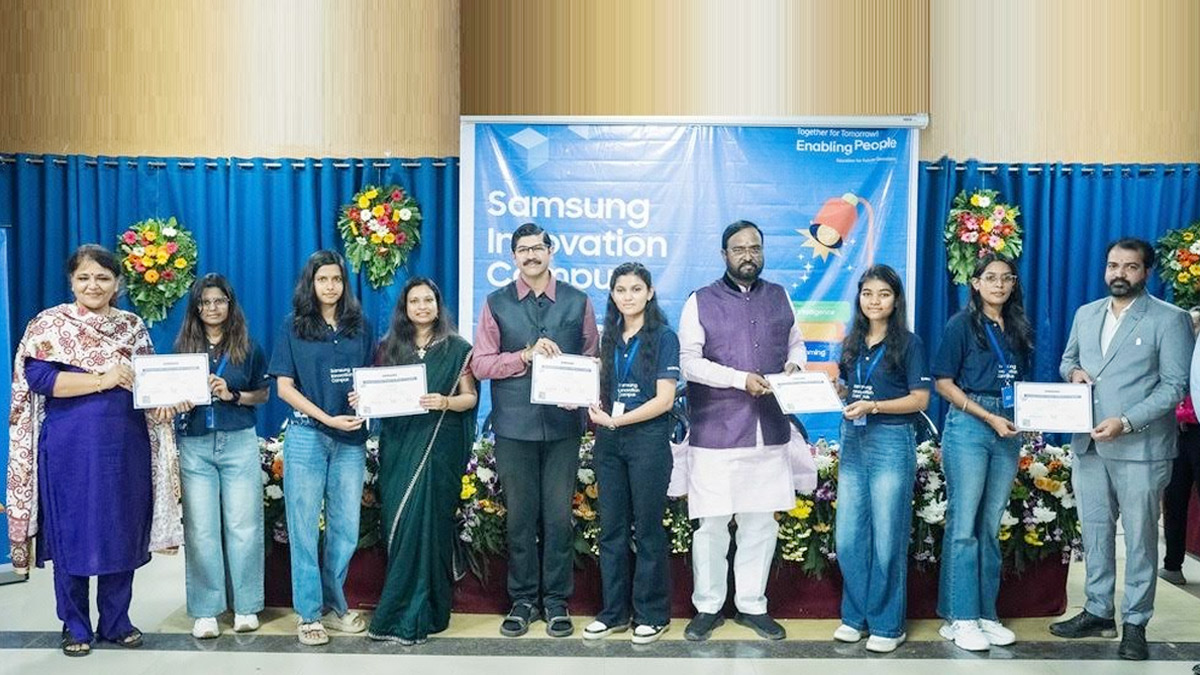
PUNE: Samsung has put 1,000 students in Maharashtra through a certified training programme in artificial intelligence and coding, the largest such drive the South Korean electronics company has run in the state and a signal that corporate India’s skilling ambitions are moving well beyond the boardroom brochure.
The certifications were awarded under Samsung Innovation Campus (SIC), the company’s flagship corporate social responsibility programme, which launched in India in 2022 with the stated aim of democratising access to future-technology education. The 1,000 graduates were drawn from four institutions: 127 from Savitribai Phule Pune University, 373 from Pimpri Chinchwad University, 250 from D.Y. Patil University’s Ramrao Adik Institute of Technology and 250 from Anjuman-I-Islam’s Kalsekar Technical Campus. All completed training in either AI or coding and programming, the two disciplines Samsung has identified as the critical pillars of the digital economy.
The programme does not stop at technical training. Soft-skills development and career-readiness modules are baked into the curriculum, a deliberate attempt to close the gap between what universities teach and what employers actually want.
“India’s digital growth story will ultimately be shaped by the quality of its talent pipeline,” said Shubham Mukherjee, head of CSR and corporate communications at Samsung Southwest Asia. “As technologies like AI move from the periphery to the core of industries, skilling must evolve from basic training to building real-world capability. This milestone in Maharashtra reflects how industry and academia can come together to create a future-ready workforce that is both globally competitive and locally relevant.”
The Maharashtra drive sits within a rapidly scaling national effort. Samsung Innovation Campus trained 20,000 young people across India in 2025, hitting its stated target for the year. Women account for 48 per cent of national enrolments, a figure the company cites as evidence of its push for an inclusive technology ecosystem. The programme is implemented in partnership with the Electronics Sector Skills Council of India and the Telecom Sector Skill Council.
Samsung, which is marking 30 years in India this year, runs SIC alongside two other initiatives, Samsung Solve for Tomorrow and Samsung DOST, as part of a broader effort to build what it calls a generation of innovators with both the technical depth and the problem-solving mindset to thrive in a fast-moving digital world.
A thousand certified students is a tidy headline. Whether they find jobs that match their new skills is the harder question, and the one that will ultimately determine whether corporate skilling programmes like this one are genuine pipelines or well-photographed gestures.






