MAM
Broadband is changing the dynamics of ad business in the US: Nielsen

MUMBAI: Nielsen Analytics in the US has released a new report revealing that advertisers and television programmers are finding new and more lucrative advertising opportunities with broadband video.
The study has also determined that the use of broadband video actually extends the reach of traditional TV, and that broadband consumers are young, affluent, highly educated, and tend to have high speed web access virtually 24/7, making it an integral part of their lifestyle.
The study, Whatever, Whenever, Wherever: How Broadband is Redefining the Economics of Television is authored by Nielsen Analytics head Larry Gerbrandt and completed in partnership with Scarborough Research.

He says, “By researching controlled broadband access, this study concludes that programmers have the opportunity to create new revenue models to benefit content owners and their affiliated stations. Such ad-supported models are uniquely adaptable to the broadband environment and are potentially superior to existing models because they can take full advantage of the digital environment. With broadband streams, for example, fast forwarding through commercials can be disabled making it more likely the consumers will watch the spots and possibly interact with them.”
Despite growing numbers of prime time television shows being streamed (or pre-viewed) on network web sites, or the increasing popularity of user generated content (UGC), there has been no measurable negative impact on traditional television viewing. Video on PCs and iPods actually is expanding the audience of traditional TV programmes, supported by the fact that total TV usage was at a record high in U.S. households at 8 hours, 14 minutes a day during the 2005-2006 TV season according to Nielsen Media Research data. Household viewing has risen more than an hour a day over the past decade – or more than a half hour more per person.
Gerbrandt adds, “Advertisers and programmers using broadband have a unique advantage in the increasingly competitive advertising world. Ad models can be customized and managed in a broadband environment, and interactivity can be embedded into the program in such a way as to enhance engagement which does not take viewers away from the enjoyment of the programme.”
Broadband Video Advertising Models: There is a general consensus that viewers prefer short web-served ads, though the market is split between 15-second and 30-second pre-rolls per program segment. Furthermore, because broadband video offers levels of interactivity and viewer engagement not possible in a traditional TV spot, that argues for a higher CPM.
But television – especially the ad-supported kind – works according to a very different revenue model, and systems such as broadband streaming and downloading, could represent a new frontier to be explored and exploited. However, the posting of copyrighted content to web sites still presents challenges that remain to be litigated.
About the Broadband Consumer: Broadband access across the US has reached critical mass and is having a clear impact on user behaviour. According to Scarborough Research broadband consumers tend to have high speed web access virtually 24/7 – at work, at home and increasingly across an array of portable devices such as laptops, PDAs and mobile phones.
While only about nine per cent of US adults report spending 20 hours or more a week on the Internet, this number nearly doubles, to 17 per cent, among those with broadband access at home.
There is a strong correlation between education and Internet access, and the same holds true for broadband connections. Of the roughly one-third (33 per cent) of U.S. adults reside in households without any Internet connection, 69 per cent have only a high school degree or less. The comparable percentage for those in broadband households is one-third or 33 per cent.
Of all US adults, almost a quarter (24 per cent) have a college degree or greater. This number increases to 35 per cent among adults with broadband Internet access at home. Moreover, the overwhelming majority of those with post-graduate degrees have an Internet connection, and most of those have a broadband connection.
Broadband consumers are upscale: According to Scarborough’s findings, 17 per cent of consumers have an annual household income of $100,000 or more, compared to 28 pr cent of those with broadband connectivity. Less than a quarter (21 per cent) of all consumers live in homes worth $300,000 or more; but the figure is 30 per cent for those consumers with broadband in their household.
There is a clear generational divide in broadband adoption. The 18-34 demographic represents 34 per cent of those with broadband connectivity in their household. Though consumers 55+ are less likely than their 18-34 or 35-54 year-old counterparts to be broadband customers, broadband penetration among this older age group will likely increase. The 35-54 demographic is currently most likely to have home broadband access (45 per cent).






MAM
India’s financial sector spent less on TV ads in 2025 but flooded the internet
Banks, insurers and lenders cut tv ads as digital jumps, LIC and Muthoot lead tv and Axis Bank tops online
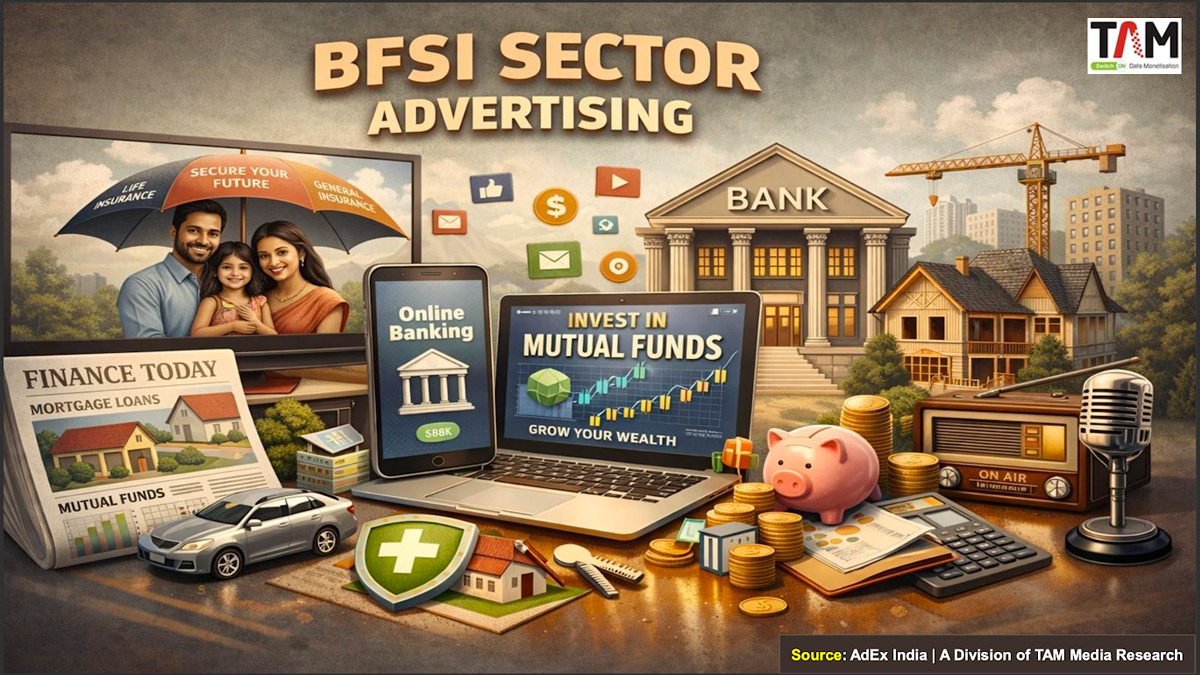
MUMBAI: India’s banking, financial services and insurance sector, one of the most prolific advertisers in the country, delivered a split verdict on media in 2025. It spent less on television, held its nerve in print, turned up the volume on radio and deluged the internet with a ferocity that left every other medium looking pedestrian. The picture that emerges from TAM AdEx’s cross-media report for the BFSI sector is of an industry in transition, still wedded to the news bulletin but increasingly seduced by the algorithm.
Television: a retreat with caveats
TV ad volumes for the BFSI sector fell 16 per cent in 2025 compared with 2024, a sharp reversal after two years of consistent growth that had pushed volumes 16 per cent above 2021 levels by 2023 and a further 7 per cent higher by 2024. Within 2025 itself, the drop was concentrated in the middle of the year: the second and third quarters saw ad volumes slide 35 per cent each against the first quarter, with a partial recovery of 13 per cent in the fourth.
The retreat did not reshuffle the deck. Life insurance retained first place among TV categories with 19 per cent of ad volumes, mortgage loans held second with 16 per cent, and the top ten categories together accounted for 82 per cent of all BFSI television advertising. The dominance of news channels was equally pronounced: news claimed 68 per cent of ad volumes, general entertainment channels a distant 14 per cent and movies 12 per cent. Together, news and GEC captured 82 per cent of the sector’s television spend. News bulletins alone took 48 per cent of programme-genre volumes, with feature films second at 12 per cent. Prime time, between 6pm and 11pm, drew 34 per cent of ad volumes, followed by afternoon at 22 per cent and morning at 20 per cent. A full 82 per cent of all ads ran between 20 and 40 seconds.
Life Insurance Corporation of India was the sector’s biggest TV spender with 11 per cent of ad volumes. Muthoot Financial Enterprises came second with 9 per cent, followed by National Payments Corporation of India at 6 per cent, Tata AIG General Insurance at 5 per cent and State Bank of India at 5 per cent. The top ten advertisers together accounted for 51 per cent of total TV volumes. Three names were new to the top ten in 2025: Tata AIG General Insurance, IIFL Finance and Tata Capital. At brand level, Muthoot Finance Loan Against Gold led with 9 per cent share, Tata AIG Health Insurance entered the top ten for the first time, and the top ten brands together contributed 35 per cent of ad volumes.
Print: the long climb continues
Print told a different story. Ad space for the BFSI sector has grown every year since 2021, rising 16 per cent in 2022, 30 per cent in 2023, 51 per cent in 2024 and 64 per cent in 2025, all measured against a 2021 baseline. Within 2025, ad space was flat in the second quarter but surged 46 per cent in the third and 33 per cent in the fourth compared with the first. Life insurance led print categories with 21 per cent of ad space, followed by mutual funds and banking services and products at 13 per cent each, and corporate financial institutes at 11 per cent. The top ten categories together took 82 per cent of print ad space. LIC led print advertisers with 6 per cent share, and the top ten together covered just 19 per cent of ad space, a reflection of how fragmented print spending remains. Three new entrants joined the top ten in 2025, with Billion Brains Garage Ventures the only exclusive presence not seen in 2024’s list. In the top ten brands, LIC dominated with a 2 per cent share, while Nippon India Mutual Fund rose to third position from fourth in 2024. English accounted for 62 per cent of print ad space, Hindi for 20 per cent. Business and finance publications took 59 per cent of the genre split. The south zone led regional spending with 33 per cent of print ad space, Bangalore topping that zone, while New Delhi and Mumbai were the leading cities nationally.
Radio: louder than ever
Radio ad volumes for the BFSI sector have climbed steadily, rising 12 per cent above 2021 levels in 2023, 36 per cent in 2024 and 45 per cent in 2025. The quarterly pattern within 2025 was volatile: a sharp drop of 43 per cent in the second quarter and 42 per cent in the third, followed by a near-full recovery in the fourth. Life insurance led radio categories with 22 per cent of volumes, banking services and products second at 14 per cent and corporate NBFCs third at 11 per cent. LIC of India held its position as the leading radio advertiser with 20 per cent of ad volumes; the top ten radio advertisers together covered 69 per cent. Muthoot Financial Enterprises led radio brands with 10 per cent share, five of the top ten brands belonged to LIC alone, and SBI Mutual Fund made a remarkable leap to fifth position from 272nd in 2024. Evening and morning time-bands together captured 84 per cent of radio ad volumes, with evenings at 44 per cent and mornings at 40 per cent. Maharashtra was the leading state for radio BFSI advertising with 18 per cent share; Maharashtra, Gujarat and Uttar Pradesh together accounted for 43 per cent.
Digital: the five-times surge
If one number defines the 2025 BFSI advertising story, it is five. Digital ad impressions for the sector multiplied fivefold between 2021 and 2025, having already doubled in 2023 and doubled again in 2024 before the 2025 leap. Within the year, impressions dipped 19 per cent in the second quarter and 12 per cent in the third before recovering 8 per cent above the first quarter by the fourth. Banking services and products led digital categories with 27 per cent of impressions, life insurance and credit cards tied at 19 per cent each, and securities and sharebroking organisations fell from first place in 2024 to fourth in 2025. Axis Bank was the runaway leader among digital advertisers with 12 per cent of impressions, followed by ICICI Bank at 9 per cent, IDFC First Bank at 7 per cent and Kotak Mahindra Bank at 6 per cent. The top ten digital advertisers covered 59 per cent of impressions, and seven of them were new entrants compared with 2024, signalling rapid churn in the digital spending hierarchy. At brand level, Axis Bank led with 9 per cent, ICICI HPCL Super Saver Credit Card vaulted to third place from 921st in 2024, and six of the top ten digital brands were new to the list. Programmatic buying accounted for 91 per cent of all digital BFSI transactions; combined with ad networks, it captured 96 per cent.
The data from TAM AdEx paints the portrait of a sector that still believes in the power of the television news bulletin to sell insurance to the masses, but increasingly knows that the next generation of borrowers, investors and cardholders is scrolling, not watching. The race is now on to reach them before the algorithm serves up someone else’s loan offer first.






