Brands
BrandVid 2018: Hyperlocal content a new opportunity for brands


MUMBAI: Time spent and attention levels are sliding down for digital as there is so much content to offer that if the content doesn’t have some uniqueness nobody will show interest. The answer to change this is branded content.
Speaking at Indiantelevision.com’s new video economy event BrandVid powered by Colors, Y&A Transformation co-founder and MD S Yesudas said, “Content is king because people don’t watch platforms, people watch content. So the belief system changed to 'content is king' but instead of meaningful content, distribution actually became god.”
The event was organised by Indiantelevision.com on 30 October 2018, for the brands, agencies, marketers, broadcasters, publishers and producers to understand how to work closely and create short form and long form content which will connect with the audience directly.

There is an ocean of opportunities for brands today to not just be extremely confined to certain predefined norms of looking at integrating brands with videos but start looking at the whole arena that hyper-local has to offer.
Talking about the difference in distribution channels from a traditional media perspective, Jagran Prakashan COO digital media Rachna Kanwar said, “We create content for nine websites which spans across news, media, lifestyle, education and many more. We being of the print legacy, are today competing with a lot of TV content put on digital platforms. How you are able to catch the user's attention is important and therefore distribution is very important. It is the key to give your content to the user. As content creators we have to reach wherever the user is and today actually the user is on search, social media on YouTube.”
According to Lokmat Media senior EVP and head- digital business Hemant Jain, content technology and distribution when synced in the right proportion will deliver growth to any business aspiring to attain scale in the digital space. The early belief of putting print onto a website is not exactly how an online publishing business typically works. Even the e-paper formats of today are a low hanging fruit according to him. From e-paper the traditional publishers went on to a journey which is now called as a very hyper competitive environment of news publishing.
GroupM business head- entertainment sports and live events Vinit Karnik said, “Content has always been the king and distribution is the god but the missing link between content and distribution is data. Data is the new oil.”
“I don’t think that the way you define your content strategy is going to remain the same which is very important for the creators and brands to take notice of. While video would definitely give a much better brand impact but you can’t keep distributions in isolation," Jain added. He even highlighted that Pune is a very important market for Lokmat. 50 per cent of traffic which is close to 4 million monthly active users comes from Pune.
The attention spans are increasingly reducing and one size fits all is not the norm anymore. From a one channel and couple of print mediums, the market has got into cluttered environment.
Talking about the tech interventions, Karnik said, “Tech interventions are absolutely important you just can’t ignore it, shorter the content size better ability for it to register. Today if you look at e-paper or app of the Lokmat or Jagran, the good old days of you going back to the audience to do a research to understand what they will consume is out of the park. Today, every app gives a consumer an option to choose the kind of interest level he/she has right there on the app and the owners will get the data in real time. Today news is also served to everyone based on their preferences,” Karnik added.
“Today it’s not like we are giving a big overview to the client or the buyer, we are slicing our data and giving them specifics about which is the time of the day that audience is going to be more receptive for a particular kind of content,” Kanwar added.
“From a content strategy perspective 20 per cent of the resources go into content creation and conveying and the remaining 80 per cent goes into distribution,” Yesudas added.
“Distribution is more complex now, if you want to optimise it right. Within the 80 per cent today you have to over emphasis on which platform to choose,” Jain concluded.







Brands
Samsung certifies 1,000 Maharashtra students in AI and coding
The South Korean electronics giant marks its first large-scale skilling push in the state, with women making up nearly half the national programme’s enrolment
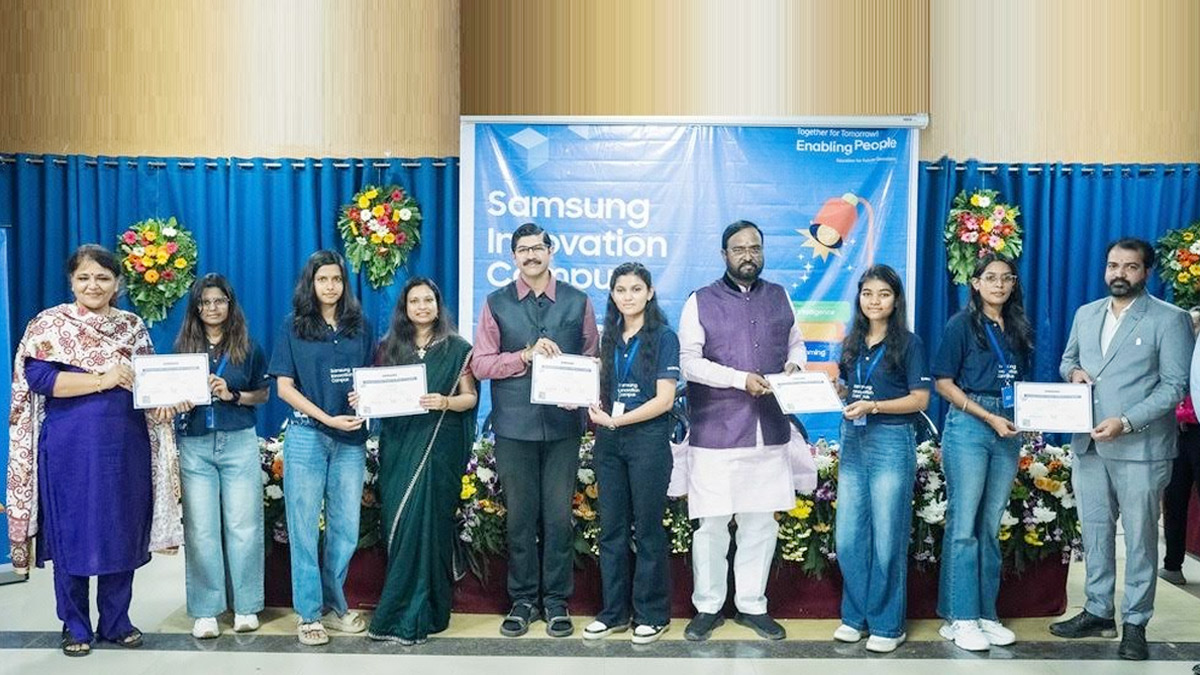
PUNE: Samsung has put 1,000 students in Maharashtra through a certified training programme in artificial intelligence and coding, the largest such drive the South Korean electronics company has run in the state and a signal that corporate India’s skilling ambitions are moving well beyond the boardroom brochure.
The certifications were awarded under Samsung Innovation Campus (SIC), the company’s flagship corporate social responsibility programme, which launched in India in 2022 with the stated aim of democratising access to future-technology education. The 1,000 graduates were drawn from four institutions: 127 from Savitribai Phule Pune University, 373 from Pimpri Chinchwad University, 250 from D.Y. Patil University’s Ramrao Adik Institute of Technology and 250 from Anjuman-I-Islam’s Kalsekar Technical Campus. All completed training in either AI or coding and programming, the two disciplines Samsung has identified as the critical pillars of the digital economy.
The programme does not stop at technical training. Soft-skills development and career-readiness modules are baked into the curriculum, a deliberate attempt to close the gap between what universities teach and what employers actually want.
“India’s digital growth story will ultimately be shaped by the quality of its talent pipeline,” said Shubham Mukherjee, head of CSR and corporate communications at Samsung Southwest Asia. “As technologies like AI move from the periphery to the core of industries, skilling must evolve from basic training to building real-world capability. This milestone in Maharashtra reflects how industry and academia can come together to create a future-ready workforce that is both globally competitive and locally relevant.”
The Maharashtra drive sits within a rapidly scaling national effort. Samsung Innovation Campus trained 20,000 young people across India in 2025, hitting its stated target for the year. Women account for 48 per cent of national enrolments, a figure the company cites as evidence of its push for an inclusive technology ecosystem. The programme is implemented in partnership with the Electronics Sector Skills Council of India and the Telecom Sector Skill Council.
Samsung, which is marking 30 years in India this year, runs SIC alongside two other initiatives, Samsung Solve for Tomorrow and Samsung DOST, as part of a broader effort to build what it calls a generation of innovators with both the technical depth and the problem-solving mindset to thrive in a fast-moving digital world.
A thousand certified students is a tidy headline. Whether they find jobs that match their new skills is the harder question, and the one that will ultimately determine whether corporate skilling programmes like this one are genuine pipelines or well-photographed gestures.






