MAM
Branding services agency Alia creates ‘kundalis’ for major brands

MUMBAI: We’re familiar with advertising agencies and media agencies. But what’s a branding services agency and how different is it from an ad agency? Wondering what the demarcation line between the two is?
Here’s what… A branding services agency sets the road map for a brand on how to position itself in the market by offering branding strategies, branding manifestations along with implementation and regulation. It does not encroach upon the ad agency’s space of visualizing an ad and rolling out the final product. One such player in the market, which provides strategic branding, is the Alia Group – the brain child of Sanjeev Malhotra.
Operating in a unique space, that of before, after and beyond advertising, the Alia Group works towards achieving simplicity in brand expression. Recently the group launched two new divisions namely Arc-CGL and Maximus. Arc-CGL has been formed in association with Mumbai’s leading architectural firm – Ratan J Batliboi. This division aims to create the space of ‘place branding’ in India and has bagged the contract of beautifying and branding Mumbai’s Marine Drive.

Maximus on the other hand, is a specialist provider of retail solutions that enhance brand presence at the ‘point of choice’. The agency offers solutions for experimental marketing.
A six and a half year old agency, Alia has worked with over 70 brands across 20 categories. Some of its clients are Hindustan Levers Limited (HLL), Amul, Timex, Marico, Dabur, Tata, Larsen & Tubro, Reebok, ITC, Reliance and many more. Some of the brands that Alia handles are Pepsodent, Pillsbury, Tata Indicom, Surf, Lakme, Lux, Aviance, Ayush, Clinic Plus, Liril, Close Up, Dove, Pears, Sunfeast and others.
Alia Group presidentSanjeev Malhotra
Speaking about the agency’s four C’s for brand communication audit, Malhotra says, “Compelling communication comes from a coherent idea, which is spread cohesively across mediums and is also consistent across time. We have married the three disciplines of branding strategies, manifestations and implementation to give the client a choice under one umbrella and a single window with seamless delivery.”
Stressing on the fact that strategic brand foundation is most important Malhotra says that finding the right Brand Expression, Brand Style and Brand Essence is the key to the success of any brand. Brand Style is the vocabulary one uses for a brand, which comprises seven elements namely – mnemonics, icons, name, logo, sonic, brand line and structure. “The space of controlling brand communication begins with the brand’s identity, goes on to packaging and finally the communication,” says Malhotra. One of the best examples of Brand Style was that of Star Plus’ Kaun Banega Crorepati with its distinct music, Bachchan’s persona coupled with his baritone voice and the ‘Lock Kar Diya Jaye’ line to name a few.
One of the biggest challenge that Alia faces is that of working with ad agencies as the former faces resistance from the latter as their creativity is immediately limited and restricted. However, with the long clientele list, Alia has proved that clients are becoming more open to branding solutions before taking the plunge in the market.
Malhotra who touted the agency as being responsible for creating a ‘kundali’ for a brand says that what has made the agency to reach where it is today is its passion and belief in getting in-depth communication with objectivity and honesty.

Brands
FICCI-EY report: India’s M&E engine accelerates to Rs 2.78 trillion as digital dominance deepens
FICCI–EY flags structural shifts in consumption, with digital ads at 63 per cent, AI reshaping content, and the sector set to cross Rs 3 trillion by 2027
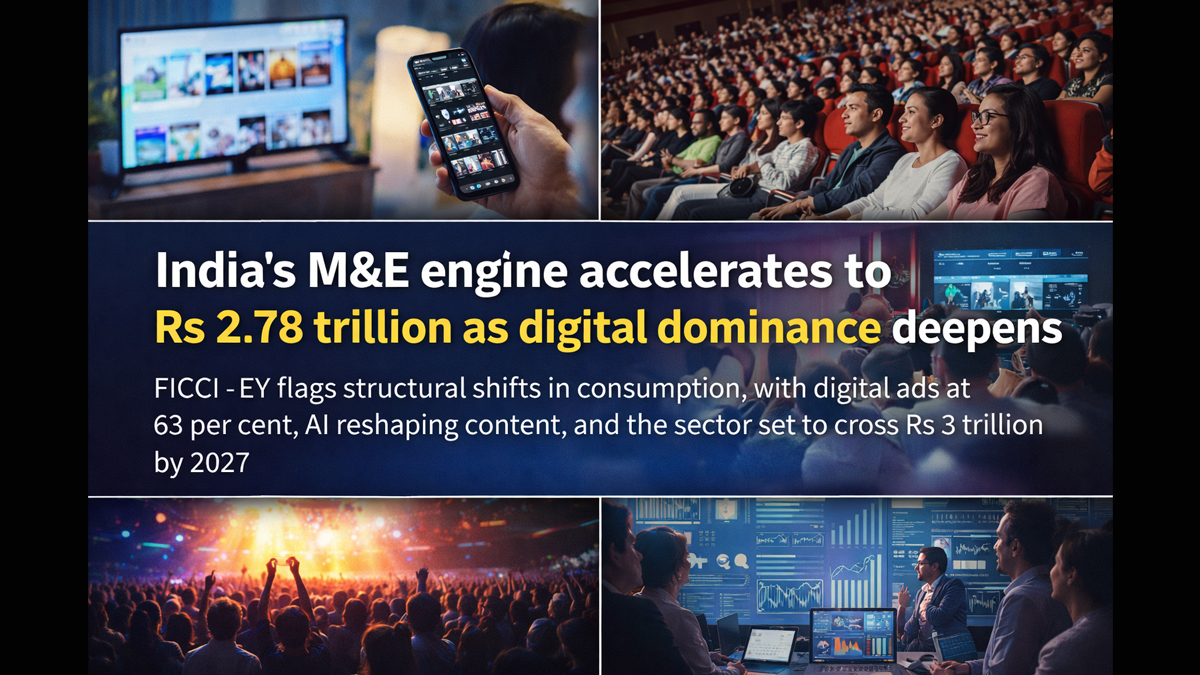
MUMBAI: India’s media and entertainment (M&E) industry has crossed a defining threshold, expanding not just in size but in structure, as digital consumption, data-led monetisation and shifting audience behaviour redraw the contours of the business. The sector grew 9 per cent in 2025 to reach Rs 2.78 trillion, signalling a deeper transformation underway, according to the latest FICCI–EY report Stories, scale and impact.
What was once a broadcast-led ecosystem is now decisively digital-first. Growth is being powered by online platforms across advertising, subscriptions and content consumption, even as traditional formats struggle to keep pace.
“Media and entertainment are no longer discretionary pursuits; they have become essential frameworks through which people interpret the world,” said Ashish Pherwani, M&E sector leader at EY India.
Digital becomes the centre of gravity
The most significant inflection point is the rise of digital media as the industry’s largest segment, overtaking television in 2025, a shift widely seen as irreversible. Digital media crossed Rs 1 trillion in revenues, growing over 30 per cent year-on-year, driven by both advertising and subscriptions.
Digital advertising alone rose 26 per cent to Rs 94,700 crore, accounting for 63 per cent of total ad revenues, up sharply from 56 per cent a year earlier. E-commerce and point-of-sale advertising surged 50 per cent to Rs 22,000 crore, underscoring a pivot towards performance-led marketing.
India’s overall advertising market grew 13.5 per cent to Rs 1.5 trillion, nearly twice the pace of GDP growth, with digital contributing more than the entirety of incremental gains as traditional segments declined.
Screens multiply, attention fragments
Consumption trends reveal the scale of change. Indians spent 1.2 trillion hours on mobile devices in 2025, with nearly 60 per cent of that time devoted to media and entertainment. Video audiences climbed to 572 million, while social media users approached 500 million, reflecting a vast and expanding digital user base.
Connected TV is emerging as a crucial bridge between traditional and digital ecosystems. Time spent on connected TVs surged to 85 hours per month for OTT viewing, while connected TV households reached around 40 million weekly active homes.
Yet this explosion in consumption is not translating evenly into revenues. Online news platforms saw reach decline by 9 per cent, with AI-driven summaries and search reshaping how audiences access information.
Subscriptions rise, but monetisation remains uneven
Digital subscriptions are gaining traction as premium content moves behind paywalls. Subscription revenues rose 60 per cent to Rs 16,300 crore, with 216 million paid video subscriptions across 143 million households.
Still, monetisation challenges persist. Much of India’s digital consumption remains ad-supported, particularly in music streaming, where 178 million users generated 5.98 trillion streams but limited subscription uptake continues to weigh on revenues.
Television declines, but adapts
Television remains deeply embedded, reaching around 745 million viewers weekly, but its economic model is under strain. Advertising revenues fell by more than 10 per cent, while subscription revenues declined 8 per cent, with the loss of 11 million pay-TV households.
Rather than disappearing, television is evolving into a hybrid model, increasingly bundled with digital offerings as the lines between linear and streaming blur.
Advertising and experiences drive growth
Two engines powered industry expansion in 2025, advertising and live experiences. While digital advertising surged, live events emerged as the fastest-growing segment, expanding 44 per cent.
Concerts, large-scale events, weddings and religious gatherings are driving demand for shared, in-person experiences, creating a counterbalance to rising digital consumption. Industry executives increasingly view this duality as complementary rather than contradictory.
Films, music and print show mixed fortunes
The film industry delivered record revenues of Rs 20,500 crore, with over 1,900 releases and 37 films crossing Rs 100 crore at the box office. However, digital and satellite rights values softened as platforms tightened spending.
Music revenues grew 10 per cent, aided by live events and licensing, though streaming economics remain challenging. Print held steady, with advertising revenues rising around 2 per cent, even as circulation declined among younger audiences.
Radio, by contrast, continued to contract, with revenues falling 7 per cent amid declining listenership and advertiser migration to digital platforms.
Gaming, AI and the creator economy reshape the future
Gaming is emerging as a structural growth driver, with Indian developers generating over $1.5 billion in export revenuesand global revenues from India-made games expected to grow 20 to 30 per cent annually.
Artificial intelligence is rapidly embedding itself across the value chain, from content creation to distribution and personalisation. At the same time, audiences are shifting from passive consumption to active participation, increasingly acting as creators, curators and distributors of content.
Three forces, information, escapism and digital self-expression, are reshaping demand, pushing companies towards data-driven, outcome-based monetisation models.
Consolidation and capital flows intensify
The structural shift is mirrored in deal activity. The sector recorded 105 transactions in 2025, up 8 per cent year-on-year, with 73 per cent of deals concentrated in digital and sports segments. Public markets accounted for 35 per cent of deal value, reflecting investor confidence in scalable, tech-led media businesses.
At the same time, content production has entered what executives describe as a “buyer’s market”, with studios cutting back on high-cost projects and focusing on efficiency.
The road to Rs 3 trillion
Looking ahead, the industry is projected to cross Rs 3 trillion by 2027 and reach Rs 3.3 trillion by 2028. Digital advertising alone is expected to contribute an additional Rs 44,600 crore in incremental revenue, while digital subscriptions continue to expand as OTT adoption deepens.
By 2028, new media, including digital platforms and gaming, is expected to account for 53 per cent of total revenues, overtaking traditional formats for the first time. Live events are also set to expand beyond metros into more than 20 cities, reinforcing the rise of experiential consumption.
FICCI president Anant Goenka described the sector as “a powerful driver of innovation, employment, cultural influence and economic growth”, underlining its central role in India’s digital transformation.
The message from the report is unambiguous. This is not a cyclical upswing but a structural reset. Scale is no longer the differentiator. The future of India’s media economy will be defined by precision in targeting, monetisation and engagement, as a converged, multi-platform ecosystem takes shape.