MAM
Big gains for some on 2019 forbes india rich list despite challenging year


Amid a challenging year for the economy, the total wealth of the tycoons on the 2019 Forbes India Rich List shrank 8% to US$452 billion from a year ago. More than half of India’s 100 richest saw a decline in their net worth. The complete list is available at www.forbes.com/india and www.forbesindia.com. The list can also be found in the Special issue of Forbes Asia and the December issue of Forbes India.
Despite a slowing economy, some tycoons saw big gains to their fortunes. Mukesh Ambani remains India’s richest for the 12th consecutive year, with $51.4 billion in wealth. He added $4.1 billion to his net worth as Jio, the three-year old telecom unit of his Reliance Industries, became one of India’s biggest mobile carriers with 340 million subscribers.
Another big gainer was infrastructure tycoon Gautam Adani, who jumps eight spots to No. 2 this year with a net worth of $15.7 billion. After a nine-year wait, Adani secured permission in June to start work on an Australian coal mine. He has also ventured into a slew of new businesses from airports to data centers.

The Hinduja brothers are ranked at No. 3 this year with a net worth of $15.6 billion, while Pallonji Mistry ranks No. 4 with $15 billion. A $4 billion boost propelled banker Uday Kotak into the top five for the first time with a net worth of $14.8 billion. Shares of his Kotak Mahindra Bank rose 39% in the past year.
Naazneen Karmali, Asia Wealth Editor and India Editor of Forbes Asia, said: "While India's slowing economy took a toll on the combined wealth of the nation's 100 richest this year, there were some who defied the odds to charge ahead. Resilience is the hallmark of Indian entrepreneurs and they have the capacity to take setbacks in their stride. It won't be long before they bounce back."
There are four returnees to this year list. They include Mofatraj Munot (No. 75, $1.85 billion) of Kalpataru, Rajju Shroff (No. 87, $1.69 billion) of UPL, as well as K. Dinesh (No. 89, $1.61 billion) and S.D. Shibulal (No. 100, $1.4 billion) cofounders of Infosys.
Six newcomers made their debut on this year’s list. They are the Singh family (No. 41, $3.18 billion), who inherited the fortune of pharma magnate Samprada Singh, founder of Alkem Laboratories, who died in July this year; Byju Raveendran (No. 72, $1.91 billion), the 38-year-old founder of fast-rising edtech unicorn Byju’s; Mahendra Prasad (No. 81, $1.77 billion) of Aristo Pharmaceuticals; Manohar Lal and Madhusudan Agarwal (No. 86, $1.7 billion) of Delhi-headquartered Haldiram Snacks; Rajesh Mehra (No. 95, $1.5 billion), whose family owns the popular sanitary ware brand Jaquar, and Sandeep Engineer (No. 98, $1.45 billion) of Astral Poly Technik.
Brian Carvalho, Editor of Forbes India, said: “It’s been a challenging economic year with notable changes in the list, but the good news is that we are still seeing the emergence of new billionaires with contemporary business models.”
More than a third of the decline in total wealth of India’s 100 richest was due to generous tech tycoon Azim Premji, who gave away a chunk of his fortune in March and consequently dropped in the ranks to No. 17 from No. 2 with a net worth of $7.2 billion.
Several fortunes linked to autos and consumer goods suffered from weak consumer sentiment. About a tenth of the listees this year are automotive tycoons, who are bearing the brunt of an industry slump. Autoparts maker Vivek Chaand Sehgal’s net worth more than halved to $2.45 billion as shares of his Motherson Sumi Systems fell 61% on slowing demand in Indian and global auto markets. He ranks at No. 52 on this year’s list.
The minimum amount required to make this year’s list was $1.4 billion, down from $1.48 billion last year.
The top 10 richest in India are:
1) Mukesh Ambani; US$51.4 billion
2) Gautam Adani; $15.7 billion
3) Hinduja brothers; $15.6 billion
4) Pallonji Mistry; $15 billion
5) Uday Kotak; $14.8 billion
6) Shiv Nadar; $14.4 billion
7) Radhakishan Damani: $14.3 billion
8) Godrej family; $12 billion
9) Lakshmi Mittal; $10.5 billion
10) Kumar Birla; $9.6 billion
This list was compiled using shareholding and financial information obtained from the families and individuals, stock exchanges, analysts and India’s regulatory agencies. The ranking lists family fortunes, including those shared among extended families such as the Godrej and Bajaj families. Public fortunes were calculated based on stock prices and exchange rates as of September 27. Private companies were valued based on similar companies that are publicly traded.







Brands
Jubilant FoodWorks faces Rs 47.5 crore GST demand, plans appeal
Tax authorities flag alleged misclassification of restaurant services
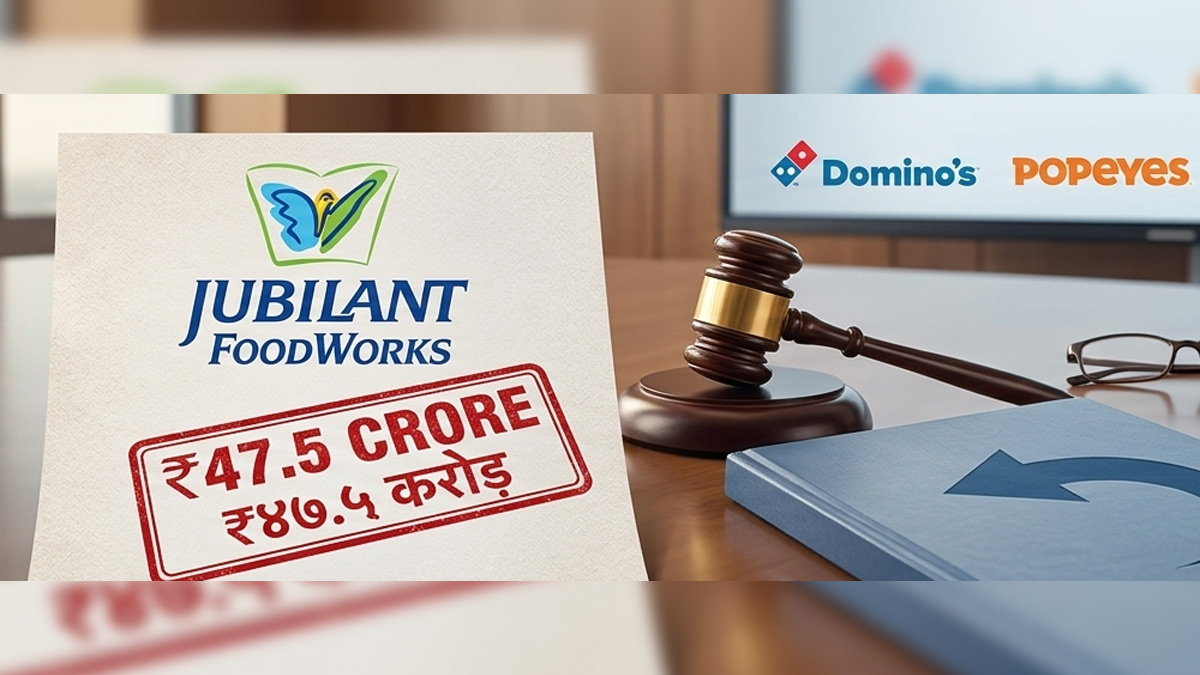
MUMBAI: Jubilant FoodWorks Limited has landed in a tax tussle after receiving a GST demand of Rs 47.5 crore from the office of the additional commissioner of CGST and central excise in Thane, Maharashtra.
The order, issued under the provisions of the Central Goods and Services Tax Act, 2017, relates to an alleged incorrect classification of certain services under the category of restaurant services. According to the tax authorities, this classification resulted in a short payment of goods and services tax for the period between the financial years 2019-20 and 2021-22.
The demand includes Rs 47.5 crore in GST along with an equal amount as penalty, in addition to applicable interest. The order was received by the company on March 13, 2026.
In a regulatory filing to the BSE Limited and the National Stock Exchange of India Limited, the company said it disagrees with the order and believes its arguments were not adequately considered.
The company is preparing to challenge the decision and plans to file an appeal. It added that once the redressal process is complete, the demand is likely to be dropped.
Despite the sizeable figure attached to the notice, the company said it does not expect any material impact on its financials, operations or other activities.
The disclosure was signed by Suman Hegde, EVP and chief financial officer, who confirmed that the company received the order at 19:06 IST on March 13 and has already initiated steps to contest it.
The development places the quick service restaurant major in the middle of a tax debate that could hinge on how certain restaurant-linked services are classified under GST rules. For now, the company appears ready to take the matter from the tax office to the appeals desk.







