MAM
Avoiding Cyber Oblivion

Today, there is a major shift in thinking on how to build a major corporate personality. To play the game, one must clearly figure out the secret powers of e-commerce and the role of new technologies in contrast to traditional print and old-fashioned, mass-advertising driven models.
During the last century, mega corporations throughout the world followed the prime rules of building corporate image and name identity in the strictest sense. Their goal was simply to achieve an elite, world-class image by having their name and logo brightly displayed on skyscrapers in every city. They ran massive advertising campaigns to promote their identity and claimed ownership to specific colours and designs, all in an effort to create a single visual global icon. They used every opportunity, from naming stadiums to sponsoring parades. The objective was simple: to demonstrate their exclusive power and their domination by big image.
Internet-Savvy Age

This expensive shotgun approach often created successful and powerful images for a period, but at times, it also created the corporate images of rigid, monolithically dysfunctional giants. The last decade can easily summarise the winners and losers of this expensive corporate identity game, but in an Internet-savvy age of global cultures, this approach has proven to be unsuitable for today’s corporations. Today, there is a major shift in thinking on how to build a major corporate personality.
To play the game, one must clearly figure out the secret powers of e-commerce and the role of new technologies in contrast to traditional print and old-fashioned, mass-advertising driven models. New rules for building global corporate images demand serious re-evaluation. It is all about being discovered with speed and efficiency or sluggishly lost in oblivion.
Secret Powers of Cyber Domination
The new phenomenon of cyber-branding is driving today’s corporate identities. It is mainly focused on how to dominate the corporate accessibility and showcase the colourful image of a corporation, all via cyber-media.
For this reason, corporations like Yahoo, Amazon, eTrade, eBay and millions of others worldwide do not conjure up the images of overpowering logos on skyscrapers, specific colours, irrelevant and forgetful taglines or repetitive advertising campaigns. Rather, they are almost invisible in the traditional corporate identity sense.
These emerging cyber-giants are quietly working and residing in our laptops and personal digital assistants (PDAs), snug and warm in our pockets. Who knows if these little icons come out in the middle of the night when we are fast asleep and clean our dishes too? This is how corporate accessibility and images will be built in the cyber-economies of the globe — because it is fast, user-friendly and extremely cheap.
‘We Are Very Big, You Are Very Small’
In the old days, status- and symbol-driven corporations conveyed their powers; they offered a limited-access, 9-to-5, Monday-through-Friday format, while appearing formal, boring and, at times, unaffordable. However, in cyber-domination, a corporation provides interactive, 24/7, user-friendly service that focuses on being extremely economical and efficient. This can be achieved very economically in cyberspace, by constantly emulating a corporate presence in a viral formation.
Corporations, under the new rules, are developing sophisticated Web presence and working on global portalisation of the entire corporation. In this major shift, there is a serious decline of the traditional collateral material that corporations produced under the old rules of corporate identities: intricate brochures, thick catalogs and colorful annual reports. Rather, all imaging and information is being transferred to user-friendly, sophisticated websites — where information changes in an instant and services are available at bullet speed.
‘The World Is Our Customer – Really?’
Corporations practicing the old corporate identity rules were absolutely convinced that the entire globe was their potential target audience. In every instance, these corporations used general broadcast and shotgun methods to relay their messages, including skyscrapers, billboards and bulky brochures, all addressing the “global occupant.”
Now, cyber-domination provides custom information to a select, potential client base, located in specific demographics worldwide. The message is highly pertinent, clear, precise and user-friendly, offering instant results. Today it is one-to-one in a very smart way.
Why Are Logos, Designs, Colours Out?
In the old strategy, the key for success was in the total image, including the logo, design and colour. The name of a corporation was not the key issue, but rather a small part of the design puzzle. The emphasis was placed on the logo, specific colours and graphic designs, taglines and other paraphernalia, to create a total visual-identity experience.
The rule of cyber-domination is very simple: It all boils down to a powerful name, which equates to a powerful domain name or URL which is then used as a key to find and unlock the Web site in a complex global maze. It is all based on how well you can remember the name, how easily you can type it in, how to find the corporation right up front on a search engine and how to get instant accessibility.
This is a very big change and has created a noticeable shift in how companies build global corporate images in cyberspace. This explains the decline of advertising agencies as image builders, and confusion in boardrooms creating budgets for corporate image.
In today’s corporate world, the key to success, or the “magic,” clearly lies in the name — a URL to set the company apart in the global e-commerce arena. Let’s face it, when a name cannot be found easily on the Internet, the corporation is no longer in cyber-domination, rather, it is in cyber-oblivion.




Brands
Axis Bank named Official Banking Partner of DP World PGTI
Partnership supports all tournaments this season to grow professional golf in India.
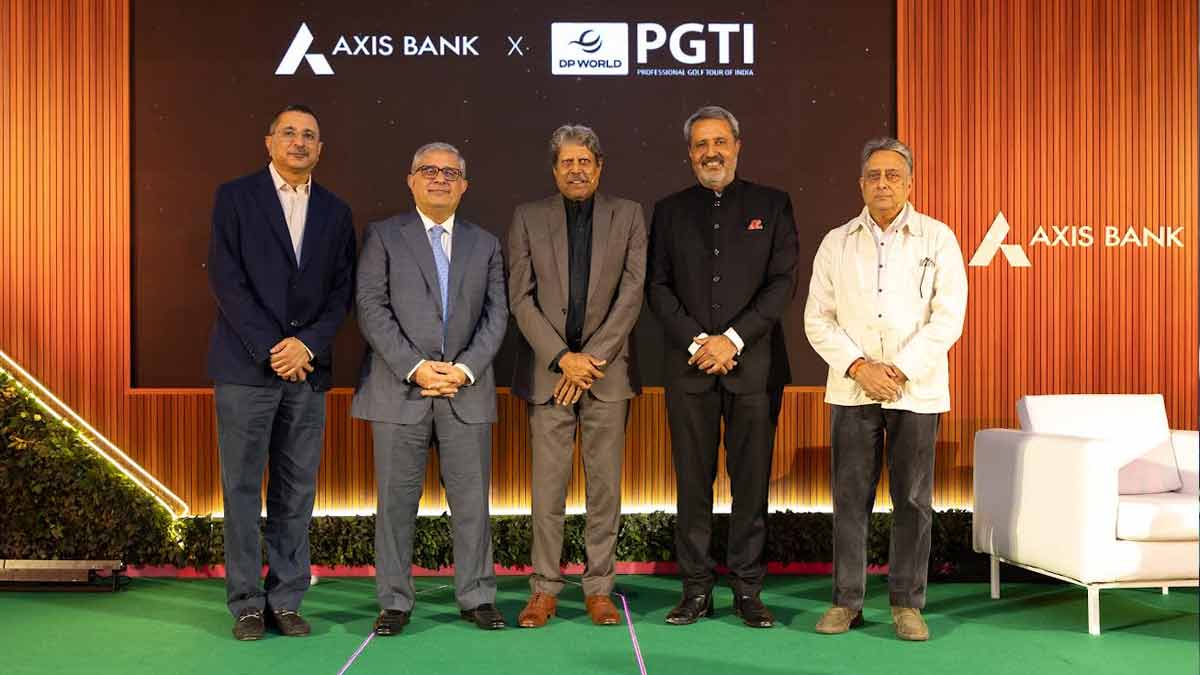
MUMBAI: Axis Bank just teed up a hole-in-one partnership because when a bank sponsors golf’s biggest swing in India, even the fairways feel more financially secure. Axis Bank has been appointed Official Banking Partner of the DP World Professional Golf Tour of India (DP World PGTI), strengthening its commitment to sporting excellence and community engagement while backing the growth of professional golf across the country.
Under the partnership, Axis Bank will support all DP World PGTI tournaments this season, contributing to talent development, enhanced tournament experiences and wider fan engagement. The collaboration aligns the bank’s values of precision, discipline and trust with the Tour’s focus on performance and opportunity.
Axis Bank executive director Munish Sharda said, “We are pleased to partner with DP World PGTI as its Official Banking Partner. Golf embodies precision, discipline, and a pursuit of excellence qualities that strongly reflect who we are at Axis Bank. This association also strengthens our engagement with India’s growing premium customer segments, where the sport has a deep and enduring connect.”
Professional Golf Tour of India president Kapil Dev said, “We are extremely pleased to welcome Axis Bank as a Tour Partner of the DP World Professional Golf Tour of India. Partnerships of this stature play a vital role in strengthening the foundation of the Tour, enhancing opportunities for our players, and expanding the sport’s reach across the country.”
Professional Golf Tour of India CEO Amandeep Johl added, “Axis Bank’s strong legacy of excellence, innovation, and nationwide reach aligns perfectly with DP World PGTI’s goal to elevate professional golf in India and provide greater opportunities for our players.”
In a sport where every stroke counts and every partnership drives distance, Axis Bank isn’t just backing golfers, it’s investing in the fairway to future, turning India’s greens into a stage where precision meets passion and every drive has the power to inspire.