MAM
ASCI upheld complaints against 52 of 84 ads; healthcare

MUMBAI: ASCI‘s Consumer Complaints Council (CCC) upheld complaints against 52 out of 84 advertisements, which came under the scanner of the self regulatory body in March 2013. Taking a proactive measure to protect the interest of healthcare, education and personal care consumers, ASCI upheld complaints against those ads that were making misleading claims to engage clients, in forming pseudo brand image.
The major brands that had come under ASCI‘s scanner, include Dabur India Ltd, Procter & Gamble Hygiene & Health Care Ltd, Hindustan Unilever Ltd, Johnson & Johnson Ltd, Ag Herbs (Singapore) Pte Ltd, Zaptech, Garima Career Foundation, Montfort Group of Institute, The Economic Times, Honda Siel Power Products Ltd, Hindustan Unilever Ltd and Eureka Forbes Ltd.
In March 2013, ASCI witnessed a surge in number of complaints against the deceiving ads, which had mounted to 84. However, all of them did not contravene ASCI‘s codes or guidelines, and 32 complaints were later taken back. Those which didn‘t trespass the code were, Aditya Birla Management Corporation Pvt Ltd- Idea 3 G, Applect Learning Systems Pvt Ltd– Meritnation.com, Cadbury (India) Ltd – Perk Glucose, Carrier Midea India Pvt Ltd – Midea Air Conditioners, Hindustan Unilever Ltd – Dove Elixir Hair Oil and Nitta Gelatin India Limited, Parle Products Pvt Ltd – Parle Londonderry.

In the case of health & personal care products or services ASCI upheld complaints against those inadequate and unscientific print ads, which had violated the Chapter I of the ASCI code. Some of the healthcare product or services ads also contravened the provisions of the Drug & Magic Remedies Act. Due to which industry‘s major players, including Dabur India Limited, Hindustan Unilever Ltd, Johnson & Johnson Ltd, Dr. Monga Clinic, ClinTech Medical & Aesthetic Center, Rvita Ayurveda Centre, Vaarid Herbal Face Pack and Soliel International came under the fire.
On the educational fore, there were 14 advertisements that could prove its essence and had violated the ASCI Guidelines for Advertising of Educational Institutions. For instance, players like Zapak, Garima Career Foundation, Mazenet Solution Pvt Ltd and BS Abdur Rahman University, Montfort Group of Institute‘s claims came up futile in providing 100 per cent job to people.
ASCI‘s regulation didn‘t spare India‘s biggest media conglomerate like Times Group, when ET Now came under scanner for its print ad saying, “ET Now is the undisputed leader on the budget date, and only our competitor will say it was a bad budget.” They have quoted ET Now has 64 per cent of the market share and CNBC TV18 has 36 per cent of the market share.The CCC noted the contents of the ad and concluded that the market share claimed by the advertiser was not adequately substantiated. The advertisement contravened Chapter I.1 of the Code; therefore, the complaint was upheld.
Above all, there were some other companies from Automobile, FMCG and consumer durable products that flouted the codes of ASCI‘s Consumer Complaints Council (CCC).







MAM
Madison World to launch AI platform M BrAIn for media planning
Agency group invests about $1 million as it shifts to AI driven growth planning.
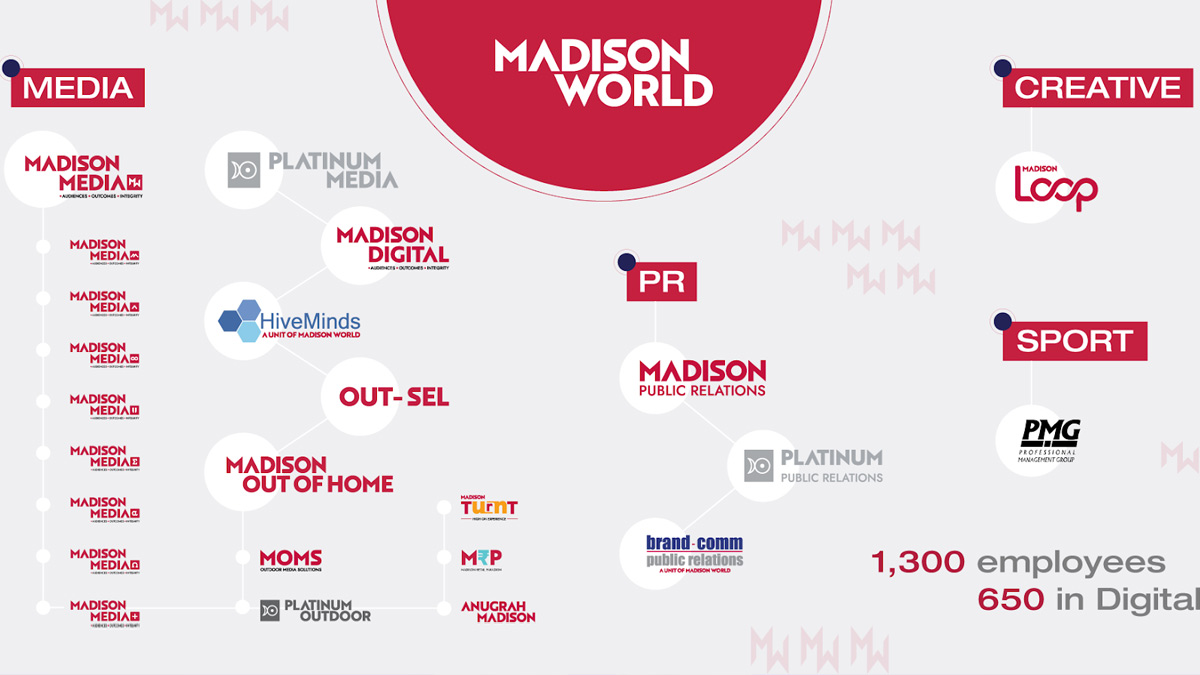
MUMBAI: If media planning once ran on spreadsheets and gut instinct, the next chapter may run on algorithms and curiosity. Madison World is preparing to roll out the first version of its proprietary artificial intelligence platform Madison M BrAIn in early April, as the independent agency group accelerates its transition toward AI driven planning and product led media services.
The platform, expected to involve an investment of around $1 million, is designed to reshape how the agency approaches strategy by combining internal knowledge, external data sources and advanced AI models into a single intelligence ecosystem.
According to Madison Media, OOH and Hiveminds partner and group CEO Ajit Varghese the initiative forms part of a larger structural rethink within the organisation. “Traditionally agencies built frameworks around media planning and allocation. We are redesigning that structure into what we call a Growth Planning System (GPS),” Varghese said.
The shift reflects a growing belief that effective media strategy must begin earlier in the decision making process. Instead of jumping directly to channel allocation, planners must first decode the market itself identifying consumer barriers, purchase triggers and the core challenges facing a brand.
Once those insights are mapped, agencies can build clearer growth agendas for clients and design media strategies that connect more closely with business outcomes.
To support that approach, Madison has built Madison M BrAIn as what it describes as a human AI cognitive ecosystem. Acting as a central intelligence hub, the platform aggregates proprietary insights alongside external data sources and large language models, enabling planners to access deeper market intelligence before building campaign strategies.
Varghese said one of the core objectives is to democratise knowledge across the organisation. “In the past, this level of understanding was largely available to senior leaders or experienced strategists. With Madison M BrAIn, even a junior planner should be able to access the same intelligence and approach clients with a far more informed perspective,” he said.
The agency has already implemented the new planning philosophy internally and completed three months of testing for the AI platform, with early trials showing encouraging results in terms of learning capability and system performance.
While the first version relied on global large language models, Madison is now developing its own proprietary Small Language Model (SLM) to serve as the core of the M BrAIn ecosystem.
“The SLM will be able to read global LLMs, but the LLMs cannot read the SLM,” Varghese explained. “That ensures all the intelligence we build remains within the Madison ecosystem and strengthens our proprietary knowledge base.”
The first version of Madison M BrAIn is expected to go live in early April, with a more refined version targeted by the end of June. Over time, the platform will integrate additional external data streams and APIs including consumer insight platforms, social listening tools and client datasets.
These integrations are expected to enhance the system’s learning capability and enable it to generate increasingly sophisticated strategic recommendations.
Although the platform is currently being deployed for internal use, Madison sees potential for it to evolve into a licensable product in the future.
“At the moment, our focus is to stabilise and strengthen M BrAIn internally. But over time there is potential for this to become a product that could be licensed externally,” Varghese said.
The AI platform is also part of a wider technology transformation underway at the agency group. Alongside M BrAIn, Madison is building a broader digital infrastructure called the Catalyst operating system, which aims to integrate operational processes, data and product platforms into a unified ecosystem.
This broader technology stack could require an additional $1 million to $1.5 million investment over time, though spending will be phased and reviewed regularly.
“We are evaluating progress every three months and prioritising the most critical capabilities first,” Varghese said.
Madison expects the full AI and operating ecosystem to be fully functional within 12 to 18 months, positioning the agency to combine human strategy with machine intelligence as the advertising industry enters its next data driven phase.