MAM
Annual retail mkt growth 25-30%: White Paper

NEW DELHI: India is making waves in the international circuit and has been touted as the fourth largest economy in the world in Purchasing Power Parity (PPP) terms after USA, China and Japan.
India’s PPP has been on a steady rise since the initiation of the economic reforms in the early 1990s. One of the key developments during India’s growth path has been a favorable shift towards the service sector, which now accounts for almost 50 per cent of the total gross domestic product (GDP).
In the light of this, the Indian retail industry is currently estimated at Rs 8750 billion and is expected to grow at five per cent per annum. On the other hand, organised retailing market stands at Rs 280 billion , and is projected to grow at 25 – 30 per cent per annum to become Rs 350 billion by 2005 and Rs 1000 billion by 2010 as was projected by research paper developed jointly by ICICI Property Services and KSA Techopak.
Over the last few years, Indian consumers have evolved at a fast pace, retailers are beginning to establish scalable and profitable business models and a host of foreign brands have entered the market. On the strength of these growth drivers, property developers are aggressively building shopping malls across the country, the White Paper said.
In the next two years, 93 malls are planned across the top 14 Indian cities. Of these, 39 will be launched in 2005 and the remaining 54 in 2006. Mall culture in India is growing at a steady pace similar to that growth patters seen in USA, China and the Middle East, especially Dubai.
India entered the ‘infancy’ stage of mall development in the 1990s when the first wave of malls sprung up in the form of Spencer Plaza in Chennai, Crossroads in Mumbai, and Ansal Plaza in New Delhi. At present, the country is in the ‘development’ phase marked by rapid pace of creation of retail infrastructure.

South East Asia and the Middle East are in the ‘maturity’ stage as mall developers in these nations adopt innovative practices to differentiate their product offering from the ever-increasing competition.
On the other hand, the UK and the US are in the ‘decline’ phase involving a period of consolidation wherein the relatively stronger malls with a sustainable trade mix continue to survive and begin to control a larger share of the total market, the Paper said.
Since India is witnessing an evolution of its retail sector and mall development activity at a relatively later stage as compared to major countries across the globe, it has the potential to integrate learnings from those nations and leapfrog into a higher stage of development in a relatively shorter time span.
Modern malls are being developed in a way that embraces, or at least acknowledges, their surroundings. ‘Hybrid malls’, attempting to conjoin large enclosed malls with outdoor urban streetscape retail / entertainment component is one of the hottest concept in the industry today.
To add to that, entertainment is also becoming increasingly popular for malls as they place a greater emphasis on ‘Shoppertainment’ – a concept that includes interactive retailing, state-of-the-art movie theater complexes, mini motor speedways, natural rock climbing walls, ice rinks, themed restaurants and more.
In the Indian context, multiplexes have already emerged as the most significant entertainment option considering that movie watching is a favorite pastime.
The survey revealed that location was the single-most important factor determining the success of a retail development. Mall developers should do an analysis of the catchment population including assessment of demographic and psychographic profile, disposable income and spending patterns of residents in neighbouring areas.
Keeping in view the consumer demand for a one-stop shop for all shopping and recreation needs, malls should be developed with an ‘all-under-one-roof’ positioning. Components such as residential apartments, offices, hotels, entertainment, civic and cultural activities may also be included. In addition, every aspect of the mall’s design should encourage consumerism in order to maximize time spent per visit, number of stores entered per visit as well as average transaction value.
Also interesting is the fact that leasing has emerged as the most favorable pricing arrangement in India as developers have realised that it gave them flexibility to constantly optimize the tenant mix in a dynamic retail market.
The White Paper predicted that in the context of the dynamic environment that the retail sector in India operated in, future strategies for mall developers would entail devising market-specific solutions for different demographics, psychographics, regions and locations.
Developers should also attempt to reduce their over-reliance on traditional anchor tenants like department stores and multiplexes and should target newer categories including food and groceries, ‘home’ including furniture, consumer appliances, furnishings and bed-and-bath.
Learning from the experiences of malls in developed markets such as USA, developers in India should build and design malls allowing for flexibility for innovation, re-leasing, re-configuration, expansion and sometimes – even contraction. Further, malls should be made a preferred destination for marketers for advertisement, product launches and product testing.
Thus, a re-engineering of approach is required to ensure that retail malls attain a competitive advantage that can be leveraged to achieve long-term sustainability, the White Paper concluded.



Brands
KKR sixes to power EV charger rollout under VIDA campaign
Cricket meets clean mobility as big hits spark India’s charging growth
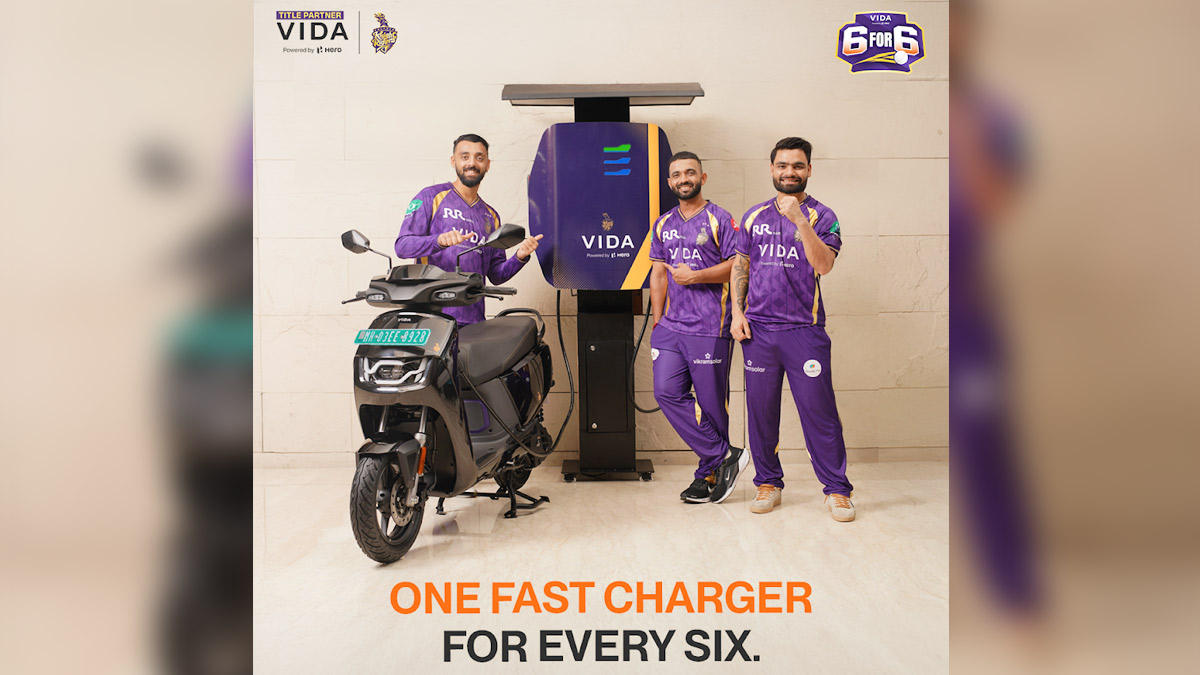
NEW DELHI: VIDA, the electric mobility arm of Hero MotoCorp, has teamed up with Kolkata Knight Riders to launch a campaign that turns cricketing flair into real-world impact.
Titled ‘6 for 6’, the initiative promises to install a 6kW fast EV charger for every six hit by KKR during the ongoing Indian Premier League season. The idea is simple but powerful, as each big hit on the field contributes directly to expanding India’s fast-charging infrastructure.
The campaign builds on VIDA’s growing network, which already spans over 5,300 fast-charging points across more than 430 cities. With EV adoption gaining pace, the brand is using cricket’s mass appeal to accelerate both awareness and infrastructure growth.
Explaining the thinking behind the move, Hero MotoCorp emerging mobility business unit chief business officer Kausalya Nandakumar said, “Cricket has an incredible ability to unite and inspire millions across the country. With the ‘6 for 6’ campaign, we are turning every big hit on the field into a step towards a cleaner and a more accessible mobility future.”
She added that VIDA’s expanding fast-charging network and removable battery technology are designed to make EV ownership more convenient and practical for everyday users.
From the franchise’s side, the campaign is also about giving on-field moments a larger purpose. Kolkata Knight Riders chief executive officer Venky Mysore said, “The ‘6 for 6’ campaign exemplifies the potential of sport as a platform for meaningful, real-world impact. By linking every six to the expansion of EV charging infrastructure, this partnership transforms fan excitement into tangible progress.”
As part of the rollout, VIDA has introduced co-branded charging stations in KKR’s signature colours, with a flagship installation unveiled alongside team players. The chargers are designed for quick top-ups, powering VIDA scooters from zero to 80 percent in about an hour, while also being positioned along key highways to support longer journeys.
The initiative also taps into VIDA’s removable battery system, which allows users to charge using standard household plug points, adding flexibility to the charging ecosystem.
By blending the thrill of cricket with the urgency of clean mobility, VIDA and KKR have found a neat way to make every six count twice, once on the scoreboard and again on India’s road to an electric future.








