MAM
Amap looks to add agencies to client roster, examining possibility of a Cas panel

MUMBAI: Now that it has reached all India coverage Audience Measurement and Analytics (AMA) which runs aMap which delivers television ratings overnight is looking to add media agencies to its client roster.
Speaking on the sidelines of a media visit to aMap’s facilities in Ahmedabad AMA CEO Tapan Pal says, ” We already have 12 clients who are broadcasters. The agencies were waiting for two things to happen.
Firstly they wanted all India coverage, which is now happening. Secondly they wanted data logs for ads. As of now we have logs for over 50 channels. By the end of the month we will have logs for 75 channels.”

However as Lodestar Media’s Nandini Dias puts it, “Most of the leading media houses and channels are represented in the JIB. They have selected Tam as the database for the industry. Hence we would rather add value and work with the elected body to improvise the Tam rating system than create a parallel rating system with a different methodology.
“Besides there are lot of practical issues. The media industry already works on thin margins. Within this we try to cover a lot of fronts. Including investing in research. The industry doesn’t have the luxury of having two readership surveys and two TV rating system. We would rather have research for a different medium than have two databases for the same medium. For some clients KPIs are connected to incentive remuneration. And changing the goal post makes no sense.”
Responding to this Pal says that the two readership surveys IRS and NRS offer the same facilities. “There is no difference between the two of them today. I have been on the technical committee for both of them.
Earlier there was no concept of periodicity. But when NRS launched quality changes came about in IRS. Both surveys added new features and now there is no difference between the two of them. The data dimension that aMap offers is more complex than the other system. I believe that in the technology arena supply creates demand. If you want to know about the television consumption patterns of an executive is it enough to say c&s SEC A 25+? Of course not.”
When this writer persisted with the cost factor as being a deterrent Pal says, “Intam merged with Tam a few years back. After that the payout by clients has grown without there being an improvement in the service in terms of sample size.
The industry got marginalised as there was a monopoly. Just before launching aMap a couple of years back I asked a few media people how many peoplemeters Mumbai has. I was aghast to find that nobody knew. Their answers varied from 150-300. That is basic knowledge that one should have when one invests so much money.
“What we have tried to do is introduce transparency, which is why we have organised this trip for the media fraternity. Now if you notice the other system has come out with features like Elite Panel, which could easily have been done earlier. Why was that? Because when there is a monopoly you are not under pressure to improve. The industry has to accept what is there. We are going out of our way to show the media and clients that there is demonstrable quality and not simply magic happening.”
The Cas strategy: When asked about the strategy to monitor Cas AMA director research and knowledge management Ravi Dixit says, ” Right now we are not measuring homes that have taken a set top box. That is because the penetration level is low. Only one per cent of homes in the notified areas in Mumbai, Delhi and Kolkatta have taken boxes. We are conducting establishment surveys at the end of each week.
Perhaps a little later we might come out with a survey on viewership patterns in Cas homes if there are enough homes. In fact we will talk with a major broadcaster in a few days time to examine the best way to move forward. After all aMap is a service for the industry. The survey might combine the three Metros.”
Creating forecasts out of data: In terms of why Ahmedabad was chosen Pal says that it allows aMap to work closely with DecisionCraft Analytics. Also there is less of a problem of people turnover compared to if it was based in Mumbai. And real estate is less expensive.
DecisionCraft Analytics started a few years back and its aim is to build mathematical models to solve business problems. It does price forecasts for many firms abroad one of which is a petroleum firm based in the UK. Apart from aMap it does not have Indian clients as too much time gets lost in terms of concept selling. It uses both univerate and multiverate models.
The latter involves variable factors like the economy that can affect price. It has also done online ad work in the US with client SpecificMedia. Here it worked in the area of behavioural and demographic targetting.
The challenge is in putting in ads that are relevant for the visitor. That is what DecisionCraft Analytics has helped with. In India AMA MD Raviratan Arora who co-founded DecisionCraft Analytics says that aMap offers the opportunity to create magic out of data.
Right now it is working on prediction models for broadcasters. He points out that there will be different models for different genres as one size does not fit all. As of now it has built models for deviant behaviour. So if a home has a 17-year-old boy and the TV has not been switched on for a few days then aMap will ring up the home and found out what has happened. Perhaps he has gone on a holiday.
The prediction models will be rolled out in the coming months. It will include whether a show is taking root. Also it could see when a broadcaster should launch a certain show. DecisionCraft Analytics has also worked in the area of finance. An instance of working with a debt collection agency was given in terms of what debts were easier to collect. DecisionCraft Analytics will also work on models for advertisers in terms of how they can get the best bang for their buck.
Meanwhile aMap is also looking to launch ethnic panels in the US, UK a little later on this year. This will help give broadcasters an understanding of what NRIs are watching. It is also in the process concluding a deal in an Asian country to offer aMap for which it beat out TNS and Nielsen.
Data Center: AMA’s data center has 10 servers. One set receives data from peoplemeters by placing a phone call by GSM into the peoplemeters at the users homes from 2 pm to around 4 pm. Once the data is collected the second set of servers picks up the data and then processes it. A data health check is done. It then goes into a main database from which clients can pick it up. Also the servers store work that DecisionCraft Analytics’ team has been working on.
There is also a screen to which a hard drive is attached. It records channels, which are then transferred to different computers. Data logs for ads are created. A bookmarking utility helps speed up the process. From the clients point of view a report is generated using a function called TC Reporter, which this writer has worked on. It can be slinced and diced in a myriad of ways.
The users side: How does the process work from the users end? Dixit explains that there is a remote control for the peoplemeter. When a person switches on the TV he has to press a button on the peoplemeter remote. If he does not then it will start beeping. The remote control will have buttons and depending on which family member you are you press that button.
If say the father presses the button and watches the news for 20 minutes it is fine. If however the mother comes in and changes the channel to watch a film then she has to process her button on the remote control. The peoplemeter can also track if someone is watching a DVD or playing a game. The peoplemeter box will ask what the person is doing. Is he watching the VCR? Is he watching the DVD? If so what genre is being watched?
Each day five per cent of the homes are checked. Changes happen if the home says that it does not want to participate or there is fatigue or there is not enough compliance. Each year Pal says that around 20 per cent of the homes are changed. Once a new home is added there is a seven to 14 day waiting period to see how the home is adjusting.
AMA is also collaborating with OMS on a facility at Mica. Here there are nine screens, which can record nine channels. The aim is to gain an insight into programming trends. For instance when a tragedy happens how do news channels cover the same event?
Which channel did people gravitate towards? Also one can study the effect of the success of one show on rival channels. The results of a study could be published next month adds Dixit.



Brands
Samsung certifies 1,000 Maharashtra students in AI and coding
The South Korean electronics giant marks its first large-scale skilling push in the state, with women making up nearly half the national programme’s enrolment
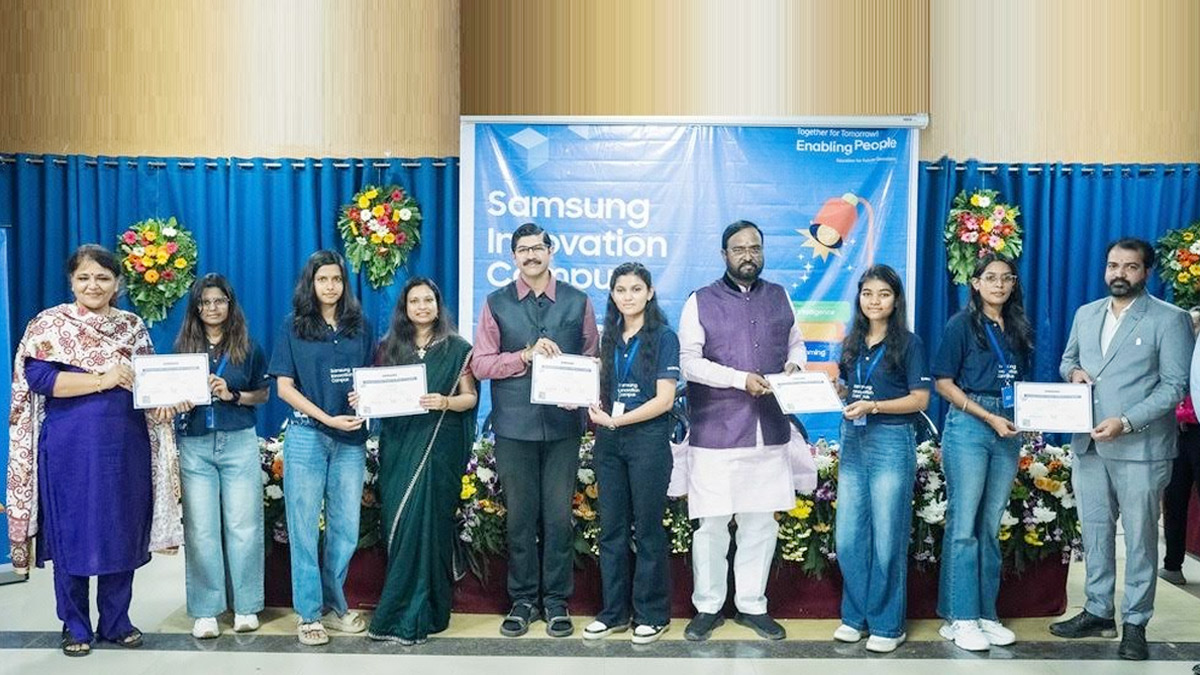
PUNE: Samsung has put 1,000 students in Maharashtra through a certified training programme in artificial intelligence and coding, the largest such drive the South Korean electronics company has run in the state and a signal that corporate India’s skilling ambitions are moving well beyond the boardroom brochure.
The certifications were awarded under Samsung Innovation Campus (SIC), the company’s flagship corporate social responsibility programme, which launched in India in 2022 with the stated aim of democratising access to future-technology education. The 1,000 graduates were drawn from four institutions: 127 from Savitribai Phule Pune University, 373 from Pimpri Chinchwad University, 250 from D.Y. Patil University’s Ramrao Adik Institute of Technology and 250 from Anjuman-I-Islam’s Kalsekar Technical Campus. All completed training in either AI or coding and programming, the two disciplines Samsung has identified as the critical pillars of the digital economy.
The programme does not stop at technical training. Soft-skills development and career-readiness modules are baked into the curriculum, a deliberate attempt to close the gap between what universities teach and what employers actually want.
“India’s digital growth story will ultimately be shaped by the quality of its talent pipeline,” said Shubham Mukherjee, head of CSR and corporate communications at Samsung Southwest Asia. “As technologies like AI move from the periphery to the core of industries, skilling must evolve from basic training to building real-world capability. This milestone in Maharashtra reflects how industry and academia can come together to create a future-ready workforce that is both globally competitive and locally relevant.”
The Maharashtra drive sits within a rapidly scaling national effort. Samsung Innovation Campus trained 20,000 young people across India in 2025, hitting its stated target for the year. Women account for 48 per cent of national enrolments, a figure the company cites as evidence of its push for an inclusive technology ecosystem. The programme is implemented in partnership with the Electronics Sector Skills Council of India and the Telecom Sector Skill Council.
Samsung, which is marking 30 years in India this year, runs SIC alongside two other initiatives, Samsung Solve for Tomorrow and Samsung DOST, as part of a broader effort to build what it calls a generation of innovators with both the technical depth and the problem-solving mindset to thrive in a fast-moving digital world.
A thousand certified students is a tidy headline. Whether they find jobs that match their new skills is the harder question, and the one that will ultimately determine whether corporate skilling programmes like this one are genuine pipelines or well-photographed gestures.






