MAM
AdAsia begins with I&B Minister stressing on the need of CSR


NEW DELHI: Even as advertising has grown from Rs 100 billion to Rs 300 billion in the last 20 years, consumers are rewarding those advertising agencies who are doing good for society and fulfilling their corporate social responsibility (CSR), Information and Broadcasting Minister Ambika Soni said here today.
CSR should be used in a country like India for health and education, she said while inaugurating the 27th AdAsia being held in India after a gap of eight years.
Reiterating that the government is for a free media, she noted that the Advertising Standards Council of India (Asci) is doing a great job in self-regulation as far as advertising was concerned.

At the same time, the government wants to bring in a more robust system for television rating points and is working towards that end.
She said the Directorate of Advertising and Visual Publicity (DAVP) is being revamped to “match up to the private advertising agencies”.
Meanwhile, she said that despite the meltdown in the west, Indian media has continued to grow and there is a boom in the newspaper industry where around 107 billion copies are being sold daily. The number of television channels has reached almost 800 and the number of radio FM channels is expected to go up to 839 after the third phase.
She said the country had also taken concrete steps to be fully digitalised by 31 March 2014.
Referring to the theme of the meet, ‘Uncertainty: the new Certainty‘, Soni said “the only certainty is that there will always be uncertainty.”
Bollywood star Shah Rukh Khan, who has just achieved a milestone in marketing with the way his film Ra.One has been promoted, said on the occasion that he saw himself in various ways as far as advertising was concerned. He was the consumer who always fell for the dream merchants and the “tricks unveiled on my poor unsuspecting greed”; the brand endorser; the seller of his own films and the causes he endorsed including the Kolkata Knight Riders; and marketing himself as a brand for which he always needed to re-invent himself. Luring attention to himself is a great effort and therefore he believed in the idiom “early to bed and early to rise, work as hell and advertise.”
Khan also unfurled the AdAsia flag, before former Miss India Diana Hayden who was conducting the inaugural ceremony asked him to do a jig on ‘You are my chhamak chhalo‘ from Ra.One.
About 1200 delegates from India and 25 other countries are attending the meet, which is featuring around fifty of the world‘s top experts in the world of marketing, media and advertising.
Around 18 sessions are being held on various subjects apart from the opening and closing ceremonies. The speakers will include around 45 from overseas.



MAM
Madison World to launch AI platform M BrAIn for media planning
Agency group invests about $1 million as it shifts to AI driven growth planning.
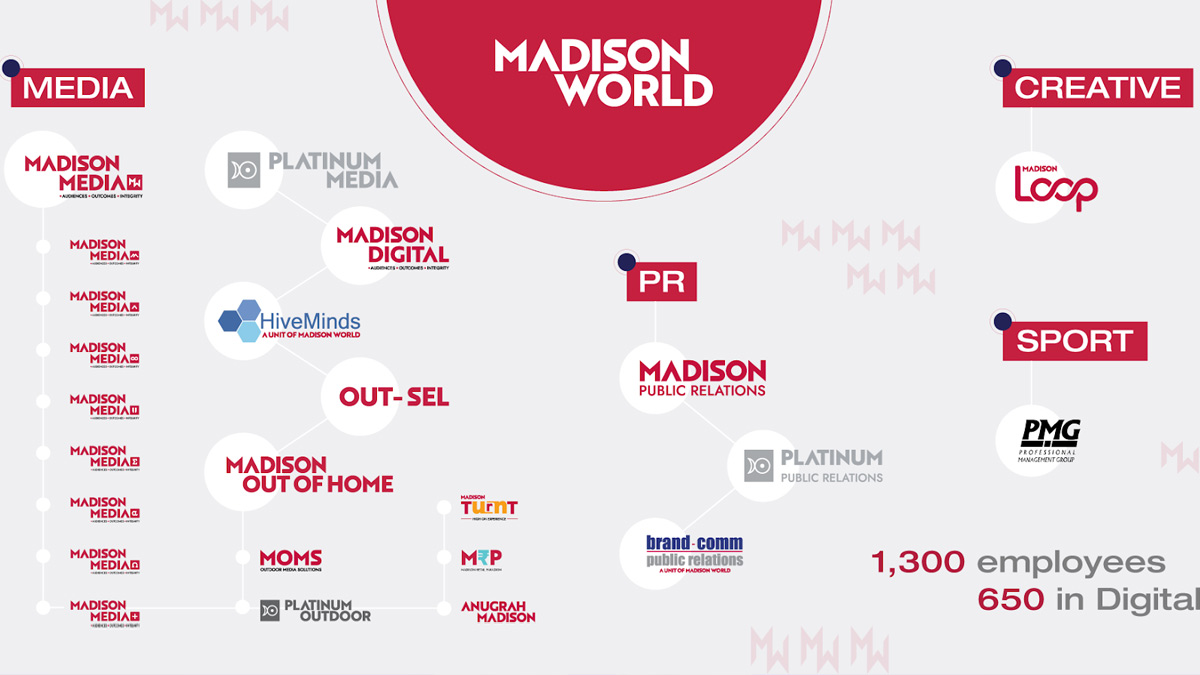
MUMBAI: If media planning once ran on spreadsheets and gut instinct, the next chapter may run on algorithms and curiosity. Madison World is preparing to roll out the first version of its proprietary artificial intelligence platform Madison M BrAIn in early April, as the independent agency group accelerates its transition toward AI driven planning and product led media services.
The platform, expected to involve an investment of around $1 million, is designed to reshape how the agency approaches strategy by combining internal knowledge, external data sources and advanced AI models into a single intelligence ecosystem.
According to Madison Media, OOH and Hiveminds partner and group CEO Ajit Varghese the initiative forms part of a larger structural rethink within the organisation. “Traditionally agencies built frameworks around media planning and allocation. We are redesigning that structure into what we call a Growth Planning System (GPS),” Varghese said.
The shift reflects a growing belief that effective media strategy must begin earlier in the decision making process. Instead of jumping directly to channel allocation, planners must first decode the market itself identifying consumer barriers, purchase triggers and the core challenges facing a brand.
Once those insights are mapped, agencies can build clearer growth agendas for clients and design media strategies that connect more closely with business outcomes.
To support that approach, Madison has built Madison M BrAIn as what it describes as a human AI cognitive ecosystem. Acting as a central intelligence hub, the platform aggregates proprietary insights alongside external data sources and large language models, enabling planners to access deeper market intelligence before building campaign strategies.
Varghese said one of the core objectives is to democratise knowledge across the organisation. “In the past, this level of understanding was largely available to senior leaders or experienced strategists. With Madison M BrAIn, even a junior planner should be able to access the same intelligence and approach clients with a far more informed perspective,” he said.
The agency has already implemented the new planning philosophy internally and completed three months of testing for the AI platform, with early trials showing encouraging results in terms of learning capability and system performance.
While the first version relied on global large language models, Madison is now developing its own proprietary Small Language Model (SLM) to serve as the core of the M BrAIn ecosystem.
“The SLM will be able to read global LLMs, but the LLMs cannot read the SLM,” Varghese explained. “That ensures all the intelligence we build remains within the Madison ecosystem and strengthens our proprietary knowledge base.”
The first version of Madison M BrAIn is expected to go live in early April, with a more refined version targeted by the end of June. Over time, the platform will integrate additional external data streams and APIs including consumer insight platforms, social listening tools and client datasets.
These integrations are expected to enhance the system’s learning capability and enable it to generate increasingly sophisticated strategic recommendations.
Although the platform is currently being deployed for internal use, Madison sees potential for it to evolve into a licensable product in the future.
“At the moment, our focus is to stabilise and strengthen M BrAIn internally. But over time there is potential for this to become a product that could be licensed externally,” Varghese said.
The AI platform is also part of a wider technology transformation underway at the agency group. Alongside M BrAIn, Madison is building a broader digital infrastructure called the Catalyst operating system, which aims to integrate operational processes, data and product platforms into a unified ecosystem.
This broader technology stack could require an additional $1 million to $1.5 million investment over time, though spending will be phased and reviewed regularly.
“We are evaluating progress every three months and prioritising the most critical capabilities first,” Varghese said.
Madison expects the full AI and operating ecosystem to be fully functional within 12 to 18 months, positioning the agency to combine human strategy with machine intelligence as the advertising industry enters its next data driven phase.