MAM
Ad & marketing growth may decelerate due to ‘online’ slowdown & no major spending: KPI

MUMBAI: PQ Media’s Annual KPI benchmark sees slower growth in 2017 owing to political & economic anxieties. Political leaders and parties were replaced in several leading global markets (US, UK, Brazil, South Korea), while other incumbents faced increased pressure from opposing parties (France, Japan, Germany, India). And, various economic and political issues weighed down other major media economies, including South Africa, China and Russia.
Global advertising & marketing revenues grew an estimated 4.9% in 2016 to $1.2 trillion, accelerating from 3.7% growth in 2015, but growth is poised to decelerate in 2017 as online media growth slows down rapidly due to brand marketers shifting budgets to mobile and other digital & alternative media, as per a closely watched annual KPI benchmark report by PQ Media. Revenues had grown owing to strong growth in mobile media, over-the-top (OTT) video, branded entertainment, content marketing and digital out-of-home (DOOH) advertising, as per the report.
Global ad & marketing growth is poised to decelerate in 2017, due to the absence of major political and sports-related media spending, as well as the continued slowdown in online media growth. Seven of the 13 mobile media channels PQ Media tracks posted growth rates of faster than 40% in 2016, including mobile coupon marketing, mobile videogame advertising, mobile sampling & contests, mobile search and mobile video, as well as emerging smart technology marketing (or “acronym tech”) via the Internet of Things (IoT), artificial intelligence (AI) and augmented reality (AR), among others, according to PQ Media’s Global Advertising & Marketing Revenue Forecast 2016-20.

Positive cyclical growth drivers in 2016, such as the Summer Olympics, increased political spending despite the Trump campaign’s unusual reliance on earned media coverage, and surging mobile media use worldwide, were offset in the second half of the year by increasingly volatile political climates and continued economic trepidation in the US and abroad.
In addition, several key global markets in early 2017 were expecting to feel the impact of new Trump administration policies, some viewed as positive (Russia, China) and others perceived as negative (Mexico, Taiwan, China). PQ Media indicated US and global trends were buoyed by cyclical drivers last year, which may have masked a combination of potentially adverse secular developments that resurfaced in late 2016. Due to these turns in PEST variables, PQ Media said it recalibrated several ad & marketing growth rates for 4Q 2016 and 2017.
“We have not seen such a strong combination of potential political and economic headwinds worldwide in many years,” said PQ Media president Patrick Quinn. “Despite this volatile mix, the advertising & marketing industry remains relatively stable due to several key growth drivers, including the need to engage more effectively with on-the-go consumers through experiential and influencer marketing; the shift to omnichannel media campaigns that employ the strengths of both traditional and digital media; and the quick adaptation of new technologies and strategies to engage target consumers for extended periods in the right venue, at the right time and in the ideal mindset.”
The primary reason for decelerating growth in online media is that brand marketers are shifting budgets to media platforms and channels that demonstrate the consistent ability to execute on those critical objectives, Quinn added. For example, advertising on digital healthcare networks in captive doctors’ offices, engaging shoppers on smartphones with mobile beacons at retail, and using word-of-mouth ambassadors to develop social media conversations.
While print media advertising has lost almost half its value over the past 20 years, due to the rise of digital media advertising & marketing, PQ Media believes a similar phenomenon has emerged in online media as brands rapidly move investments from internet to mobile media channels. Several internet channels have begun to post low single-digit, or even negative, growth rates after years of boasting double-digit gains annually, such as e-mail marketing and online search, according to the Global Advertising & Marketing Revenue Forecast 2016-20.
Mobile was not the only digital & alternative media to post double-digit growth in 2016. Brands are seeking methods to interactive more efficiently with consumers, particularly as foot traffic at bricks-and-mortar retail outlets declines. OTT video, product placement, content marketing, DOOH media and word-of-mouth marketing have all consistently posted strong gains in recent years. Meanwhile, traditional direct marketing remained the largest of the 21 digital and traditional media platforms PQ Media tracks, surpassing $215 billion in 2016, with three other platforms exceeding $100 million, including live events, terrestrial broadcast television and traditional promotions.
Brands are also moving to develop campaigns that utilize the fastest-growing of the 40 digital & alternative media channels PQ Media tracks, such as smart tech marketing, which is defined, sized and projected for the first time anywhere in the new PQ Media report. Smart tech marketing growth skyrocketed by over 1,000% in 2016, as select brands scrambled to embed messages in the AR game Pokemon Go!; to team up with IBM’s Watson to drive AI campaigns; and to develop IoT marketing messages. Other highlights from the report include:
–Digital & alternative media expanded 12.5% to $399.4 billion, while traditional inched up 1.4% to $783.7 billion;
–US remained the largest media market in 2016 at $461.7 billion, while no other market exceeded $100 billion;
–Four of the top 20 media markets posted double-digit growth in 2016, led by India, as the US ranked 14th with overall growth of 4.7%;
–Direct marketing was the largest of the 15 hybrid (traditional & digital media) silos tracked, with revenues of $230.4 billion worldwide;
PQ Media estimates global advertising & marketing revenues will rise at a 5.1% CAGR in the 2016-20 period to $1.45 trillion, while the US market expands at a tamer 4.3% CAGR.





MAM
8PM Packaged Drinking Water named Lead Trouser Sponsor for Sunrisers Hyderabad
Brand partners with IPL team for 2026 season with campaign ‘Rise in Orange, Celebrate with Black’.
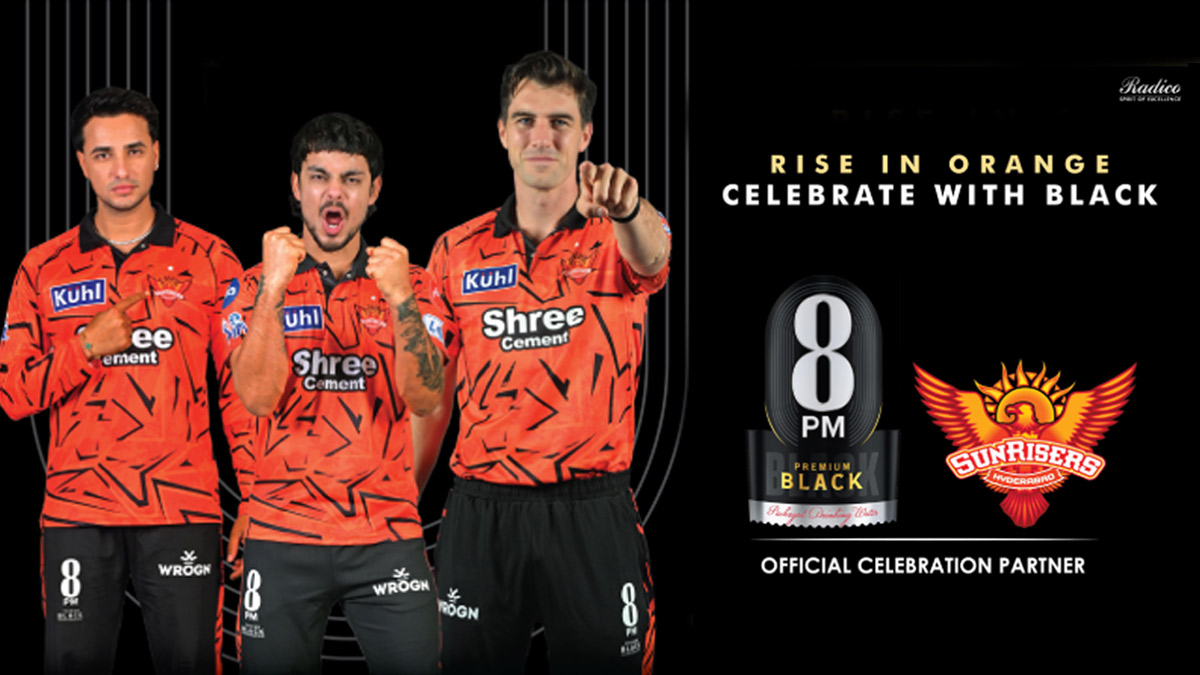
MUMBAI: 8PM Packaged Drinking Water has found a clever way to stay in the game by hitching its wagon to one of cricket’s most exciting teams. The brand from Radico Khaitan Limited has announced its association with Sunrisers Hyderabad as the Lead Trouser Sponsor for India’s Premier Cricket League 2026. The partnership will see 8PM Packaged Drinking Water gain prominent visibility during the high-energy tournament.
To mark the collaboration, the brand has launched the campaign thought “Rise in Orange, Celebrate with Black.” The idea cleverly links the on-field intensity of Sunrisers Hyderabad’s iconic orange jersey with the off-field celebrations powered by 8PM Premium Black Packaged Drinking Water.
Radico Khaitan Limited chief marketing officer Kunal Madan said, “We are delighted to be associated with Sunrisers Hyderabad for the 2026 season. With the league’s unmatched reach and the team’s strong fan following, this is a great opportunity to connect meaningfully with consumers across the country.”
Sunrisers Hyderabad enters the season with a formidable lineup featuring players such as Abhishek Sharma, Ishan Kishan, Travis Head, and Pat Cummins, making it one of the most watched teams this year.
A spokesperson from Sunrisers Hyderabad added, “We are pleased to welcome 8PM Packaged Drinking Water to the Sunrisers family. This association brings together shared values of energy, resilience, and excellence.”
The partnership underscores Radico Khaitan’s strategy of aligning with marquee sporting platforms to build contemporary, consumer-centric brands. By tapping into the emotional connect and massive viewership of the league, 8PM aims to deepen engagement and strengthen brand affinity during the cricket season.
In the fiercely competitive world of Indian cricket sponsorships, 8PM has chosen to play it smart, pairing the thrill of orange with the cool refreshment of black. As Sunrisers Hyderabad prepare for another exciting season, the brand is set to ride the wave of passion, performance, and celebration.







