MAM
ABP creates a big bang on outdoors

MUMBAI: With elections season buzzing in, ABP News rolled out an extensive nationwide outdoor campaign. The mastermind behind this campaign was Milestone Brandcom.
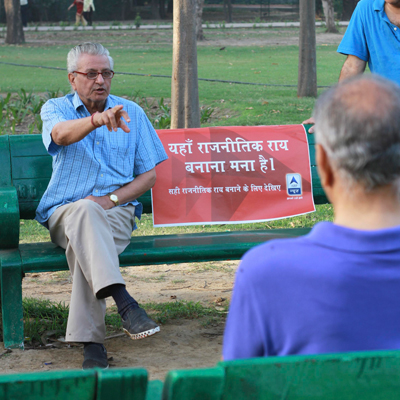
The idea behind this campaign was around “Aap apni rajneetik rai kahan banate hain.” The outdoor touch points involved spots such as tea stalls, tiffin delivery boxes, public benches and mobile vans to reach out to the common man across cities.

Launched on 1 April, the campaign lasted a month and was specifically tailored to different regions in the country for maximum impact.
The brief given to agency was to urge common people to not form their opinions on politics and politicians while discussing them with each other. Instead, created a campaign message to watch the channel for comprehensive reportage of the most crucial elections. The campaign was designed keeping in mind the congregational places where all strata of society across regions, cultures and dialects meet.
Milestone launched a full-fledged outdoor campaign in Delhi NCR, UP, Bihar, Jharkhand and Kolkata where over 1000 sites were put up covering five lakh sq ft making it one of the most visible campaigns this year. The site locations covered strategic spaces with heavy footfalls such as major junctions, railway stations, office complexes, food courts etc where people would normally group and chat about politics.
Stickers and ply-cards were put up on benches asking them not to form political opinion while discussing politics on their morning jogs and to make an informed choice after watching ABP News. This exercise covered the Lodhi Garden in Delhi, Jogger Park in Mumbai, Raja Park in Agra and Dr Ram Mohan Lohia Park in Lucknow. Railway announcements were carried out in Uttar Pradesh which is the largest state for the elections. The state also saw mobile vans driving across 150 towns educating and informing the masses, posters were put up at various grocery, barber shops, tea stalls etc purporting them to watch ABP News.
In Mumbai, Milestone targeted the office goers by placing leaflets with the message “Don’t talk while having food and don’t make political opinion while having food” inserted in lunch boxes delivered by Dabbawallas. To capture the youth and urban class, the activation was extended to Café Coffee Day and McDonalds outlets where tent cards and posters featured the message.
Over 200 outlets across the five markets were covered with this activity. Skits were performed in the canteens of colleges, food courts, Dhaabas and Tea Stalls with the objective to create awareness about the TVC of ABP News at ground level. The skits discussed elections and the responsibility of every citizen to choose the right candidate for betterment of the nation.
Milestone tied-up with around 15000 tea stalls in around 200 cities in UP, Mumbai and Delhi where Danglers and posters were put up asserting the campaign and not to form political opinion while drinking tea. Around 25 lakh tea cups branded with the same message were distributed at these stalls. This was an attempt to cover the highly promoted concept of politicians having chai with the public during these elections. On 16th May ’14, T3 terminal at Delhi airport will air ABP News covering the election results for all travellers so they can catch every event of the landmarked day.
According to MCCS, marketing manager Vikas Singh said, “ABP News Campaign asks its viewers ‘Aap apni rajneetik rai kahan banate hain’. The on ground activation is a tactical intervention to capitalize on the current election frenzy bringing alive the core message of “apni rajneetik rai sahi jagah banayee”. Chai seems to have taken centre stage this election and we have attempted a serious take on this. The humble tea stall frequently sees animated political discussions and hence we identified it as key pillar for the activation idea.”
Milestone Brandcom MD Nabendu Bhattacharyya, said “This was a very significant project for us as we are amidst the biggest political event of our country and ABP News is a prestigious media house known for its honest and comprehensive coverage of news. We have utilised all media resources to create an expansive campaign to reach out to people across barriers and have used some very unconventional tools to do so such as setting up tea stalls and inserting leaflets in tiffins delivered by Dabbawallas. The campaign has already started showing results and has been appreciated by the target group and is another feather in the cap for Milestone Brandcom”

Digital
Content India 2026 opens with a copro pitch, a spice evangelist and a £10,000 prize for Indian storytelling
Dish TV and C21Media’s three-day summit puts seven ambitious projects before an international jury, and two walk away with serious development money
MUMBAI: India’s content industry gathered in Mumbai this March for Content India 2026, a three-day summit organised by Dish TV in partnership with C21Media, and it wasted no time making a statement. The event opened with a Copro Pitch that put seven scripted and unscripted television concepts before an international panel of judges, and by the end of it, two projects had walked away with £10,000 each in marketing prize money from C21Media to support development and international promotion.
The jury, comprising Frank Spotnitz, Fiona Campbell, Rashmi Bajpai, Bal Samra and Rachel Glaister, evaluated a shortlist that ranged from a dark Mumbai comedy-drama about mental health (Dirty Minds, created by Sundar Aaron) to a Delhi coming-of-age mystery (Djinn Patrol, by Neha Sharma and Kilian Irwin), a techno-thriller about a teenage gaming prodigy (Kanpur X Satori, by Suchita Bhatia), an investigative crime drama blending mythology and modern thriller (The Age of Kali, by Shivani Bhatija), a documentary on India’s spice heritage (The Masala Quest, hosted by Sarina Kamini), a documentary on competitive gaming (Respawn: India’s Esports Revolution, by George Mangala Thomas and Sangram Mawari), and a reality-horror competition merging gaming and immersive fear (Scary Goose, by Samar Iqbal).
The session was hosted by Mayank Shekhar.
The two winners were Djinn Patrol, backed by Miura Kite, formerly of Participant Media and known for Chinatown and Keep Sweet: Pray & Obey, with Jaya Entertainment, producers of Real Kashmir Football Club, also attached; and The Masala Quest, created and hosted by Sarina Kamini, an Indian-Australian cook, author and self-described “spice evangelist.”
The summit also unveiled the Content India Trends Report, whose findings made for bracing reading. Daoud Jackson, senior analyst at OMDIA, set the tone: “By 2030, online video in India will nearly double the revenue of traditional TV, becoming the main driver of growth.” He noted that in 2025, India produced a quarter of all YouTube videos globally, overtaking the United States, while Indians collectively spend 117 years daily on YouTube and 72 years on Instagram. Traditional subscription TV is declining as free TV and connected TV gain ground, forcing broadcasters to innovate. “AI-generated content is just 2 per cent of engagement,” Jackson added, “highlighting the dominance of high-quality human content. The key for Indian media companies is scaling while monetising effectively from day one.”
Hannah Walsh, principal analyst at Ampere Analysis, added hard numbers to the picture. India produced over 24,000 titles in January 2026 alone, with 19,000 available internationally. The country now accounts for 12 per cent of Asia-Pacific content spend, up from 8 per cent in 2021, outpacing both Japan and China. Key exporters include JioStar, Zee Entertainment, Sony India, Amazon and Netflix, delivering over 7,500 Indian-produced titles abroad each year. The top importing markets are Saudi Arabia, the UAE, Egypt, the United States and the Philippines. Scripted content dominates globally at 88 per cent, with crime dramas and children’s and family titles performing particularly strongly.
Manoj Dobhal, chief executive and executive director of Dish TV India, framed the summit’s ambition squarely. “Stories don’t need translation. They need a platform, discovery, and reach, local or global,” he said. “India produces more movies than any country, our streaming platforms compete globally, and our tech and creators win international awards. Yet fragmentation slows growth. Producers, platforms, and tech move in different lanes. We need shared spaces, collaboration, and an ecosystem where ideas, technology, and people meet. That is why we built Content India.”
The data, the pitches and the prize money all pointed to the same conclusion: India is not waiting for the world to discover its stories. It is building the infrastructure to sell them.







