Digital Agencies
74% of respondents will continue to make purchases via contactless mode: MasterCard report

NEW DELHI: As communities begin to slowly reopen, business owners and the consumers they serve are entering unknown territory, navigating the new normal, living with precautions. During these times, contactless and other forms of digital payments have emerged as the healthiest way of making payments as they are more secure and require minimum physical contact between the merchant and customer.
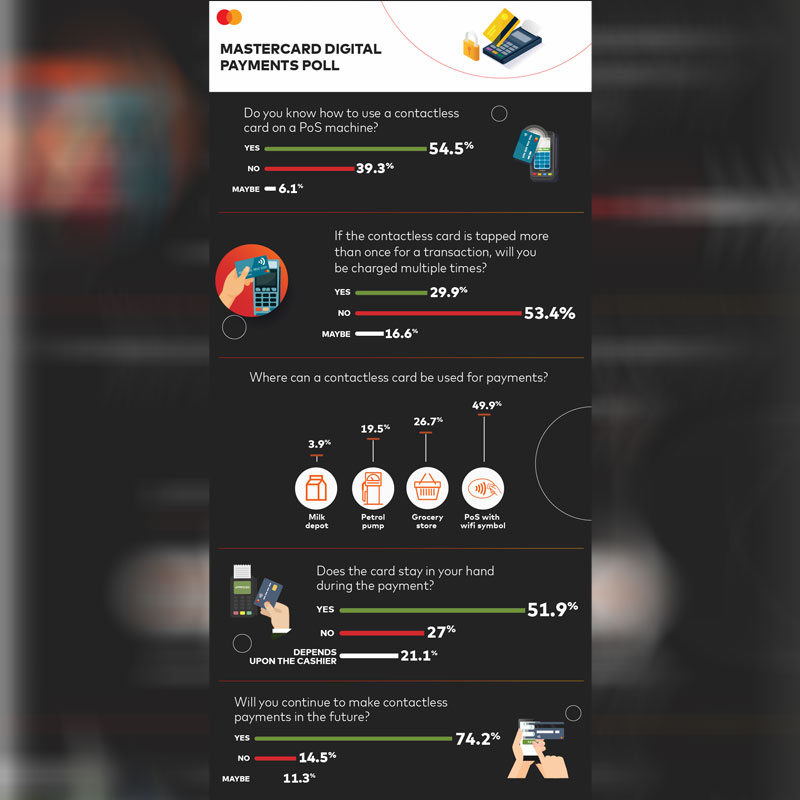
To garner more insights on Indian consumer sentiment towards contactless payments Mastercard in India recently conducted a digital payments poll. Indian consumers show an increased awareness and positive shift in preferences towards contactless payments:
Over 54 per cent of the respondents know how to use a contactless card on a PoS machine
53 per cent of the respondents know that consumers don’t get charged multiple times if the contactless card is tapped more than once. However, 30 per cent did not know this highlighting the need for more awareness of the safety of contactless payments
74 per cent of the respondents, a high number, said that they will continue to make purchases digitally or via contactless mode in the coming times
51 per cent of the respondents know that contactless card remains in the hand of the customer while making a transaction
49 per cent of the voters know that a POS machine with a WIFI symbol will allow them to use a contactless card to make a payment

Increase in awareness and usage of digital payments
In the current environment, there has been significant growth in adoption of contactless payments both globally and in India. Consumers are aware that contactless technology and digital payments can ease some of the tension by reducing a measure of daily risk when we pay. This technology also empowers some of the most financially vulnerable with a safe and secure way to make and receive payments.
According to recent Mastercard data, there is a 19 per cent increase in the actual contactless cards issued in Q1 2020 over Q4 2019. Currently, the top 5 cities in contactless transactions are Bengaluru at 16 per cent, Delhi and NCR at 12 per cent, Chennai at seven per cent and Mumbai at six per cent. The South region dominates the contactless ecosystem with maximum number of contactless transactions seen there. Bangalore has by far the highest number of contactless transactions, more than twice the next city which is Hyderabad.
Interestingly penetration of contactless transactions is the highest in the lowest ticket size. Below $ 10 seems to be the sweet spot for contactless transactions in India and this trend bodes well for mass adoption. India is making rapid strides in bridging the digital payments divide. Penetration of contactless transactions is being driven by the top four categories that includes food stores, restaurants, fuel and drug stores dominating the contactless ecosystem. Food stores, restaurants and bars and gas stations are the only category with one million + transactions in each month of Q1 2020.
The poll was conducted with approximately 39288 individuals between 15-19 June 2020 through Twitter.




BENGALURU: For years, creative teams have learned to live with ambiguity. Vague comments, last-minute changes, feedback that arrives without context, clarity, or conviction. It became part of the job – something teams worked around rather than getting it solved.
But as we head into 2026, that tolerance is wearing thin.
Creative work today moves faster, scales wider, and involves more stakeholders than before. Teams are producing more content across more formats, often with distributed collaborators and tighter timelines. In this environment, guesswork is no longer a harmless inconvenience. It’s a cost – to time, to budgets, and to creative mindspace.
The real problem isn’t feedback, it’s how it’s given
Most creative professionals you see today will tell you they’re not against feedback. In fact, they rely on it. Good feedback sharpens ideas, strengthens execution, and pushes work forward. The problem is ‘unclear’ feedback. When someone says “this doesn’t feel right” without context, they aren’t just revising – they’re basically decoding. They’re guessing what the problem might be, trying different directions, and burning time in the process. Multiply that by a few stakeholders and a few rounds, and suddenly days disappear.
In 2026, when teams are expected to deliver faster without compromising quality, interpretation is a luxury most can’t afford.
Scale has changed rverything
Creative projects used to be smaller and simpler. A designer, a manager, maybe one client contact. Feedback loops were short, even if they weren’t perfect.
Today, the same project might involve internal marketing teams, agencies, freelancers, brand reviewers, and regional teams. Everyone has a say. Everyone leaves comments. And often, those comments don’t agree. More people reviewing work means alignment matters more than ever. Clear feedback isn’t just about being nice to creative teams, it’s about keeping projects moving when complexity increases.
Guesswork quietly wears teams down
One of the less talked-about impacts of unclear feedback is what it does to people.
When feedback is vague or contradictory, creatives second-guess their decisions. They hesitate. They overwork. They keep extra time buffers “just in case.” Over time, confidence drops. Ownership fades. Work becomes safer, not stronger. Creative energy gets spent on managing uncertainty instead of pushing ideas forward. And in an industry already grappling with burnout, unclear feedback adds unnecessary mental load.
Actionable feedback is a shared skill
Clear feedback doesn’t mean controlling creative decisions or dictating every detail. It means being specific enough that someone knows what to do next.
Actionable feedback answers three basic questions:
What exactly needs attention?
Why does it matter?
What outcome are we aiming for?
This applies whether you’re reviewing a video frame, a design layout, or a copy draft. The clearer the feedback, the fewer follow-ups it creates. In 2026, teams that treat feedback as a skill and not an afterthought, will move faster with less friction.
Tools shape behaviour (whether we admit it or not)
The way feedback is delivered is often dictated by the tools teams use. Comments buried in long email threads, messages split across chat apps, or notes detached from the actual work all contribute to confusion.
When feedback lives outside the work, context often gets lost. When it’s disconnected from versions and timelines, decisions get questioned. When it’s scattered, accountability disappears. More teams are starting to realise that feedback problems aren’t just communication issues, they’re workflow issues. How work moves between people matters just as much as the work itself.
From Opinions To Alignment
One of the biggest shifts happening in creative teams is a move away from purely opinion-driven feedback. Instead of “I like this” or “I don’t,” teams are asking better questions:
● Does this meet the brief?
● Does this solve the problem?
● Does this align with the goal?
This change reduces unnecessary back-and-forth and helps feedback feel less personal and more productive. It also makes decisions easier to explain and defend. As creative work becomes more strategic, feedback has to support that shift.
2026 Is About Fewer Loops, Not Faster Loops
There’s a misconception that speed means moving through feedback cycles faster. In reality, the most creative teams aren’t just accelerating loops, they’re reducing them. Clear, actionable feedback upfront leads to fewer revisions later. Clear approval stages prevent last-minute surprises. Clear decisions stop work from circling endlessly.
In 2026, efficiency won’t come from working harder or longer. It will come from designing workflows that respect creative time and attention.
Ending guesswork is a mindset change
Ultimately, ending creative guesswork isn’t just about better tools or processes. It’s about mindset. It’s about recognising that clarity is an act of respect – for the work, for the people doing it, for the time invested and for the mindspace used. It’s about moving from “figure it out” to “here’s what we’re aiming for.”
Creative teams that embrace this shift will find themselves not only delivering faster, but also enjoying the process more. And in an industry built on imagination, that might be the most valuable outcome of all.






