Brands
13th BMW Art Car comes to India


MUMBAI: BMW Group India presents the 13th BMW Art Car created by Italy’s most renowned contemporary artist Sandro Chia. His creation will be exclusively exhibited from 2-5 February 2017 at the India Art Fair in New Delhi. Sandro Chia created the 13th Art Car for BMW in 1992 with the BMW M3 GTR which is celebrating its 25th anniversary in 2017.
The art car was recently showcased at Quadriennale d’Arte held in Rome from October 13, 2016, to January 7, 2017.
The BMW Art Cars or the ‘Rolling Sculptures’ are original masterpieces of art that demonstrate an individual synthesis of artistic expression and automobile design. Since 1975, eighteen prominent artists from across the world have created Art Cars on the basis of contemporary BMW automobiles of their times, all offering a wide range of artistic interpretations.

BMW Group India president (act) Frank Schloeder said, “Cultural communication has been one of the long-standing commitments of BMW Group. The partnerships we build strengthen intercultural dialogue and create platforms for multidisciplinary exchange. The BMW Art Cars collection spans the work of prominent artists across continents. Together they form a mirror of contemporary culture, as exemplary as it is unique. Through the exclusive showcase of the BMW Art Car by Sandro Chia at the India Art Fair, we bring yet another coveted masterpiece of art closer to connoisseurs and patrons of art. Visitors will be able to discover the design and creative process of the 13th BMW Art Car at the India Art Fair 2017.”
BMW Art Cars are an indispensable component and a core platform of BMW Group’s cultural engagement. They are unique creations combining automobiles, technology, design and art.
It was back in 1992 when Sandro Chia became the only Italian artist so far to be asked to put his mark on a BMW Art Car. The artist decided to give a BMW car a distinctive look; he created a combination of BMW’s design language and the artists’ perspective of multiple gazes of the onlooker and how the car reflects on them.
For over 40 years, the BMW Art Car Collection has fascinated art and design enthusiasts as well as lovers of cars and technology with its amalgamation of fine art and innovative automobile technology. Several cars from the BMW Art Car Collection are usually on display at the BMW Museum in Munich, the home of BMW Art Cars, as part of its permanent collection. The remaining BMW Art Cars travel the globe – to art fairs as well as exhibitions.
The BMW Art Car Collection was born when French race car driver and art aficionado Hervé Poulain, together with Jochen Neerpasch, then BMW Motorsport Director, asked his artist friend Alexander Calder to design an automobile. The result was a BMW 3.0 CSL which competed in 24 Hours of Le Mans in 1975, where it quickly became the crowd’s favourite. Since then, 17 international artists have designed BMW models, among them some of the most renowned artists of our time: Alexander Calder (BMW 3.0 CSL, 1975), Frank Stella (BMW 3.0 CSL, 1976), Roy Lichtenstein (BMW 320 Group 5, 1977), Andy Warhol (BMW M1 Group 4, 1979), Ernst Fuchs (BMW 635CSi, 1982), Robert Rauschenberg (BMW 635CSi, 1986), Michael Jagamara Nelson (BMW M3 Group A, 1989), Ken Done (BMW M3 Group A, 1989), Matazo Kayama (BMW 535i, 1990), César Manrique (BMW 730i, 1990), A. R. Penck (BMW Z1, 1991), Esther Mahlangu (BMW 525i, 1991), Sandro Chia (BMW M3 GTR, 1992), David Hockney (BMW 850CSi, 1995), Jenny Holzer (BMW V12 LMR, 1999), Ólafur Eliasson (BMW H2R, 2007) and Jeff Koons (BMW M3 GT2, 2010).
On 19 November 2015, at the celebration of the 40th anniversary of BMW Art Cars at Guggenheim Museum in New York, a jury of distinguished museum directors and curators chose Chinese artist Cao Fei and American artist John Baldessari to separately design the next BMW Art Cars in 2017 with the BMW M6 GT3 and BMW M6 GTLM.
On 30 November 2016, the 19th BMW Art Car designed by John Baldessari celebrated its world premiere at Art Basel Miami Beach. The world premiere of the 18th BMW Art Car designed by Cao Fei is scheduled during the summer of 2017.
The artist’s pictorial language is in light-hearted contrast to the often tough milieu of the big city, to which he reportedly feels himself drawn: figures of the mythical appearance parade themselves before us in a timeless, bucolic Arcadian setting.
“I have created both a picture and a world. Everything that is looked at closely turns into a face. A face is a focus, a focus of life and the world,” says Sandro Chia.
“Paint me, paint me!” the racing car’s surface had called out to him, said Sandro Chia. So he started to paint, painted faces and a sea of intensive colours until the car’s whole bodywork had been completely covered. “The automobile is a much coveted object within our society”, said Sandro Chia commenting on his work. “It is the centre of attraction. People look at it. This car reflects those looks.” The design of the Art Car was not his first artistic involvement with an automobile. Even as a child he painted graffiti on cars.






Brands
KKR sixes to power EV charger rollout under VIDA campaign
Cricket meets clean mobility as big hits spark India’s charging growth
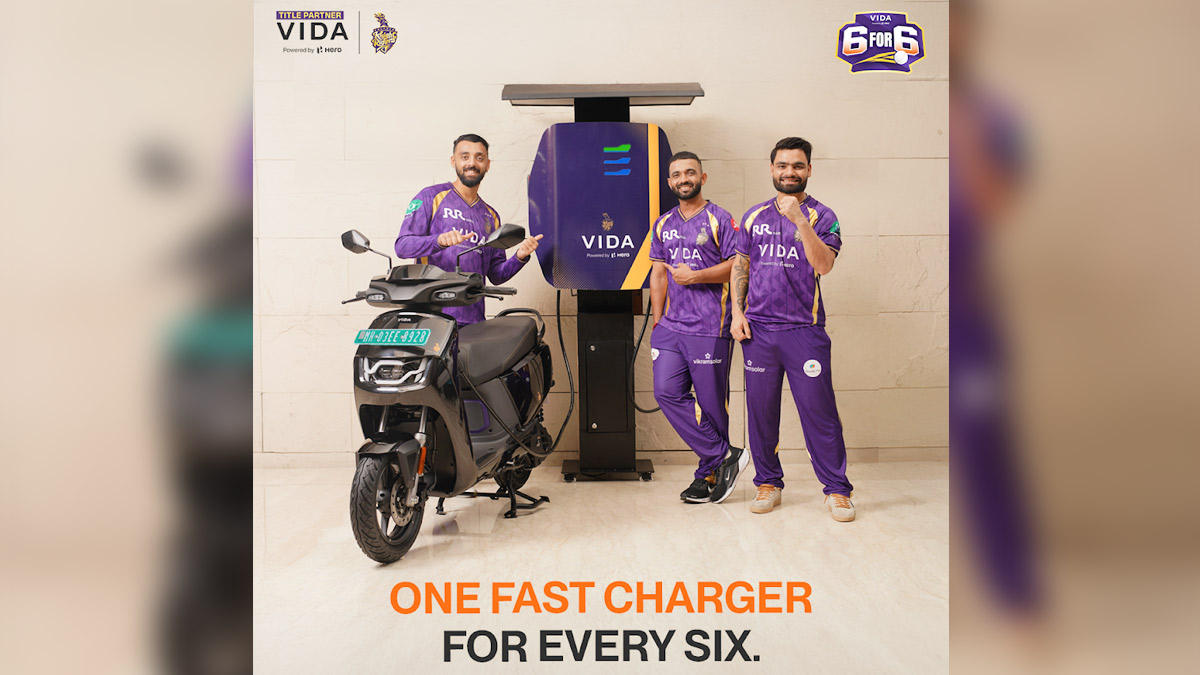
NEW DELHI: VIDA, the electric mobility arm of Hero MotoCorp, has teamed up with Kolkata Knight Riders to launch a campaign that turns cricketing flair into real-world impact.
Titled ‘6 for 6’, the initiative promises to install a 6kW fast EV charger for every six hit by KKR during the ongoing Indian Premier League season. The idea is simple but powerful, as each big hit on the field contributes directly to expanding India’s fast-charging infrastructure.
The campaign builds on VIDA’s growing network, which already spans over 5,300 fast-charging points across more than 430 cities. With EV adoption gaining pace, the brand is using cricket’s mass appeal to accelerate both awareness and infrastructure growth.
Explaining the thinking behind the move, Hero MotoCorp emerging mobility business unit chief business officer Kausalya Nandakumar said, “Cricket has an incredible ability to unite and inspire millions across the country. With the ‘6 for 6’ campaign, we are turning every big hit on the field into a step towards a cleaner and a more accessible mobility future.”
She added that VIDA’s expanding fast-charging network and removable battery technology are designed to make EV ownership more convenient and practical for everyday users.
From the franchise’s side, the campaign is also about giving on-field moments a larger purpose. Kolkata Knight Riders chief executive officer Venky Mysore said, “The ‘6 for 6’ campaign exemplifies the potential of sport as a platform for meaningful, real-world impact. By linking every six to the expansion of EV charging infrastructure, this partnership transforms fan excitement into tangible progress.”
As part of the rollout, VIDA has introduced co-branded charging stations in KKR’s signature colours, with a flagship installation unveiled alongside team players. The chargers are designed for quick top-ups, powering VIDA scooters from zero to 80 percent in about an hour, while also being positioned along key highways to support longer journeys.
The initiative also taps into VIDA’s removable battery system, which allows users to charge using standard household plug points, adding flexibility to the charging ecosystem.
By blending the thrill of cricket with the urgency of clean mobility, VIDA and KKR have found a neat way to make every six count twice, once on the scoreboard and again on India’s road to an electric future.








