Brands
Rohit Roy patches in as investor in wellness disruptor Bigme

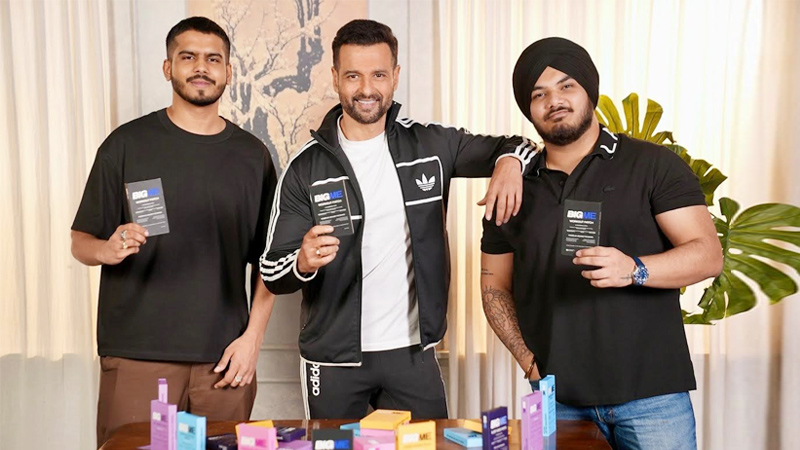
MUMBAI: It’s out with the pills and in with the patch. Bigme, a new-age health-tech brand reimagining wellness, has brought actor Rohit Roy onboard as strategic growth advisor and investor, adding star power to its science-backed mission of delivering wellness quite literally through the skin.
Bigme is among India’s first movers in transdermal wellness, a delivery format that skips the gut entirely and releases clinically backed ingredients directly into the bloodstream. The result? Faster absorption, longer-lasting effects, and no need to gulp down pills or mix up messy powders.
Built for modern, always-on lifestyles, Bigme’s patches use timed-release technology to address real-world concerns like stress, PMS, energy crashes, and poor sleep no water required. Just peel, slap, feel.

“I started out as a curious customer,” said Rohit Roy, explaining what drew him to the brand. “The patches fit seamlessly into my workouts and routine. It’s rare to find something that’s so rooted in science but still incredibly simple. I’m not just endorsing it, I’m investing in what I truly believe is the future of wellness.”
Co-founders Arjit Jain and Gurman Bhatia see Roy’s involvement as more than a celebrity tie-in. “This isn’t trend-chasing, it’s transformation,” they said. “Rohit joining the journey after experiencing the product first-hand adds authenticity and momentum to a format that’s set to change how India approaches self-care.”
Each Bigme patch is formulated with targeted functional ingredients by experts in nutraceuticals and wellness, designed for specific needs: calming anxiety, boosting energy, aiding post-workout recovery, supporting hormonal balance, and improving sleep.
With no pills, no powders, no guesswork, Bigme aims to make wellness minimal, effective, and mobile like slapping on a solution and moving on with your day.
As of now, Bigme’s transdermal patches are live and available online, marking the beginning of what could be a major mindset shift in India’s Rs 50,000 crore plus wellness market. This isn’t just a supplement. It’s self-care, simplified and wearable.





Brands
Dunkin’ Donuts to exit India as Jubilant FoodWorks ends 15-year franchise deal
The quick service restaurant giant is ending a 15-year franchise partnership with the American doughnut chain, even as it renews its Domino’s agreement for another 15 years

NOIDA: Dunkin’ is done in India. Jubilant FoodWorks Ltd, the country’s leading quick service restaurant operator, has decided not to renew its franchise agreement with the American coffee and doughnut chain, and will wind down its Indian stores in a phased manner before December 31, 2026, bringing a 15-year partnership to a quiet, loss-laden close.
The decision, approved by JFL’s board on March 30, 2026, ends a relationship that began with a Multiple Unit Development Franchise Agreement signed on February 24, 2011. JFL will now evaluate and undertake what it described in a regulatory filing as the “rationalisation and/or cessation of certain operations and/or sale, transfer or disposal of assets and/or assignment or transfer of franchise rights,” all in consultation with Dunkin’s brand owners and strictly within the terms of the original agreement.
The numbers tell the story bluntly. In the financial year 2024-25, Dunkin’ India posted a revenue of Rs 37 crore against a loss of Rs 19 crore — a haemorrhage that was always going to test the patience of a parent company recording revenues of Rs 6,104 crore and a profit of Rs 194 crore in the same period. Doughnuts, it turns out, were never going to move the needle.
The contrast with JFL’s handling of its other marquee franchise could hardly be sharper. Even as it walks away from Dunkin’, the company has just doubled down on Domino’s, signing a fresh Master Franchise Agreement on March 31, 2026, granting it exclusive rights to develop and operate Domino’s Pizza stores in India for 15 years, with an option to renew for a further 10.
JFL, incorporated in 1995 and promoted by the Bharatia family, operates a network of more than 3,500 stores across six markets — India, Turkey, Bangladesh, Sri Lanka, Azerbaijan and Georgia. Its portfolio includes Domino’s and Popeyes on the global side, and two home-grown brands: Hong’s Kitchen and COFFY, a café brand in Turkey.
For Dunkin’, India was always a stretch. The brand never quite cracked the cultural code in a market where filter coffee and chai command fierce loyalty and where the doughnut remains, at best, an occasional indulgence rather than a daily habit. Fifteen years, mounting losses and a parent with better things to spend its capital on was always going to be a difficult equation to solve.
The doughnut has had its last day. The pizza, however, is staying.






