Gaming
Why the World’s Deepest Liquidity Pools Form Around the Most Regulated Venues


The stock market, FX, and derivative markets are all vastly different. However, they all share a common thread that makes them attractive for institutional and retail investors alike. These markets have deep liquidity and mature market frameworks. The reason? They are tightly regulated, which in turns attracts the capital that deepens the liquidity available.
The rules are clear and consistently applied, so big capital holders feel confident enough to make moves. Crypto markets are different, but that difference is quickly diminishing. Money goes where investors feel secure and where the rules are transparent and specific.
Liquidity Concentration as a Sign of Market Maturity
Liquidity is all about being able to match buyers and sellers quickly and cheaply. This lets retail buyers get $50 worth of Bitcoin on a Tuesday, and also lets an institutional player sell $50 million worth on the same day. The more mature and deep a liquidity pool is, the better equipped it is to handle large buy and sell orders without stumbling or creating slippage. Liquidity goes beyond just order volume. A mature market can handle stress and pressure.

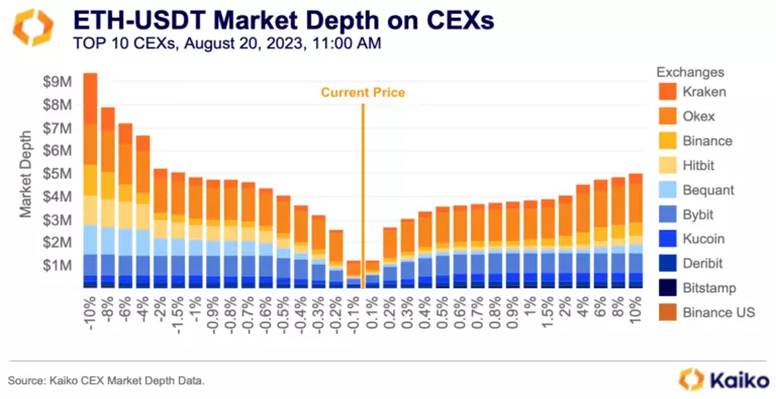
A natural outcome of market maturation is the gradual concentration of liquidity. While this may appear counterintuitive, it is a function of how efficient markets form. Consider a fragmented market made up of many small sellers offering modest amounts of an asset and a single buyer seeking to transact at scale. In such an environment, liquidity is quickly exhausted, prices become unstable, and execution becomes inefficient. This is hardly the conditions required for a reliable market. A well-functioning liquidity pool, according to CME Group, is “one where a large volume of transactions can be executed without substantial impact on the price.”
Binance’s Liquidity Scale in a Global Context
For an example on how this plays out at scale in the crypto markets let’s take a look at Binance. Crypto markets are high-velocity, meaning value changes hands quickly. Since the platform launched, their all-time trading volume is in excess of $145 trillion per Cointelegraph. To put some context to that number, the global GDP is estimated by the World Bank to be around $110 trillion. This means the company is handling trading volumes that are on-par with national financial systems.
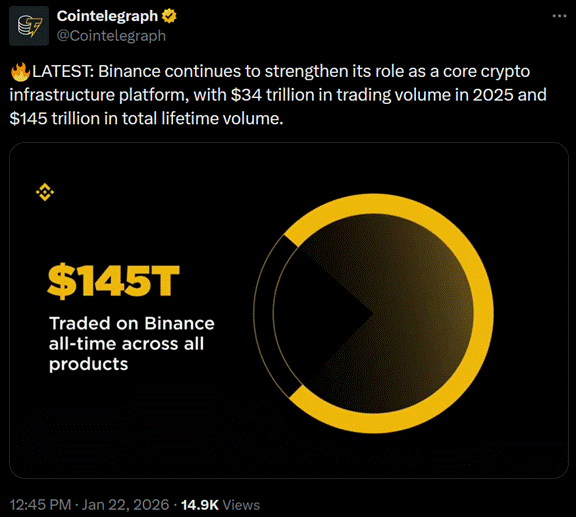
Binance Co-CEO Richard Teng recently commented on this scale during the WEF in Davos, “As we move into 2026, I am pleased to share that we have continued to grow from strength to strength. On the user front, we crossed 300 million users globally last month. That roughly translates to 1 out of every 20 adults in the world is using the Binance platform for investing.”
Teng continued, “Binance remained a primary venue for global crypto liquidity, with $34 trillion traded on the platform in 2025 and spot volume exceeding $7.1 trillion, about a 20% increase in average daily trading volume across all products. All-time traded volume reached $145 trillion across all products—more than the annual global GDP.”
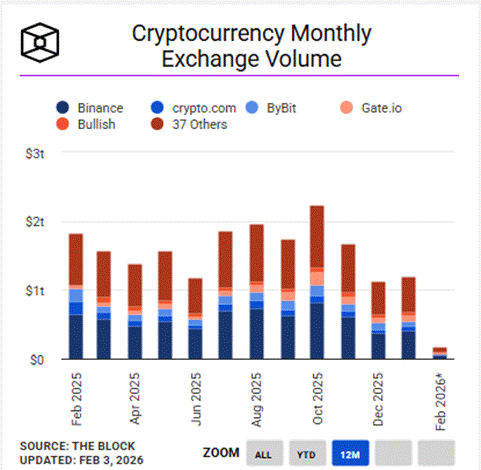
According to CoinGecko data shared by Wu Blockchain, Binance’s spot trading volume rose from $365B in December 2025 to $409B in January 2026, marking a +12.1% month-over-month increase. This is nearly 5X larger than the next exchange.
Why Compliance Attracts Professional Capital
A 2026 report from PwC notes that “Institutional involvement has crossed the point of reversibility.” Blockchain technologies are being used behind the scenes to move large volumes of value. These moves are so deeply embedded in the fabric of the world’s financial infrastructure that trying to remove them could be costly. Financial markets are using these technologies already, so the regulators catching up has become essential.
It’s also essential to understand how professional capital views risk. Smaller players will focus on upsides and first-move advantages, but the professionals care first about legal risk which is non-negotiable. When doing business in any market, professional capital must know that what they are doing is permitted (and not in a gray area), who is overseeing it, and what are the risks or likelihoods of sudden rule changes.
Professional capital isn’t cautious by choice, but instead by the fact that they answer to auditors, regulators, company boards, and their own fiduciary responsibilities. Compliance means their need for caution has been fulfilled.
Market Integrity as a Competitive Moat
Integrity in crypto markets is all about predictability from market participants. We know there are no front runners or hidden fees because we can see the fee schedule and order book live. Market makers and professional capital only use markets with integrity because it makes things predictable and ensures everyone is following the same rules.
Market integrity thus acts as a defensive layer that keeps dishonest players from attracting professional capital. Integrity is made up of three parts: surveillance, controls, and transparency. IOSCO formalizes these, writing in a report that regulators must verify entities like crypto exchanges “for the monitoring, surveillance and supervision of the exchange or trading system and its members or participants to ensure fairness, efficiency, transparency and investor protection, as well as compliance with securities legislation.”
Liquidity as the Ultimate Vote of Confidence
What this all tells us is fairly simple. Liquidity goes where investors are confident. Professional capital has more needs than retail capital. When their needs are met, they vote with their resources by deploying value into pools they trust the most. That trust comes from regulation, market integrity, and above all, confidence in the pool itself.
Disclaimer:This article has been published without the journalistic or editorial involvement of indiantelevision.com, IndianTelevision.com Group, or any of its affiliated websites. IndianTelevision.com Group does not endorse, subscribe to, or take responsibility for the content, opinions, or views expressed herein.
Readers are further advised that Online Casino, Betting, Cryptocurrency products, Financial Investments/Engagements, NFTs, and products or calls-to-action related to Health, Booking, Wellness, and Food are largely unregulated and carry significant risk. There may be no regulatory protections or avenues for recourse in the event of financial losses or health-related risks arising from engagement with such products or services.
IndianTelevision.com Group expressly disclaims any responsibility or liability for the information, views, announcements, declarations, or affirmations presented in this article. By choosing to proceed, the reader acknowledges and agrees that they do so at their own discretion and risk, and expressly absolve indiantelevision.com (IndianTelevision.com Group) from any potential legal claims, liabilities, or actions.







Gaming
Konami concludes successful eFootball India campaign
Campaign featuring Rinku Singh, Varun Chakravarthy and other stars boosts engagement ahead of FIFA World Cup 2026.
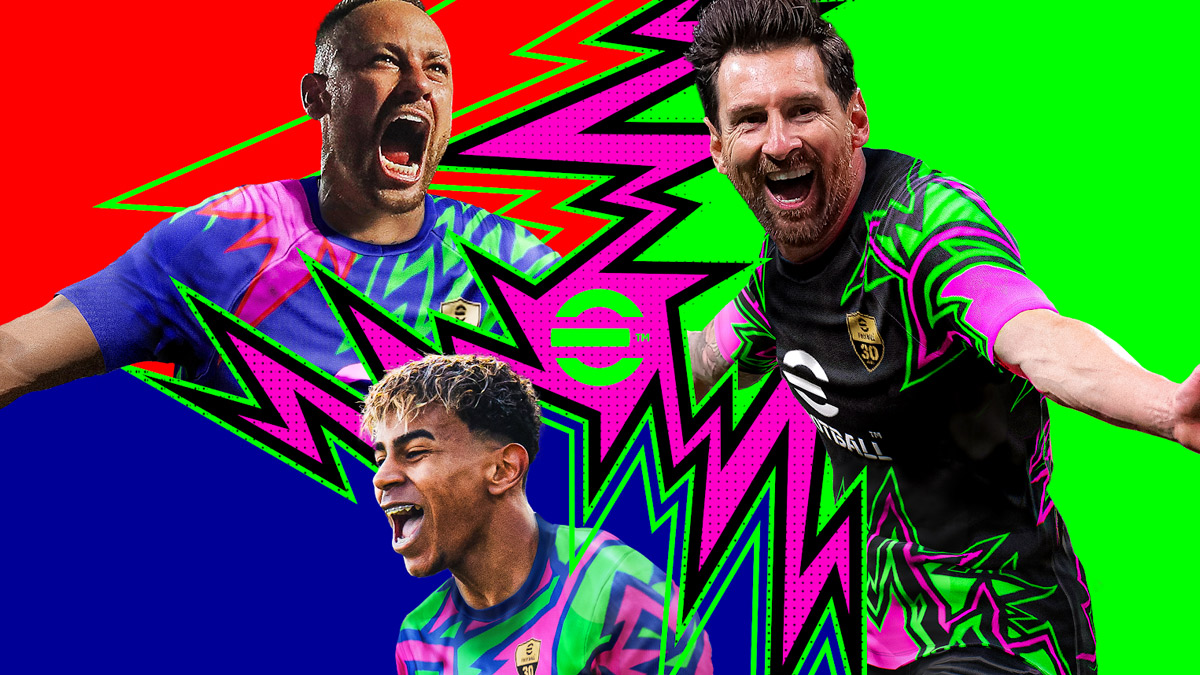
MUMBAI: When cricket meets football in the virtual world, even the biggest fans can’t help but score and Konami’s latest eFootball campaign in India has clearly hit the back of the net. Konami Digital Entertainment has successfully wrapped up its India campaign for eFootball, which brought together cricketers Rinku Singh and Varun Chakravarthy, actors Naslen Gafoor and Chandu Salim Kumar, and footballers Sahal Abdul Samad and Shubhasish Bose. The multi-star campaign generated strong excitement across gaming, football, and creator communities through social content, fan participation, and in-game engagement.
Building on the initial launch that featured a limited-time Lionel Messi card, the campaign united fan communities, lifestyle creators, football creators, and competitive eFootball influencers. It significantly expanded the game’s visibility and deepened engagement with fans across the country.
The campaign also saw thousands of entries submitted as part of its social media engagement challenge, reflecting high levels of community enthusiasm and active creator involvement.
Looking ahead, Konami plans to build on this momentum with more eFootball experiences for Indian fans as the FIFA World Cup 2026 approaches. With global attention on the tournament set to rise, India will remain a key market for deepening community engagement and bringing fans closer to the action.
In a country that lives and breathes sport, Konami has shown that mixing real-world stars with virtual thrills is a winning formula leaving fans eagerly waiting for the next goal.






