Gaming
What BlackRock’s Bitcoin Endorsement Really Signals for the Future of Institutional Finance

For years, Bitcoin and crypto were on the fringes of the financial system. More recently, however, this sentiment has shifted dramatically. No longer the domain of retail speculators, crypto is now in the process of institutionalization.
BlackRock’s head, Larry Fink, who once was a Bitcoin skeptic, now calls it “digital gold.” Alongside the financial establishment, some mavericks in the business world have also further strengthened the case for Bitcoin as a mainstream, durable asset.
Namely, Michael Saylor. In recent years, Saylor’s company, Strategy, formerly known as MicroStrategy, has evolved from a software company to a Bitcoin treasury company, effectively becoming a leveraged bet on BTC.

As discussed in a speech given on the first day of the recent Binance Blockchain Week event in Dubai, Saylor argues that “Bitcoin is emerging as digital capital because the U.S. wants to be the crypto capital of the world.” Saylor’s blunt statement fully distills why leaders like Fink are now pro-BTC, and why current trends are likely to continue.
From Skepticism To Signal: BlackRock Steps In
It’s an understatement to say that Larry Fink was a mere Bitcoin skeptic. To be honest, he was more of a staunch Bitcoin critic, associating the cryptocurrency with market speculation, unregulated exchanges, as well as innuendo regarding its use as a means of exchange in illicit activities.
In fairness to Fink, that was previously the establishment’s view of Bitcoin and crypto in general. Since 2024, however, this narrative is no longer being promoted by the financial elite. Fink now talks glowingly of Bitcoin, providing further credence to the asset’s newfound status as an institutional-grade investment.
Beyond just words and op-eds in The Economist, Fink and his firm are also taking action. BlackRock has launched Bitcoin products, such as spot Bitcoin ETFs. The financial services giant has also made a significant move into areas such as the tokenization of real-world assets (RWAs).
BlackRock’s Bitcoin pivot has provided tremendous social proof for the asset. Other institutional investors, from pension funds to wirehouse advisors, are now following its lead. As Saylor put it, “Wall Street has embraced Bitcoin; when we first traded it on our balance sheet, there were no ETFs – now BlackRock’s Bitcoin ETFs are incredibly successful.”
Bitcoin As Digital Capital, Not Just A Trade
With companies like BlackRock now involved, a question on the minds of many is “how much of our portfolios should be allocated to BTC and other cryptos?”
Prior portfolio building models, such as the popular 60/40 stocks-to-bonds model, are falling out of favor. In light of high inflation, institutional investors are seeking greater allocation to alternative investments that can serve as a hedge during such challenging times. Previously, gold was this key alternative, but now Bitcoin is becoming an “alternative” to this alternative.
However, beyond serving as an alternative asset class with returns uncorrelated to the equity and bond markets, Bitcoin and crypto could also serve another function in the traditional financial system. Unlike gold, you can more freely use it as collateral, not to mention slot it into tokenized instruments. Rather than a hard asset sitting in a vault, crypto is raw material for building digital credit markets.
That is where Saylor’s framework lines up with Fink’s pivot. “The world is built on capital but runs on credit; transforming digital capital into digital credit pays yields to investors.”
Conclusion: Inside The System, Not Outside It
BlackRock’s endorsement of Bitcoin is best understood not as a bet on short-term price appreciation, but as recognition that digital assets are becoming embedded within the core architecture of global finance. Larry Fink’s shift, from vocal skepticism to public advocacy, reflects less a change of heart than a response to evolving market realities. Regulated access points now exist, institutional-grade custody has matured, and demand from clients is no longer theoretical. In that context, Bitcoin’s integration was not optional, but inevitable.
What makes this moment distinct from earlier waves of institutional interest is that Bitcoin is no longer being treated as an external hedge or a speculative satellite holding. Instead, it is increasingly being evaluated as a form of digital capital that can interact with credit markets, collateral frameworks, and tokenized financial instruments. BlackRock’s parallel push into tokenization underscores this broader thesis. The future of finance is not simply about owning assets, but about how efficiently those assets can be deployed within programmable, always-on financial systems.
This shift carries meaningful implications for the structure of capital markets. As asset managers, banks, and custodians build regulated crypto products, the boundary between traditional finance and blockchain infrastructure continues to erode. Rather than two competing systems, a single, hybrid financial stack is emerging; one that combines the scale and trust of legacy institutions with the settlement efficiency and transparency of on-chain rails.
For Bitcoin specifically, institutional adoption does not eliminate risk or volatility, nor does it guarantee perpetual upside. What it does change is the asset’s role. Bitcoin is increasingly being positioned not as a fringe trade, but as a durable component of institutional portfolios and a foundational layer for future financial innovation. In that sense, BlackRock’s move is less a signal about where Bitcoin’s price goes next—and more a marker of where it now sits: firmly inside the system it was once built to challenge.
Disclaimer:This article has been published without the journalistic or editorial involvement of indiantelevision.com, IndianTelevision.com Group, or any of its affiliated websites. IndianTelevision.com Group does not endorse, subscribe to, or take responsibility for the content, opinions, or views expressed herein.
Readers are further advised that Online Casino, Betting, Cryptocurrency products, Financial Investments/Engagements, NFTs, and products or calls-to-action related to Health, Booking, Wellness, and Food are largely unregulated and carry significant risk. There may be no regulatory protections or avenues for recourse in the event of financial losses or health-related risks arising from engagement with such products or services.
IndianTelevision.com Group expressly disclaims any responsibility or liability for the information, views, announcements, declarations, or affirmations presented in this article. By choosing to proceed, the reader acknowledges and agrees that they do so at their own discretion and risk, and expressly absolve indiantelevision.com (IndianTelevision.com Group) from any potential legal claims, liabilities, or actions.







Gaming
India’s broadcasters say no to Fifa World Cup 2026
Fifa has slashed its asking price by 65 per cent but India’s broadcasters are still not buying

MUMBAI: The world’s biggest sporting event cannot find a single taker in the world’s most sports-mad nation. Fifa’s television rights for the 2026 World Cup remain unsold in India, and the clock is ticking loudly.
To shift the property, world football’s governing body has already swallowed hard and cut its asking price from $100m to $35m, bundling in the 2030 edition as a sweetener. It has not worked. Indian broadcasters have looked at the offer, done the sums and quietly walked away.
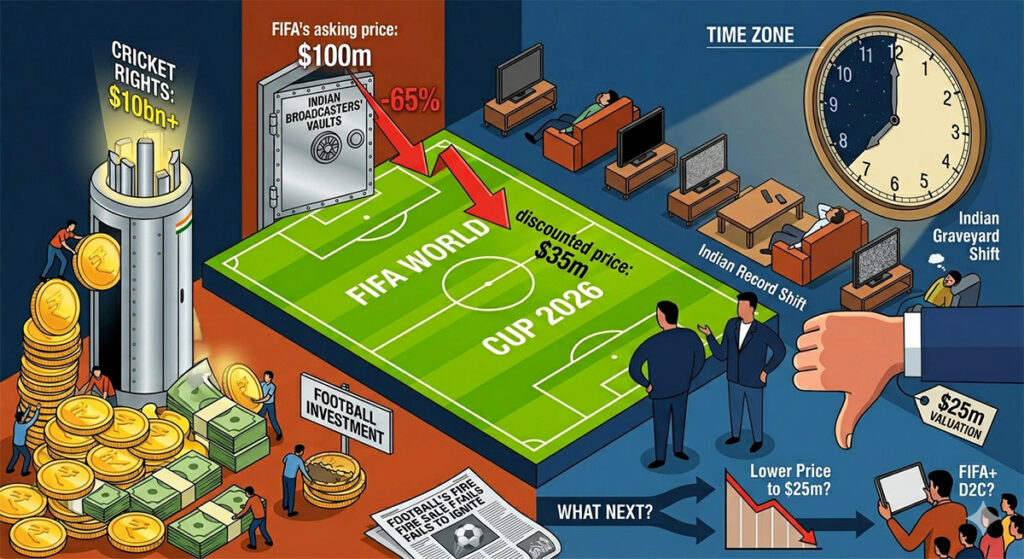
The reasons are brutally simple. The 2026 tournament, co-hosted by the United States, Canada and Mexico, kicks off in a time zone that turns India’s primetime into a graveyard shift. Most matches will air between midnight and 7am IST, a scheduling catastrophe for advertisers chasing mass reach. The 2022 Qatar edition was a gift by comparison, with matches dropping neatly into Indian evenings. North America offers no such luxury.
The market itself has also changed beyond recognition. The merger of Star India and Viacom18 into JioStar has gutted the competitive tension that once sent sports rights prices soaring. Where rival bidders once slugged it out, there is now a single dominant buyer, and it is in no hurry. JioStar has valued the rights at roughly $25m, a full $10m below Fifa’s already-discounted floor price. That gap has so far proved unbridgeable.
Broadcasters are also nursing a ferocious cricket hangover. Between 2022 and 2023, Indian media houses committed well over $10bn to cricket rights alone, covering IPL, ICC events and BCCI domestic fixtures combined. After a binge of that scale, appetite for a football package that delivers a fraction of the ratings, in the dead of night, is close to zero.
The economics of football broadcasting make the maths even harder. Cricket, with its natural breaks every few overs, is an advertiser’s paradise. Football offers a 15-minute halftime and precious little else. Recovering a nine-figure rights fee from a single half-hour ad window is a stretch at the best of times. These are not the best of times: the Indian government’s tightening grip on real-money gaming and gambling advertising has vaporised a category that once underwrote the economics of big sporting events.
Nor is the World Cup an anomaly. Indian Super League valuations have cratered. English Premier League rights have softened across successive cycles. The cooling of football as a broadcast commodity in India is structural, not cyclical.
With the tournament opening on 11th June, Fifa is running out of road. It may yet blink and meet JioStar at $25m. Or it may go direct, streaming the entire tournament on its own platform, Fifa+, or cutting a digital deal with YouTube, and hoping that a generation of Indian football fans finds its way there without a broadcaster to guide them.
Either way, the beautiful game’s Indian chapter is looking decidedly ugly.







