iWorld
The $1.75 Billion Lifeline: Why Financial Inclusion Stole the Spotlight at Davos 2026


This year at the WEF conference in Davos, Binance led a discussion forum event at Goals House, an event series and meeting space, to discuss how crypto can be used to improve financial inclusion. That means providing financial services and market access to the still over one billion people that lack access to such services. The discussion also covered pressing issues facing the developing world that crypto has shown serious promise in being able to improve, if not resolve outright. The session brought several Binance thought leaders to meet face-to-face with government and civil leaders to discuss real solutions.
The discussion was split into three goal-oriented topics, each one aimed at targeting a specific, concrete need that crypto can address.
Remittances and Cross-Border Payments

Traditional remittance fees function, in practice, as a tax on the world’s poorest families. Every year, billions of dollars are siphoned away through intermediaries simply for moving money across borders. By contrast, Binance’s payment and settlement technology has already returned nearly $2 billion directly to families by reducing fees and friction in cross-border transfers; an outcome that represents not just financial efficiency, but a tangible social victory.
As Binance CMO Rachel Conlan commented, “Between 2022 and 2024, Binance helped users save $1.75 billion in remittance fees by enabling $26 billion in instant crypto remittances. A significant proportion of this was done in stablecoins due to their speed, low cost, and cross-border efficiency. That’s not just a statistic; it’s a lifeline for families and small businesses relying on affordable, fast cross-border payments.”
In 2023, the World Bank estimated remittance flows to lower and middle income countries at $656 billion, with the number expected to grow annually. Traditionally, banks and money transfer operators (think Western Union, Wise, etc) were the only choices for quickly moving money. While these services get the job done, they come with a cost that can often be steep.
During the Goals House conference with Binance, participants identified how crypto could level the playing field between those sending remittances, and those moving the money. Specifically, they discussed the idea that blockchain payment rails can significantly shorten settlement times and enhance the transparency of fee structures.
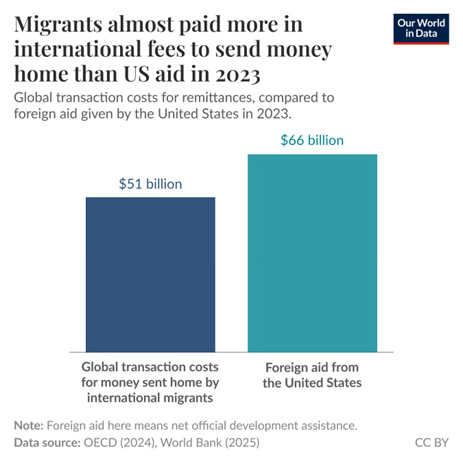
In short, blockchain payments can make remittances faster, cheaper, and more transparent. This could prove to be a significant win for remittance senders as the fees they paid in 2023 almost exceeded US foreign aid itself at $51 billion.
The same cost, speed and transparency benefits would apply to cross-border payments as well, drastically reducing the costs of cooperative global trade and helping small business players to compete more effectively.
Better Settlement, Bolstering Flexibility for Emerging Market Businesses
The second topic of discussion at the Goals House forum was all about how to “reduce frictions, expand access to credit, and make working capital more available to businesses that are underserved by traditional channels”.
In business terms, friction can be thought of as anything that slows or interferes with the normal process of business. For example, it may be difficult in some parts of the world to get a business bank account that is able to receive cross-border payments or handle foreign currencies. Or perhaps banks may not be interested in investing the time in setting up an account for a business that they consider as being too small or just not worth it.
Settlement, on the other hand, is the concept of defining when the movement of money is complete. For example, buying something with a credit card typically means the selling business won’t actually get the funds you paid to them until at least several days later, when the funds finally “settle”.
At the Binance forum, participants discussed how crypto infrastructure can help or even bypass many of these frictions entirely. For example, cryptocurrencies can allow for near-instant cross border business payments with similarly fast and transparent settlement. Smaller businesses can be included in the global economy without fear of a bank acting as a gate keeper. The group also discussed how “on-chain financing mechanisms” can help SMEs get investments that are sourced globally.
A New Model for Foreign Aid
The issue of foreign aid has been a prickly one for ages. Lack of transparency, slow speed and unaligned goals have raised complaints since the concept began. However, the idea of what Binance calls “programmable assistance and targeted grants” changes the game entirely.
Instead of the black box process that foreign aid money handling can feel like, the idea proposed here is that aid money can be distributed through smart contracts that are tied to specific goals and outcomes. Such a system could mean increased accountability, transparency, and effectiveness of funds.
Source: https://www.pewresearch.org/short-reads/2025/02/06/what-the-data-says-about-us-foreign-aid/sr_25-02-06_foreign-aid_4/
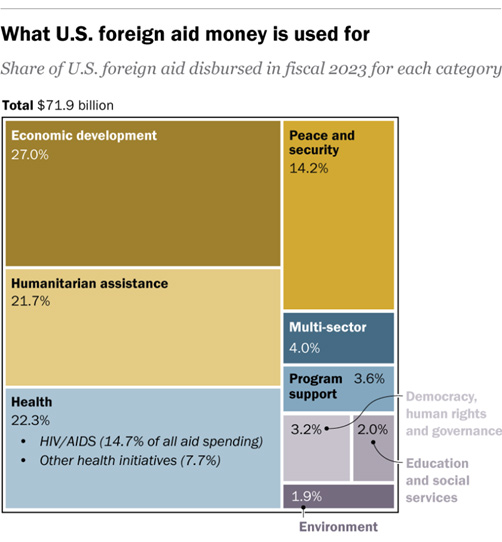
Rather than operating as a black box, foreign aid could function on a transparent, programmable ledger. In the United States alone, annual foreign aid totals $71.9 billion, with 22.3% allocated to Health, 21.7% to Humanitarian Assistance, and 14.7% specifically directed toward HIV/AIDS programs. Today, those funds are largely “disbursed” through layers of intermediaries, reporting requirements, and delayed oversight.
Under a programmable aid model enabled by blockchain infrastructure, that funding would instead be coded with conditions. Resources earmarked for HIV/AIDS prevention, treatment, or medication delivery would be released automatically as predefined milestones are met. Every dollar committed would be traceable, every release auditable, and every outcome visible ensuring that public funds are not only spent, but spent exactly as intended.
This approach does not change the mission of foreign or humanitarian aid. It changes the mechanism by replacing opacity with accountability, and trust-based disbursement with verifiable execution.
Disclaimer:This article has been published without the journalistic or editorial involvement of indiantelevision.com, IndianTelevision.com Group, or any of its affiliated websites. IndianTelevision.com Group does not endorse, subscribe to, or take responsibility for the content, opinions, or views expressed herein.
Readers are further advised that Online Casino, Betting, Cryptocurrency products, Financial Investments/Engagements, NFTs, and products or calls-to-action related to Health, Booking, Wellness, and Food are largely unregulated and carry significant risk. There may be no regulatory protections or avenues for recourse in the event of financial losses or health-related risks arising from engagement with such products or services.
IndianTelevision.com Group expressly disclaims any responsibility or liability for the information, views, announcements, declarations, or affirmations presented in this article. By choosing to proceed, the reader acknowledges and agrees that they do so at their own discretion and risk, and expressly absolve indiantelevision.com (IndianTelevision.com Group) from any potential legal claims, liabilities, or actions.







iWorld
Parineeti Chopra hosts new parenting series Mom Talks on Zee5 and Bullet
Celebrity parents share honest stories in 9-episode show launching 4 April 2026.

MUMBAI: Parineeti Chopra is stepping into a brand-new role not on the big screen, but as the warm, relatable host helping parents navigate the beautiful chaos of raising children. Bullet microdrama and Zee5 have announced the launch of Mom Talks, a fresh content-led IP hosted by the popular actress. The 9-episode series brings together celebrity parents including Imran Khan, Neha Dhupia, Vikrant Massey & Sheetal, and Gauahar Khan & Zaid Darbar to share candid, real-life perspectives on everyday parenting.
Positioned as a high-engagement format, Mom Talks taps into the growing demand for authentic and credible parenting content. It also offers seamless, contextual integration opportunities for brands. The series is backed by a strong lineup of partners including Johnson’s Baby, GSK, Aveeno Baby, Mini Klub, Titan Eye+ and Cordelia Cruises.
Bullet microdrama app, co-founder & chief business officer Azim Lalani said the show exemplifies how content is evolving towards more rooted, sustained engagement. “It’s about bringing content that people come back to, while creating a natural space for brands to be part of the narrative,” he noted.
Mom Talks creator Bullet head of AVOD & partnerships Munaf Merchant explained the core idea, “We wanted to build a safe, honest, one-stop destination for parents seeking real answers to everyday questions.”
The first episodes will stream for free on ee5 AVOD starting 4 April 2026, with new episodes dropping every Friday and Saturday. The series will also be available on the Bullet microdrama app.
Speaking about their association, Peeyush Unikkat from Johnson’s Baby highlighted the brand’s focus on supporting modern parenting journeys, while Aakash Mehta from GSK emphasised the show’s role in making important health conversations more relatable for new parents.
In a digital space often filled with filtered perfection, Mom Talks promises something refreshingly real honest conversations, celebrity insights, and practical wisdom, all wrapped in Parineeti Chopra’s engaging presence. For Indian parents, this could be the parenting series they’ve been waiting to binge.






