eNews
Revolutionize Your Music Game with Viberate!

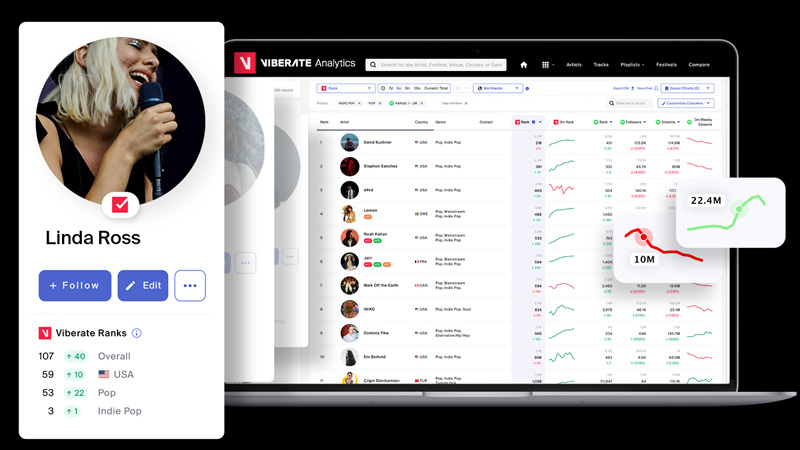
In the dynamic world of music, staying ahead requires access to comprehensive and up-to-date information. Recognizing this need, Viberate, a pioneering music data company, is transforming the industry by offering premium music analytics at an unprecedented price of just $19.90 per month. This affordable service encompasses a wide range of channels, including streaming and social media, catering to the needs of every industry professional. Among its suite of tools, in-depth Spotify stats, playlist analyzer, and more stand out as key features.
Democratizing Music Analytics with Accessible Spotify Statistics
Viberate’s mission is clear: “We strive to cultivate a more diverse music industry by ensuring that top-tier data is accessible and economical for all professionals in the field.” In the past, the high cost of data services often sidelined indie labels and artists. Viberate is changing this narrative by offering premium music analytics at a highly competitive price, reduced from $129 to just $19.90 per month.

Comprehensive Stats for Spotify and Beyond
Monitoring over 1M+ artists, Viberate translates performance across streaming platforms, social media, and other channels into actionable information. The platform specializes in analytics for channels like Spotify and TikTok, offering data-infused charts and tools essential for discovering talent. Viberate’s approach is holistic: “Our approach involves a comprehensive mapping and analysis of the music industry’s ecosystem, encompassing everything from artists and songs to festivals, collections, and record labels, all centralized in a singular location.” By transforming streaming and social media insights into useful insights, they equip users to identify new artists, manage their rosters, strategize promotional efforts, and compile effective business reports.
Spotlight on Spotify Stats
Viberate’s Spotify analytics are particularly noteworthy. They meticulously analyze the streaming performance of artists on Spotify, tracking monthly listeners, followers, streams, and playlisting. Users can delve into an artist’s Spotify history, view daily data, and enjoy the convenience of analyzing all songs in one location. The platform allows filtering by streams, release date, and even offers listening functionality within the same section. Moreover, Viberate offers an in-depth analysis of monthly listeners, segmented by country and city, thus enriching the comprehension of an artist’s geographical influence.
Innovative Spotify Statistics: Playlist Analyzer and More
The playlist analyzer dives deep into Spotify playlist performance. It identifies the best-performing playlists and songs, monitoring playlist reach and active playlist trends over time. This feature is invaluable for assessing the impact of specific song or album releases on stats for Spotify.
Viberate also boasts a comprehensive chart of over 12M+ playlists, a treasure trove for finding the perfect playlists for an artist’s genre and career stage. The filtering options are extensive, covering genres, curator types (like indie, editorial, algorithmic), song popularity, and release dates, ensuring the playlists feature fresh tracks. Users can also sort playlists by popularity metrics such as follower count and song number.
Enhanced Spotify Statistics for Talent Discovery
Viberate enhances the process of ranking artists on Spotify with country, genre, and performance filters. The platform’s overall and channel-specific rankings are instrumental in talent discovery. The Chart feature is a game-changer, enabling A&Rs to discover and screen talent more efficiently. The ability to save filtering options and revisit the chart ensures that desired information is always accessible.
Conclusion: A Must-Have Tool for Spotify Stats Enthusiasts
For those involved in music analytics, Viberate’s tools are indispensable. They offer an affordable, yet powerful solution to understand and leverage Spotify statistics. By providing detailed Spotify stats and insights into streaming performance, playlist analysis, and talent discovery, Viberate is a must-have for anyone looking to make informed decisions in the music industry.

eNews
AI could replace half of entry-level white-collar work: Anthropic study
Hiring in AI-exposed occupations fell 14 per cent post-ChatGPT

SAN FRANCISCO: From lamplighters to elevator operators, waves of technology have repeatedly erased once-common jobs. Now artificial intelligence may be poised to do the same for large swathes of professional work.
A new study by Anthropic suggests that while AI tools are technically capable of performing many knowledge-economy tasks, real-world adoption lags far behind that potential, at least for now.
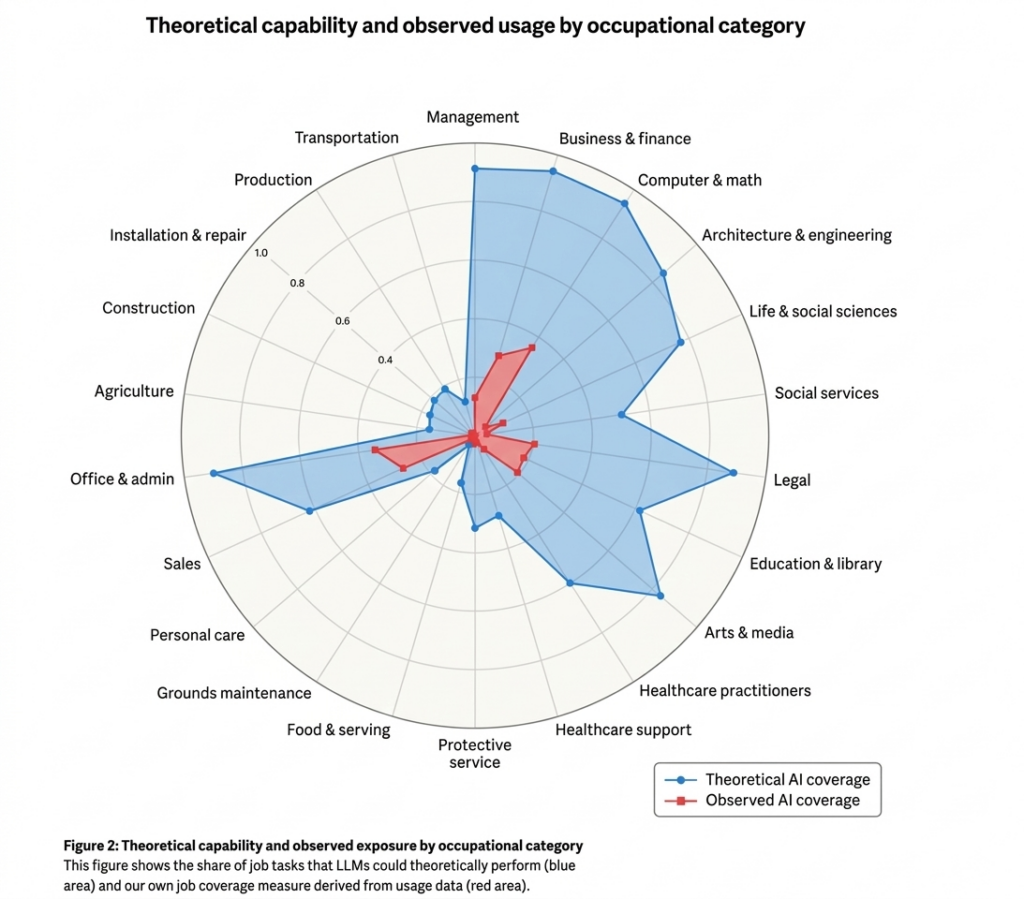
The report, Labor market impacts of AI: A new measure and early evidence, by Maxim Massenkoff and Peter McCrory, introduces a new metric called “observed exposure,” which compares what AI systems could theoretically perform with what they are actually doing in workplaces.
Using professional interaction data from Anthropic’s Claude model, the researchers found that AI could theoretically cover a wide share of tasks in business, finance, management, computing, mathematics, legal services and office administration. Yet current adoption represents only a small fraction of those capabilities.
That gap between potential and reality reflects a mix of legal barriers, technical limitations and the continued need for human oversight, the study said. But the authors suggest those constraints may prove temporary as the technology matures.
Warnings about AI’s impact on white-collar employment have been growing. CEO Dario Amodei has previously argued that AI could disrupt as much as half of entry-level professional work, while Microsoft AI CEO Mustafa Suleyman has suggested that most professional tasks could eventually be automated within 12 to 18 months.
Highly educated workers most exposed
Contrary to common assumptions, the study finds that workers most exposed to AI are not those in manual labour but highly educated professionals. The most exposed group is 16 percentage points more likely to be female, earns on average 47 per cent more than the least exposed group and is nearly four times as likely to hold a graduate degree.
Occupations including computer programmers, customer service representatives and data entry clerks are among the most vulnerable to automation.
Yet even in highly exposed fields, AI is not yet replacing jobs at scale. The researchers cite routine medical tasks, such as authorising prescription refills, as examples that AI could technically perform but is not widely observed doing in practice.
In the report’s visual framework, actual AI usage (the “red area”) remains far smaller than the theoretical “blue area” of possible tasks. Over time, the researchers expect the red area to expand as adoption deepens.
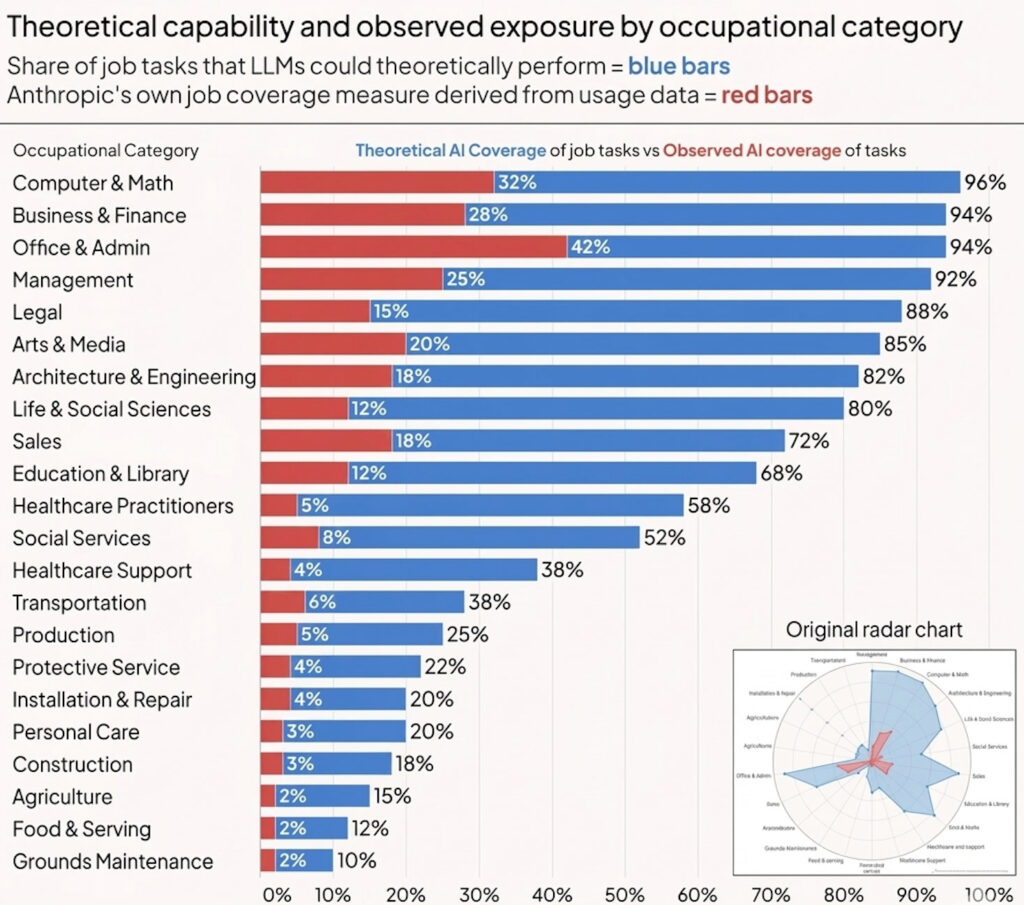
At the other end of the labour market, roughly 30 per cent of occupations show virtually no AI exposure. Roles such as cooks, mechanics, bartenders and dishwashers still depend heavily on physical presence and manual work that large language models cannot replicate.
Hiring slowdown rather than layoffs
So far the clearest labour-market signal is not mass layoffs but a slowdown in hiring within AI-exposed occupations.
According to the study, job-finding rates in those sectors have fallen about 14 per cent since the arrival of generative AI tools such as ChatGPT compared with 2022 levels. A separate study cited by the authors found a 16 per cent drop in employment among workers aged 22 to 25 in AI-exposed roles.
Recent labour data from the US Bureau of Labor Statistics also point to softer hiring conditions, with employers shedding 92,000 jobs in February and unemployment rising to 4.4 per cent.
Some companies have already linked layoffs to automation. Jack Dorsey said his payments firm Block recently cut nearly half its workforce in part because AI tools allow smaller teams to operate more efficiently.
Not everyone is convinced the technology is solely responsible. Critics such as Marc Benioff have accused some firms of “AI washing”, using automation as a convenient explanation for cost-cutting measures.
Still, the researchers warn that the longer-term risk is a potential “white-collar recession”. If unemployment in the most AI-exposed occupations were to double, from about 3 per cent to 6 per cent, it would mirror the scale of labour-market disruption seen during the Global Financial Crisis.
For now, the shift may simply mean fewer entry-level openings. Some young workers are staying longer in existing roles, switching sectors or returning to education rather than entering AI-exposed fields.