Comment
Big Worry – How much will Big Brother soon be watching?

Sex sells. Not that the Indian media and policy makers alike are waking up to the fact only now. Over the last few years the issue has kept cropping up in various forms, especially in the electronic media, which is increasingly waking up to the power of sex and its strength as a commodity. The burning question is: how much and when should sex be sold as a commodity in the Indian milieu?
Towards the beginning of this decade, when Sushma Swaraj was the information and broadcasting minister in a coalition government that was being led by the Bharatiya Janata Party, her acerbic attack on Fashion TV was criticized by many as thrusting down on millions of Indians a view that harked back to the stone age. Swaraj’s simple missive to FTV was: take off the prime time lingerie shows and other programmes that displayed female nudity in various forms or face government action. It insults Indian sensibilities, she argued.
Early 2004, just before the country got into election mode, Swaraj’s successor Ravi Shankar Prasad lamented that despite being a liberal, TV channels refused to show any maturity and instill some self-discipline in themselves where airing programmes offending Indian ‘sensibilities’ were concerned.

After a new Congress-led government took over Delhi, the present I&B minister Jaipal Reddy too has the same complaint. “I don’t believe in censorship, but the media, including TV channels, should show some restraint (in depicting shows full of sex),” he has often said.
With India TV unleashing a series of sex-related sting operations, the question of ‘how much of sex is palatable’ has been pitchforked into the limelight once again. With it is also has come up the issue of whether it isn’t high time India had a regulatory framework for content in place.
That this issue would now be more aggressively discussed is beyond doubt. An indicator came earlier this week when l’affaire Shakti Kapoor reverberated in Parliament. The common refrain: these “sexposés” on TV have to stop.
Reason: TV channels were showing pornography. Juxtapose this against what Reddy said the same day. While assuring fellow parliamentarians that the government is seized of the issue, Reddy observed that a legislation aiming to bring in a content regulator is on the anvil and that the Bill would be tabled during the monsoon session of Parliament, some three months down the line.
‘Reading Reddy’s lips’, what the the present government is working on is a regulatory framework that would curb such “aberrations” in the media, which would be cleansed of these “western influences” once the regulator was put in place with a government nominee, probably, heading it.
He has also said in private that it has always been his endeavor to have a content regulator to arbitrate on such issues and take a stand on them, but a lack of collective political will, coupled with lobbying against it by vested interests, has made his ministry’s job difficult.
Let us look at what a content regulator can or cannot do. A content regulator would, amongst other things, certainly have parameters on what could be shown on TV and what could not be.
Moreover, it would also be responsible for hearing of complaints from consumers as well as any other citizen relating to content on TV, take a stand on it and levy penalties, if necessary.
Though the Broadcast Bill of 1997 and the Communication Bill of 2001 were comprehensive pieces of would-be legislation, unfortunately they have remained that only — consigned to files in some ministry. In both these pieces of draft legislation, a content regulator had been vested with wide powers to rein in errant TV channels and had such a regulator existed today, India TV would have got into trouble immediately. Or, at least been asked to furnish an explanation.
If we take Janet Jackson’s “wardrobe malfunction” at the live telecast of the Super Bowls a year back and the subsequent dust it kicked up in the US, India TV and similar such initiatives would have raised the blood pressure of the regulator in India even if the TV channel’s aim was to expose maladies in the Indian society. After the Jackson affair, most TV stations in the US delay by a few seconds live telecast of big shows like Super Bowl, the Academy Awards and other such events where chances of peek-a-boo and personal attacks are high. This self-discipline may also be the result of the high fines imposed by the US regulator on errant TV stations.
Not that some existing piece of legislation in India are inadequate to deal with such things, but the fact that rules are not stringently applied make things easier for the media. Take, for example the Cable TV (network) Regulation Act, 1995. In a way, it has provisions to deal with content regulation, though the onus is more on the cable operators who retransmit signals to homes.
The programme code specifically states that no programme should be carried in the cable service that “contains anything obscene, defamatory, deliberate, false and suggestive innuendoes and half truths.”
It further states that programmes that are “not suitable for unrestricted public exhibition” should not be carried where “unrestricted public exhibition” has been defined to have the same meaning as assigned to it in the Cinematograph Act, 1952 (37 of 1952). If this is implemented strictly, even in this `liberal’ atmosphere of modern India, authorities could take action against TV channels on issues that are definitely debatable and prone to various interpretations.
What has emboldened certain sections of the media is the fact that the Press Council of India, a watchdog for the print medium, is nothing more than a toothless tiger. The Press Council has no power other than to censure a print medium organization on issues that it feels violates the basics of journalism. In most cases, the errant organisation says ‘sorry’, lets the issue fade from public memory and then goes back to what it’s best at doing: furthering its commercial cause through journalism.
That a content regulator, or any regulator for that matter, needs to have more powers to rein in errant players in the media is something that Indian policy-makers would have to think and think hard about it. Because it’s a double-edged sword. Give a person powers and there are chances that he would misuse it. This line of thinking emanates from the fact that politicians themselves, most of the time, behave as if they are above the law of the land.
What is disturbing the politicians is also the fact that if sting operations can be mounted in the entertainment industry and allowed to be aired for unrestricted viewing, it would only be a matter of time when the hidden camera talks regularly into the bedrooms of big-name politicians where many a skeleton might be discovered. India TV chairman Rajat Sharma’s assertions that there are “many more (sting operations) in the pipeline,” is enough to send shivers down many a politician’s spine.
Sex would definitely continue to sell on television and other media. What are the limits that need to be in place is the question the industry and Indian policy-makers would have to grapple with. At the end of the day, it’s all about give and take and here the pun is totally unintentional.







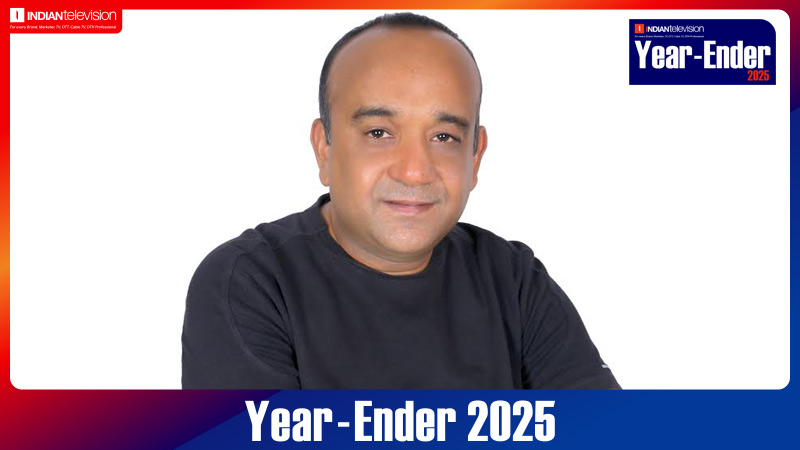
MUMBAI: 2025 will be remembered as the year India’s OTT industry stopped chasing scale for its own sake and began reckoning with how audiences actually consume content. Completion rates fell, patience wore thin and the limits of long-form excess became impossible to ignore. In this guest column, Pratap Jain, founder and CEO of ChanaJor, traces how micro-drama moved from the fringes to the centre of viewing behaviour, why short-form fiction emerged as a retention engine rather than a trend, and how platforms that respected time, habit and emotional payoff were the ones that truly grew up in 2025.
If there is one thing 2025 will be remembered for in the Indian OTT industry, it’s this: the industry finally stopped pretending.
Stopped pretending that bigger automatically meant better.
Stopped pretending that viewers had endless time.
Stopped pretending that scale without retention was success.
What began as a quiet reset in 2023 and a cautious correction in 2024 turned into a very visible shift in 2025. Business models matured. Content strategies tightened. And most importantly, platforms started aligning themselves with how Indians actually watch content, not how the industry wished they would.
At the centre of this shift was micro-drama—not as a trend, but as a behavioural inevitability.
When OTT finally understood the time problem
For years, long episodes were treated as a marker of seriousness. A 45–60 minute runtime was almost a badge of credibility. Shorter formats were pushed to the margins, labelled as “snack content” or “mobile-only.”
That belief quietly collapsed in 2025.
What platform data showed very clearly was not a drop in interest—but a drop in patience. Viewers weren’t rejecting stories. They were rejecting commitment.
Across platforms, the same patterns appeared:
* First-episode drop-offs on long-form shows kept increasing
* Completion rates continued to slide
* Viewers were sampling more titles but finishing fewer
At the same time, shows with episodes in the six to 10 minute range started showing the opposite behaviour: higher completion, higher repeat viewing, and stronger daily habit formation.
Micro-drama didn’t win because it was short. It won because it respected time.
Micro-Drama didn’t arrive loudly. It took over quietly.
There was no single moment when micro-drama “launched” in India. It crept in through dashboards and retention charts.
By mid-2025, it was clear that viewers were happy watching four, five, sometimes six short episodes in one sitting—even when they wouldn’t finish a single long episode. Romance, relationship drama, slice-of-life conflict, and grounded comedy worked especially well.
This wasn’t disposable content. It was compressed storytelling.
In shorter formats, there was no room for indulgence. Every episode had to move the story forward. Weak writing was punished faster. Strong writing was rewarded immediately.
Micro-drama raised the bar instead of lowering it.
Where ChanaJor naturally fit into this shift
ChanaJor didn’t pivot to micro-drama in 2025 because the market demanded it. In many ways, the platform was already built around the same viewing behaviour.
From the beginning, ChanaJor focused on short-to-mid-length fictional stories that felt close to everyday Indian life—hostels, rented flats, office romances, small-town relationships, young people figuring things out. Stories that didn’t need heavy context or cinematic scale to connect.
What worked in ChanaJor’s favour in 2025 was clarity:
* A clearly defined audience
* Tight episode lengths
* Storytelling that prioritised emotion and pace over spectacle
While several platforms rushed to copy global micro-drama formats, ChanaJor stayed rooted in familiar Indian settings and conflicts. That familiarity mattered. Viewers didn’t have to “enter” the world of the show—it already felt like theirs.
Why audiences started responding differently
One of the biggest misconceptions going into 2025 was that audiences wanted shorter content because their attention spans had reduced. That wasn’t entirely true.
What viewers actually wanted was meaningful payoff per minute.
On platforms like ChanaJor, episodes didn’t waste time setting the mood for ten minutes. Conflicts arrived early. Characters were recognisable within moments. Emotional hooks landed fast.
A typical consumption pattern looked like real life:
* One episode during a break
* Two more before sleeping
* A few the next day
This is how viewing habits are built—not through marketing spends, but through comfort and consistency.
Viewers came back not because every show was a blockbuster, but because they knew what kind of experience to expect.
2025 was also the year OTT faced business reality
The other big change in 2025 was on the business side. Subscriber growth slowed. Discounts stopped hiding churn. Customer acquisition costs rose.
Platforms were forced to ask harder questions:
* Are viewers finishing what they start?
* Are they returning without reminders?
* Is this content worth what we’re spending on it?
This is where micro-drama began outperforming expectations. A well-written short series could deliver sustained engagement without massive budgets. It didn’t peak for one weekend and disappear—it stayed alive through repeat viewing.
Platforms like ChanaJor benefited because they weren’t chasing inflated launch numbers. The focus was on consistency and retention, not noise.
Failures Became Visible Faster
2025 also exposed weaknesses brutally.
Several platforms assumed micro-drama was a shortcut—short episodes, quick shoots, instant traction. What they discovered was that bad writing fails faster in short formats than in long ones.
Viewers dropped off within minutes. Episodes were abandoned mid-way. Weak stories had nowhere to hide.
Micro-drama didn’t forgive laziness. It amplified it.
The platforms that survived were the ones that treated short storytelling with the same seriousness as long-form—sometimes more.
OTT Stopped Chasing Prestige and Started Chasing Habit
Perhaps the most important shift in 2025 wasn’t technical or creative—it was psychological.
OTT stopped trying to look like cinema. It stopped chasing validation through scale and awards alone. It began behaving like what it actually is in people’s lives: a daily companion.
Platforms like ChanaJor found their space here because that mindset was already baked in. The goal wasn’t to dominate a weekend launch. It was to quietly become part of someone’s everyday viewing routine.
That shift changed everything—from release strategies to how success was measured.
What 2025 Ultimately Taught the Industry
By the end of the year, three truths were impossible to ignore:
* Time is the most valuable thing a viewer gives you
* Retention matters more than reach
* Format must follow behaviour, not ego
Micro-drama didn’t take over because it was fashionable. It took over because it fit real life.
Looking Ahead
Micro-drama is not replacing long-form storytelling. It is redefining the baseline of engagement.
Longer shows will survive—but only when they earn their length. Short-form fiction will continue to evolve, becoming sharper, more emotionally confident, and better written.
Platforms like ChanaJor have shown that it’s possible to grow without shouting—by understanding the audience, respecting their time, and telling stories that feel real.
2025 wasn’t the year OTT became smaller. It was the year it became smarter.
Note: The views expressed in this article are solely the author’s and do not necessarily reflect our own.









