Hindi
Udta Punjab….Rough landing! Dhanak Delightful!


MUMBAI: Much in the news first for its duel with the Central Board of Film Certification (CBFC) and later for the leak of the film on the internet, Udta Punjab puts an end to all the controversy as it hits the cinemas today.
Has the media glare helped the film as due to this it is said to have got extra promotion? No, because controversies can bring a film into news but can’t add to the content. On the contrary, such a thing can add to expectations. Also, when you watch the film you realize that according to the CBFC norms, 89 cuts offered may be fewer than the film deserved—it is replete with street-side expletives. The film is almost 90 percent in Punjabi language and the Punjabi way of abusing only makes the abuses sound worse.
The generous use of foul words and extensive use of Punjabi dialogue may severely limit the film’s prospective audience, especially the women and families.
The film starts with a funny ‘Believe It Or Nuts’ kind of scene where a discus thrower from Pakistan, wearing a national jersey, throws a package of cocaine into India! The film proceeds to deal with the drug problem in Punjab and limits itself to that. There are no side attractions. All the characters except the few exploiters are victims.

Shahid Kapoor is a small town Punjab lad who goes off to London and returns as a singing sensation, a pop star. His idea, and that of the makers, is to model him on rock stars in West from 1960s who did Psychedelic rock which was hugely drug induced. There was a phase when rock stars did repulsive things on stage like showing bare bottoms, puking, peeing which seems to have been the inspiration here. The success as well the drugs, both having gone to his head, he considers himself bigger than the system of the state. The result is a week in jail and some eye openers like a teenager inmate having killed his mother for refusing to give him money for drugs.
Shahid needs no de-addiction, the seven day jail and the mother killer story has put him off drugs. Drugged bodies in various states of stupor are spread across the screen.
The film moves to the system side of the drug problem. There are cops on one side who are totally on the take and set rates to let the truck filled with drugs pass: this includes Diljit Dosanjh, the Punjabi star making his debut in Hindi films, and there is Kareena Kapoor, attempting to nurse drug addicts to normalcy. Try to cure them is all that Kareena can do as there is no way she can stop the spread of drugs, which involves everybody from politicians to police. But, there is a curious scene where Kareena is distributing sterile disposable syringes moving from home to home; is this her idea of stopping drug abuse? Conveniently, Dosanjh’s kid brother becomes a victim of drugs. He is on his death bed with Kareena tending to him. That changes Dosanjh for good.
Shahid, who has projected the drug menace in the first part, now takes a backseat as Dosanjh and Kareena form a team and become investigators. They are convinced that a big name is involved in the drug racket. In the process of investigating, they also get attracted to each other. The investigation and clues usually fall into their laps. Because, Dosanjh may have little intellect but Kareena can weave magic on Google.
Shahid is due to perform a show. He is not quite sure he can do it without drugs. He has realized he is a fluke and without drugs he is nothing. When egged on to sing by the audience, he vents his frustration, delivers a speech about drugs and when provoked, pees on the audience. His fans-turned-detractors are after him to lynch him and while he is on the run, he comes across Alia Bhatt, also on the run from her captors. She saves him from the goons out to beat him up. Shahid, in search of finding a man in himself, finds one in Alia instead! He goes soft on her.
Alia is a Bihari laborer, one of thousands who work on the farms of Punjab. But, this one is a smart cookie. A state level hockey player, she gives into circumstances to work in farms away from home. Her captors have taken her back from Shahid, basically a weak man with no courage to fight. He now decides to save her. The forces combine as Shahid and Dosanjh end up at the same place, the villains’ den. The film goes into an abrupt climax.
In the name of drug abuse in Punjab, Udta Punjab is a grossly crude film. The treatment is like a 1970s film when the drug issue was internationally in limelight. The script takes its own convenient twists and turns. The direction is routine and clichéd with an inclination for abrupt cuts and shifting to new scenes. For a film about a rock star, the music is grossly lacking (all songs are in Punjabi words). The first half lacks pace and needs to be trimmed.
Performance wise, Alia excels. Totally deglamorized, and having limited exposure, she is a class apart. Shahid mixes up his drug abuser and rock star with lunacy in the first half till he gets more scope later in the film. Dosanjh is natural and looks good too. Kareena puts in a controlled act like a veteran. Satish Kaushik as Shahid’s promoter is formulaic. Prabhjyot Singh is good.
Udta Punjab has a poor first half but the second half which shows some purpose and humour makes it tolerable. With the opening response being average and finding the weekend family audience a suspect, the film has just average prospects.
Producers: Shobha Kapoor, Ekta Kapoor, Anurag Kashyap, Vikramaditya Motwane, Aman Gill, Vikas Bahl,
Sameer Nair.
Director: Abhishek Chaubey.
Cast: Shahid Kapoor, Kareena Kapoor, Alia Bhatt, Diljit Dosanjh, Satish Kaushik, Prabhjyot Singh.
Dhanak
Dhanak is basically a film aimed at children. What is good about the film is that it is a totally positive, no bad-elements in the story. There are two kids on the loose on the road and the whole world is out to help them, be nice to them. There is no stepmother, there is a benevolent uncle (chacha) and there is this half khaddoos aunty (chachi) who looks after these orphaned children.
Hetal Gada and Krissh Chhabaria are an orphaned brother and sister in Rajasthan, their parents having died in Pushkar along with 25 others due to a camel stampede. They are now under the care of Vipin Sharma, their dead father’s younger brother and his wife, Gulfam Khan. While Vipin has taken to the kids as his own, Gulfam is restrained; to add to her frustrations is also the fact that she has no child of her own and that her husband, Vipin, is good for nothing. Hence, Gulfam dominates the household. Vipin lets it be that way.
What adds to the discomfiture of Gulfam is that Krissh is blind. As if to compensate for his blindness, his other faculties like smell, sound and imagination work overtime. His perception is outstanding. Hetal has only one wish, to get her brother’s eyesight restored. She has even set a deadline to do so: her brother’s ninth birthday.
Vipin loves the kids and even indulges them. He takes them to a touring cinema screening where Hetal spots a poster of Shah Rukh Khan advocating a movement against blindness. As she has already pledged that she would make sure her kid brother’s eyesight is restored before his ninth birthday, she decides to set out to a location in Jaisalmer about 300 kms away to meet Khan who is shooting there. One night, the kids walk out of their uncle’s house to search for Khan.
It turns into a road movie thereafter as the kids traverse their destination 300 kms away. Their journey is all about anxiety as well as fun. While Hetal is an SRK fan, Krissh is a Salman Bhai fan and their arguments are an utter delight.
The film is based in Rajasthan and the state’s depiction juxtaposed between its barren deserts and colourful culture is remarkable.
Hetal and Krissh carry the entire film on their own strength and their lively banter keeps the viewing a pleasant experience. Both excel in performance; while Hetal’s is an emotional character, Krissh is sharp-witted and an exploiter. He gets the best lines, too. Vipin is good in a brief role. The direction is good, adhering to the simple narrative. Dialogue is the mainstay of the film. The musical score enhances the Rajasthan ambience.
Dhanak is a fun film, a must-watch: Amen!
Producers: Manish Mundra, Nagesh Kukunoor, Elahe Hiptoola.
Director: Nagesh Kukunoor. •
Cast: Hetal Gada, Krissh Chhabbbria, Vipin Sharma, Gulfam Khan.






Hindi
Remembering Gyan Sahay, the lens behind film, television and advertising
From a puppet rabbit selling poppadums to Hindi cinema, he framed it all.
MUMBAI: There are careers, and then there are canvases. Gyan Sahay, the veteran cinematographer, director, and producer who passed away on 10 March 2026 in Mumbai, had one of the latter. Over several decades in the Indian film and television industry, he turned lenses, lights, and the occasional puppet rabbit into something approaching art.
A graduate of the Film and Television Institute of India (FTII) in Pune, Sahay built his reputation as a director of photography across a career that stretched from the early 1970s all the way to the digital age. He was the kind of craftsman who understood that a well-composed shot is not merely a technical achievement but a quiet act of storytelling.
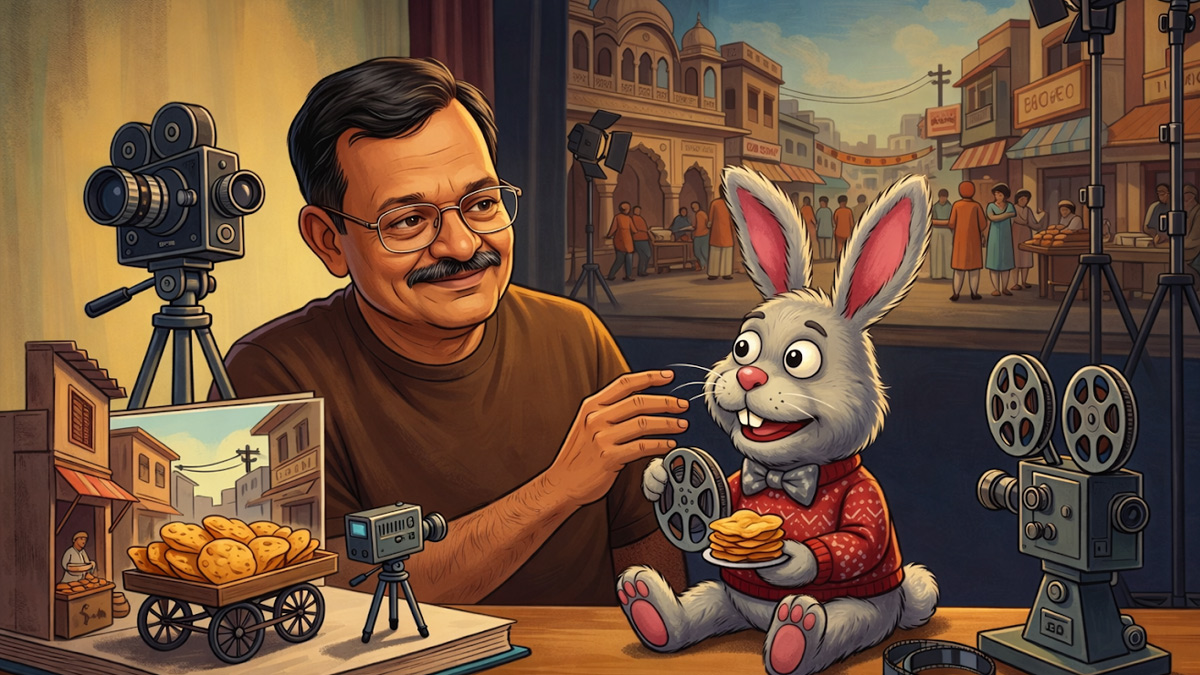
For most Indians of a certain age, however, Sahay will forever be the man behind the rabbit. His direction of the iconic long-running television commercial for Lijjat Papad, featuring its now-legendary puppet bunny, gave the country one of its most cheerfully persistent advertising images. It was the sort of work that sneaks into the national subconscious and takes up permanent residence.
His big-screen credits as cinematographer include Anokhi Pehchan (1972), Pagli (1974), Pas de Deux (1981), and Hum Farishte Nahin (1988). In 1999, he stepped behind a different kind of camera altogether, making his directorial debut with Sar Ankhon Par, a drama that featured Vikas Bhalla and Shruti Ulfat, with a cameo by Shah Rukh Khan for good measure.
On television, Sahay was particularly prized for his command of multi-camera production setups, a skill that made him a go-to technician for large-scale shows and reality programmes. In an industry that has never been especially patient with complexity, he was the calm hand on the rig.
In later life, Sahay turned teacher. He participated regularly in masterclasses and Digi-Talks, often hosted by organisations such as Bharatiya Chitra Sadhna, sharing hard-won wisdom on cinematography, the comedy of timing in a shot, and the sweeping changes brought by the shift from celluloid to digital. He was also said to have been involved in a project concerning a biographical film on Infosys co-founder N.R. Narayana Murthy.
Tributes from the film industry poured in following the news of his passing, with colleagues remembering him as a senior cameraman who served as a rare bridge between two entirely different eras of Indian cinema. That is, perhaps, the finest thing one can say of any craftsman: he kept up, and he brought others along with him.







